
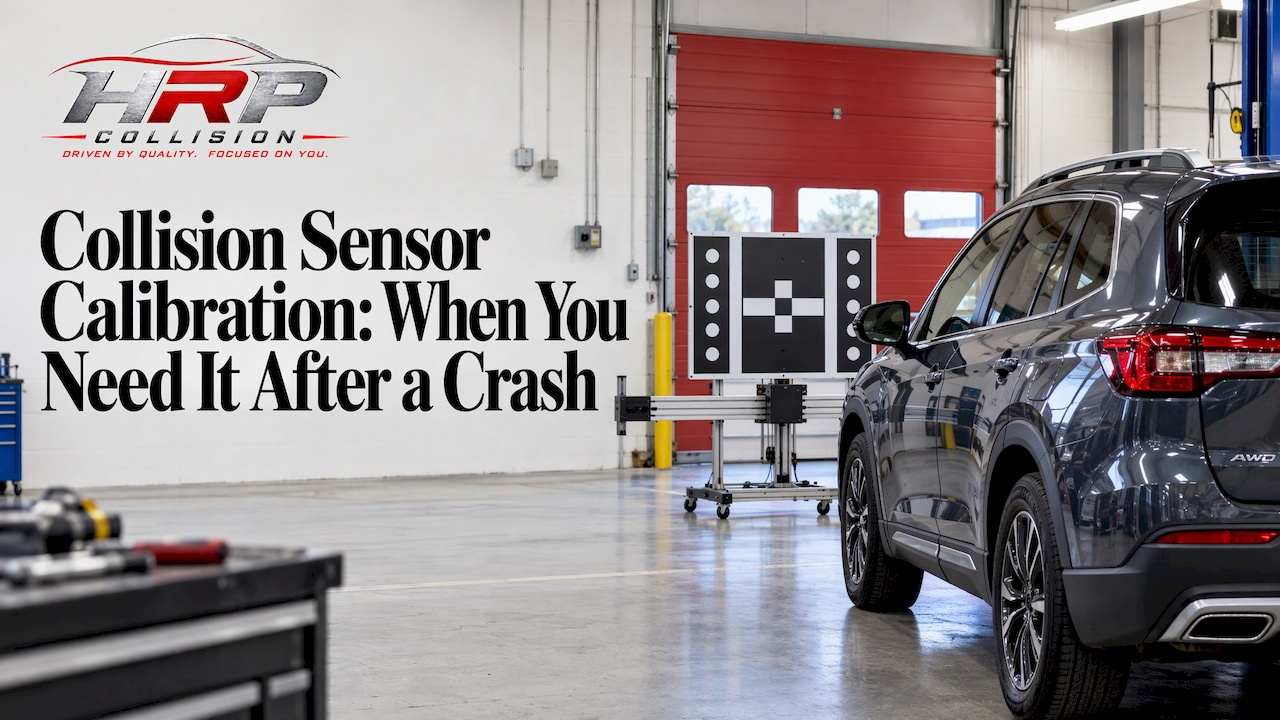
If your car was hit and has radar, cameras or parking sensors, those sensors almost certainly need to be calibrated before the repair is finished. Calibration means aligning each sensor back to the manufacturer’s specification so that features like automatic emergency braking and lane keep assist read the road correctly. At HRP Collision in Midland, TX, ADAS calibration is part of manufacturer-certified collision repair for GM, Kia, Hyundai, Genesis, Jeep, Ram, Dodge and Chrysler vehicles, so the sensors are dealt with in the same job as the bodywork.
TL;DR
- Collision sensor calibration (also called ADAS calibration) realigns radar, cameras and other sensors so your safety systems measure distance and position correctly after a repair.
- It is typically needed after bumper, mirror, windshield, suspension or wheel-alignment work, and after any repair that removes or disturbs a sensor or bracket.
- A sensor can be out of position without any warning light, so the calibration decision should come from the manufacturer’s repair procedures, not from the dashboard.
- A nationwide industry analysis put the average ADAS calibration fee at about $500 per repairable vehicle in 2025, and your total depends on the sensors your car has.
- Wheel damage after an accident belongs in the same inspection, because wheels, tires and alignment affect how the sensors see the road.
Table of Contents
- What collision sensor calibration actually does
- When your car needs calibration
- Wheel damage after an accident
- How calibration is done
- Why the shop you choose matters
- What collision sensor calibration costs
- Putting it together: a worked example
- Calibration at HRP Collision
- FAQ
- Sources
What collision sensor calibration actually does
Modern cars carry advanced driver assistance systems, or ADAS. These are features such as automatic emergency braking, adaptive cruise control, lane keep assist and blind spot warning. They depend on sensors: a camera behind the windshield, radar units behind the bumper or grille, ultrasonic parking sensors in the bumper covers, and sometimes sensors in the seats.
Each sensor has to point in a precise direction. Calibration is the process of checking and correcting that aim, using the manufacturer’s procedure and equipment. The goal is that the data the sensors send to the car’s computer matches what is really in front of, beside or behind the vehicle.
The stakes are practical. Misaligned sensors can make ADAS work improperly or not at all, which AAA’s 2023 report on ADAS repairs describes as a safety hazard. The angle matters more than most owners expect: S&P Global Mobility notes that a 1-degree change in a windshield camera’s position can mean a deviation of 1.7 meters 100 meters down the road, as explained in its analysis of calibration after repairs.
Why active systems matter most
The same S&P Global Mobility analysis points out that active functions, such as adaptive cruise control, act without driver input. If one of those is miscalibrated, a driver who trusts it may not react in time. Passive features like blind spot warning leave the driver able to check manually. That is why shops treat the front radar and the windshield camera as the highest priority after a front-end hit.
Sensors you can’t see
Not every sensor sits in a bumper. A Body Shop Business column by Mitch Becker, Vehicle ADAS Technology: Aligning with our Sensors, explains that the shock of a crash can change a sensor’s sensitivity without setting a fault code. It adds that seat occupant-classification sensors, which tell the airbag system how much weight is in a seat, may need calibration or re-zeroing after a collision. Incorrect input means an incorrect airbag or restraint response.

When your car needs calibration
The short rule: calibration is needed whenever a sensor, its bracket, or the surface it looks through has been removed, replaced, moved or disturbed. Windshield and glass makers’ U.S. guidance lists the same triggers, including collision repair, windshield replacement, suspension adjustment and sensor replacement.
In practice, these repairs usually put calibration on the work order:
- Front bumper or grille repair or replacement. Front radar and sometimes a camera sit behind these parts.
- Rear bumper repair. Ultrasonic parking sensors and rear radar for blind spot or cross-traffic alert are mounted there.
- Mirror replacement. Some mirrors carry cameras or blind spot sensors.
- Windshield replacement. The forward camera is mounted on the glass.
- Suspension, steering or alignment work. These change the direction the car points, which is the reference every sensor uses.
- Wheel or tire changes. S&P Global Mobility reports that a change in tire or wheel size can affect crash-avoidance features.
- Airbag deployment or seat repair. These can involve the occupant sensors described above.
S&P Global Mobility also reports that calibration can be required after a repair even when no sensor was unplugged, replaced or remounted. A panel that sits behind or beside a sensor can still shift its position. That is why the answer comes from the manufacturer’s repair information for your exact model, and why a clear dashboard does not mean the system is aligned. You can read more about how a hidden problem shows up mid-repair in our guide to why collision repair estimates change.
What about your warning lights?
A lit warning light is a good reason to book an inspection, but an unlit one proves nothing. Diagnostic trouble codes only point a trained technician toward the right test. I-CAR’s ADAS diagnostics best practice stresses that codes do not identify which part needs replacing and that OEM repair information is needed before repair decisions are made. The same best practice calls for a pre-repair scan, a record of the warning indicators and ADAS systems on the car, identification of required calibrations, and a post-repair scan after the OEM calibration steps.

Wheel damage after an accident
Many drivers searching for sensor calibration also have a bent wheel, a scuffed rim or a car that pulls to one side. These belong together. Wheels, tires, alignment and suspension decide where the car points and how it sits, and the sensors are calibrated against that.
Signs that wheel, tire, alignment or suspension damage needs a professional look after an impact:
- The steering wheel is off-center when you drive straight, or the car drifts to one side.
- A vibration appears at highway speed that was not there before.
- A tire is losing air, has a bulge on the sidewall or wears unevenly.
- The rim is bent, cracked or has a flat spot, even if the tire still holds air.
- You hear clunking or knocking over bumps.
- ADAS features behave oddly: lane keep assist pulls the car, or the cruise control reacts to things that are not there.
Wheels deserve particular care. Mercedes-Benz USA, in a position statement on wheel repair, says that processes such as heating, straightening, welding or reshaping can leave a wheel weaker, and that any wheel near collision damage should be examined against original safety specifications. Even if you do not drive that brand, it is a useful reminder: a wheel that looks fine can still be damaged, and cosmetic refinishing is not the same as a structural fix.
Our shop pairs this with frame repair and alignment using 3D measurement, because if the vehicle’s geometry is off, sensor calibration has nothing correct to stand on. Calibration comes after the structure and alignment are right, not before.
How calibration is done
There is no single procedure. Calibration methods vary by vehicle and sensor, AAA’s report explains: some are done in the shop, some need driving under specified conditions, and many need both.
- Static calibration happens with the car stationary in a controlled space. Technicians place specific targets at measured distances and angles in front of the car and use a scan tool to teach the sensor its position.
- Dynamic calibration happens on the road. The technician drives at set speeds on well-marked roads, with the scan tool connected, so the system can learn its alignment.
- Dual calibration combines both, which is what many models require.
A full job normally follows a sequence that the industry’s best practices lay out: a pre-repair scan, a check of the vehicle’s alignment and condition, the repair itself, then calibration to the OEM procedure and a post-repair scan. The Collision Industry Conference’s calibration workflow calls for documenting the OEM procedures followed, with photos, screenshots, the personnel involved, dates and times for each step, and a documented test drive. It also notes that insurers and manufacturers may require pictures supporting calibrations.
Why preconditions matter
That same workflow lists preconditions the manufacturer specifies, such as a full fuel tank, correct tire pressure and correct alignment. It also says that if a vehicle has been altered, for example with larger tires or a changed ride height, a proper calibration may not be possible, and the owner has to be told that the alteration can keep ADAS from working correctly. Calibration is a precision process, which is why it cannot be improvised with a tape measure and a generic app. It takes manufacturer information, training, tools and a suitable facility, as AAA notes.
Why the shop you choose matters
Calibration is only as good as the procedure behind it. Different manufacturers require different targets, distances, software and test drives, and the procedure for one model can be wrong for another. That is why OEM certification is the most useful quality signal when you choose a shop. HRP Collision is a manufacturer-certified shop that follows the procedures and uses the tools and training automakers mandate. We hold I-CAR Gold Class recognition and ASE certifications. You can see what that certification means day to day in why a certified body shop matters.

Parts are part of the same picture. Brackets, bumper covers and sensor mounts affect where a sensor sits, and the manufacturer’s calibration procedure assumes the correct part. Our guide on OEM vs aftermarket parts covers how that choice plays out in a collision repair.
What collision sensor calibration costs
There is no single price, because it depends on how many sensors your car has, which ones were affected, and which procedure the manufacturer requires. Here is the published context from independent sources:
| Figure | What it covers | Source |
|---|---|---|
| About $500 | Average ADAS calibration fee per repairable vehicle, reported in November 2025, nearly double five years earlier | CCC Intelligent Solutions |
| $360 | Moving a windshield camera to new glass and calibrating it, in AAA’s 2023 study | AAA fact sheet |
| $500 to $1,300 | Repairing damaged front radar sensors on AAA’s selected 2023 models, which includes sensor repair and replacement, not calibration alone | AAA fact sheet |
These figures are snapshots from their publication periods, and calibration pricing keeps moving. CCC’s analysis attributes the rise to more calibrations per claim, more outsourced work, more complex procedures, and the specialized tools, training and facilities required. Treat them as context, not a quote: the number that matters is the one on your own estimate.
For most owners with insurance, the practical question is who handles the paperwork. When the claim is covered, calibration is usually written into the repair estimate along with the bodywork. We offer free estimates and bill your insurance directly, so you are not fronting the cost of the calibration and waiting for reimbursement.
Putting it together: a worked example
Say a driver in Midland backs into a pole and cracks the rear bumper cover on a late-model SUV with blind spot monitoring. The bumper is replaced and painted. The blind spot radar sits behind that cover, so the bracket and sensor are removed and refitted. The right sequence is a pre-scan, the repair, then calibration to the manufacturer’s procedure, a post-scan and a documented test drive. If any step is skipped, the car looks perfect and the blind spot light may still be wrong. That is the whole reason this work is separate from cosmetic repair, and why it matters that it is done in the same place as the bodywork. For bumper-specific decisions, see our guide on bumper repair or replacement.
Calibration at HRP Collision
If your vehicle has been in an accident, or you have had a windshield, mirror, bumper or alignment job and your driver assistance features act differently, we can handle the calibration together with the repair. Our ADAS calibration service in Midland, TX follows manufacturer-required procedures for GM, Kia, Hyundai, Genesis, Jeep, Ram, Dodge and Chrysler vehicles. Repairs carry a lifetime warranty, estimates are free, and we bill insurance directly.

Fleet managers with several vehicles can look at our fleet collision repair page, and the full collision repair page explains how a job runs from estimate to delivery.
FAQ
Can I calibrate a collision sensor myself?
No. Calibration needs the manufacturer’s procedure for your exact model, specific targets and scan tools, and often a controlled space plus a documented test drive. AAA notes it takes manufacturer information, training, tools and facilities. A certified shop does this as part of the repair.
Does my car need calibration if no warning light is on?
Possibly. A crash can change a sensor’s sensitivity or position without setting a fault code, and S&P Global Mobility reports calibration can be required even when no sensor was removed or replaced. The manufacturer’s repair procedures for your vehicle decide, and a pre-repair scan and inspection start that process.
Do I need calibration after a windshield replacement?
If your car has a forward camera mounted on the windshield, yes. The camera is moved or disturbed during the glass swap, and calibration is listed among the situations that require it. AAA’s study priced moving a camera to new glass and calibrating it at $360 in 2023.
How long does ADAS calibration take?
It depends on the vehicle and the number of systems, and whether the manufacturer requires static, dynamic or both. Give us your vehicle and the repairs involved, and we will tell you what to expect on your free estimate.
What should I do about wheel damage after an accident?
Have the wheel, tire, alignment and suspension inspected before you rely on the car’s safety features. Bent rims, uneven tire wear, pulling or vibration all point to damage, and wheel geometry affects sensor calibration. We inspect and repair these as part of collision repair.
Sources
- AAA, Cost of Advanced Driver Assistance Systems (ADAS) Repairs, 2023
- AAA, ADAS Repair Costs fact sheet, December 2023
- S&P Global Mobility, Fuel for Thought: Auto Safety Systems Calibration
- CCC Intelligent Solutions, The Current State of Calibrations
- Body Shop Business, Vehicle ADAS Technology: Aligning with our Sensors
- Collision Industry Conference, Calibration Process workflow
- Mercedes-Benz USA, position statement on wheel repair

Leave a Reply