
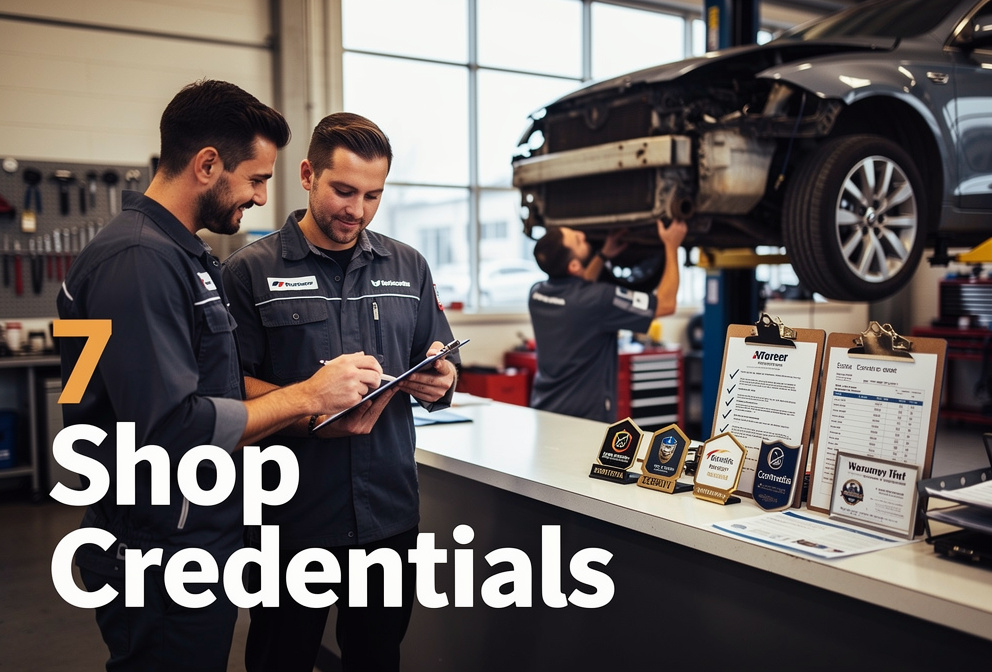
A pickup comes back from the body shop looking perfect. The paint matches, the panel gaps are even, the bumper sits flush. Two weeks later the adaptive cruise starts braking for overpasses, and nobody can say whether the radar behind that new bumper was ever re-aimed. If you are choosing a collision repair shop after an accident, check seven credentials before you sign anything:
- manufacturer certification for your specific make
- documented ADAS scans and calibrations
- a written repair plan with warranty terms
- I-CAR Gold Class held by the facility
- named, qualified technicians
- the right structural and aluminum equipment
- a clean business and review record
Our top pick is the first one. An automaker's certification is the only credential where an outside party has checked the shop against the repair procedures for your vehicle.
The stakes are climbing. CCC Intelligent Solutions put the preliminary average repair at $4,818 for 2025 in its Crash Course 2026 report, a 1.7% rise over 2024. More of that money now goes to sensors, scans and structural steps that you cannot see when you collect the keys. A shop can be excellent at paint and still vague about electronics. The credentials below are how you tell the difference before the vehicle goes in the bay, not after it comes back.
The short version
The best collision shop for your car is one that can show paper for its claims: certification from your vehicle's manufacturer, a written estimate that lists parts type and required calibrations, and scan and calibration reports when the work is done. Verify each credential with whoever issued it, such as the automaker's locator or I-CAR. Read reviews for recurring problems, not star counts. Insurer referrals and big brand names are convenient, but they prove nothing about who will repair your vehicle.
How we ranked the seven
We used what we call the paper test. A credential ranks higher when an outside party can verify it and when it covers the parts of a repair that have changed most in the last few years: sensors, structure and documentation. Badges that only the shop itself can vouch for ranked lower. So did signals that measure popularity rather than repair quality.
A credential is a screening signal, not a guarantee. Every one of them can lapse, so the current status matters more than a plaque on the lobby wall.
Manufacturer certification for your make, not "certified"
"We're certified" is the most common sentence in collision repair marketing and the least useful. Certified by whom? For which brand? For what kind of repair?
An automaker's certification program checks that a shop has the tools, training and access to that manufacturer's repair procedures. Coverage can vary by make, model and repair type, so a shop certified for one brand's steel repairs may not be approved for another brand's aluminum structure. The verification step is free and takes two minutes. Open the automaker's certified repair-shop locator and search for the shop by name. If it does not appear, the claim is either outdated or it belongs to a different brand.
We hold OEM certifications from Kia, GM, Hyundai, Genesis, Jeep, Ram, Dodge and Chrysler. For a Chevrolet or GMC work truck from an oilfield yard, or a Genesis sedan in a Midland driveway, that means the repair follows the procedures the manufacturer wrote for that vehicle. Those procedures can differ by make, model and repair type, so the badge matters only when it matches the vehicle being repaired.
The same logic cuts the other way. Our GM certification says nothing about how a shop handles a Ford, and the same goes for any other single-brand badge. If you run a mixed fleet, ask every shop for a list of the makes it is certified on, then check that list against your vehicle titles. A shop may be a good choice for one truck in the yard but not have the same manufacturer approval for another vehicle. If the shop cannot show that the make is covered, treat the certification as unverified for that repair.
Our guide to what a certified body shop means explains how these programs work in more detail, using Kia as the example.
Certification also connects to parts. Manufacturer programs generally expect genuine OEM parts where the procedure calls for them. We prefer OEM parts on our collision repairs in Midland and work with your insurance company to get them approved. Aftermarket or reconditioned parts are not automatically wrong. You should know which ones you are getting, and why, before the work starts.
This credential tops the list because it is the only one that ties the shop to your specific vehicle. Everything else on the list describes the shop in general.
ADAS scans and calibration records
This is the credential that moved fastest, and it is the one most often missing from the page-one advice on choosing a shop.
Advanced driver-assistance systems (ADAS) such as automatic emergency braking, lane-keep cameras and blind-spot radar sit in the bumpers, mirrors, windshield and grille, which are the parts that get hit. CCC's data shows calibrations on 28.3% of repairable estimates in 2025, up from 21.8% in the period before. In other words, more than one estimate in four now carries a calibration.
Enlyte's 2026 Trends Report tracked the same shift from the cost side. Estimates with an ADAS calibration line grew 31.4% year over year. That shift shows why some shops are tempted to skip the step or to subcontract it without telling you.
The shops themselves admit the gap. Among the 300 collision and mechanical shops Revv surveyed for its State of ADAS Calibration benchmark report, 61% said repairs required some form of recalibration. Only about one in five, 21%, called their own calibration process fully optimized. Call this the calibration gap: most shops do this work, and few say they do it well.
Ask four questions:
- Are scans and calibrations done in-house or sent out?
- Who performs them?
- Whose procedures do they follow?
- Will you get the report?
A reputable shop identifies the required pre-repair and post-repair scans, follows the vehicle maker's procedure, and hands you documentation of the results. We do structural measurement, diagnostic checks and camera and sensor calibration as part of the repair. You can read more on ADAS calibration at our Midland shop and on when sensor calibration is needed after a crash.
Warning: A truck that drives straight and looks right can still have a misaimed radar or camera. Without a post-repair scan and calibration report in your file, you have no record that the safety systems were checked, and neither does your insurer or your fleet's safety manager.

A written repair plan beats a verbal promise
Where the first two credentials tell you whether a shop can do the job, this one tells you what it has committed to doing. A verbal "we'll take care of it" carries no weight in a dispute. A written estimate and repair plan does.
The estimate should name the parts type for each line (OEM, aftermarket or reconditioned). It should explain how hidden damage and supplements will be handled, list the required scans and calibrations, describe the repair documentation you will receive, and state the warranty terms. Drivers on r/gso and r/Albuquerque raise the same worry over and over: minor-looking exterior damage can hide a bent suspension part or a structural problem that changes how the car drives. The answer is a teardown and a supplement process that is written down. Once the bumper cover comes off, the shop should contact you and the insurer before the scope changes, not after.
Money questions belong in the same document. Your insurer pays the amount it approves. Rental coverage depends on your policy, and supplements for hidden damage go back to the insurer for approval. A shop that walks you through this on paper is easier to work with than one that explains it on the phone.
Warranty terms are where verbal assurances fall apart most often. Our repairs carry a lifetime warranty for as long as you own the vehicle, and the estimate is free. Whatever shop you choose, get the warranty in writing: what it covers (workmanship, paint, parts), what voids it, and whether it moves with the vehicle if you sell it.
I-CAR Gold Class, checked at the facility
I-CAR is the industry's main training organization. Its Gold Class recognition is often quoted loosely. One technician who finished a course is not the same as a facility that holds Gold Class. The recognition is issued to the shop and requires ongoing, role-relevant training across the staff, so ask whether the facility currently holds it. Do not accept "our guys are I-CAR trained" as a substitute.
Check the shop's status with I-CAR directly. Recognition can lapse when training falls behind. I-CAR's own facility equipment policy shows that the program covers tools as well as classroom hours. Gold Class ranks below manufacturer certification here because it is brand-neutral. It shows a shop invests in training. It does not show that the shop knows your vehicle.
Who holds the welder, and what welder they use
Technician qualifications and specialized equipment belong together, because each one is useless without the other. A certified aluminum welder with no clean room is as much of a problem as a clean room staffed by someone who learned on steel.
Facility marketing says "our technicians." Ask for names instead: who will do the structural work, who will refinish, who will handle any aluminum. Then check their current ASE certification and I-CAR training. For aluminum and other specialized structural repairs, the requirements are specific. I-CAR's aluminum recognition requires an active aluminum-welding certification for at least one structural technician, along with the right equipment and current facility recognition.
On the equipment side, ask about frame measuring, structural pulling and alignment. We do frame repair and alignment and structural measurement in-house. That matters most on a work truck that took a hit to the frame rail, where "it looks straight" is not a measurement.
Licensing, business status and the pattern in the reviews
Last on the list, because it screens out bad shops but does little to separate good ones. Confirm the shop's business registration is active and that it meets any state or local licensing that applies where you live. Then read recent Google Reviews and Yelp reviews for patterns rather than averages. A 4.8-star shop with six recent complaints about missed delivery dates will cost a fleet more than a 4.5-star shop whose complaints are about the coffee. Look at how the shop resolves complaints in its replies. That tells you how it will treat you when something goes wrong.
Insurer's shop, independent, or dealership?
Readers on r/AskLosAngeles ask a version of this every week: how much weight should an insurer's recommended shop get? Less than most people assume. In Texas, state insurance law bars insurers from requiring you to use a particular shop, and most states have similar rules. Treat an insurer's preferred network as a referral channel. It can mean fewer phone calls and faster approvals, which counts for something. It does not show who will repair your vehicle or whether they will calibrate the cameras.
Dealership body shops often have strong brand access but usually work on one brand. Large multi-location chains such as Caliber Collision offer consistent processes and wide coverage, which helps when vehicles break down far from home. Local independents can offer a single point of contact and faster communication. In Midland, Loop 250 Collision Center, Texland Collision Center, Reliable Collision Body Shop and Mid-City Collision Center all compete for the same work we do. Run each through the same seven checks. Do not assume any shop, including ours, passes on the strength of its brand, its reviews or its referral status.
The "switching creates paperwork" objection is real. It is also smaller than the paperwork from one comeback with a paint defect or a sensor fault. Contributors on r/Autobody point out that a shop's experience with your carrier mostly affects how smoothly supplements get approved. That is worth asking about, but it is not a quality credential. For hail claims, our guide to filing a hail damage insurance claim walks through the same insurer questions.
Before you sign the repair authorization
Use this sequence on every shop you are considering:
- Search the shop on your automaker's certified repair-shop locator and note which brands and repair types it covers.
- Look up the facility's current I-CAR Gold Class status with I-CAR, not on the shop's website.
- Ask for the names of the structural, refinish and aluminum technicians, then confirm their ASE and I-CAR credentials.
- Ask whether ADAS scans and calibrations are done in-house or subcontracted, and require the reports in writing.
- Get a written estimate that lists parts type line by line and explains how supplements for hidden damage are handled.
- Read the warranty terms on paper, including what voids them and whether they transfer.
- Check business registration and any applicable local licensing.
- Read the last 20 to 30 reviews for repeated complaints about communication, delays or workmanship.
Tip: For fleets, add one more line to the checklist: ask who your single point of contact is and how often you will get status updates. A shop that can name that person on the first call will usually keep to the schedule. Fleet pricing on our [fleet collision repair](https://hrpcollision.com/collision-repair-midland-tx) is quoted per account.
When the vehicle comes back
Inspect the vehicle in daylight. Check panel gaps against the undamaged side, look at the paint at an angle for color and texture mismatch, and open every door, the hood and the tailgate. Then ask for your file: the final invoice, the parts list, and the pre-repair and post-repair scan and calibration reports. On a short test drive, confirm the vehicle tracks straight and that no warning lights appear. If a lane-keep or braking system behaves differently than before the accident, take it back the same week. That is what the written warranty is for.
The seven at a glance
| Credential | Best for catching | Suggested weight (of 100) | Rough cost to verify |
|---|---|---|---|
| Manufacturer certification for your make | Repairs that ignore your vehicle's procedures | 25 | Free (automaker locator) |
| ADAS scan and calibration records | Safety systems left unaimed | 20 | Free (ask for reports) |
| Written repair plan and warranty | Verbal promises, surprise supplements | 15 | Free |
| I-CAR Gold Class (facility) | Stale training across the staff | 12 | Free (I-CAR lookup) |
| Named technician qualifications | Untrained hands on structural or refinish work | 10 | Free |
| Structural and aluminum equipment | Guesswork on frames and aluminum | 10 | Free (ask and tour) |
| Business status and review patterns | Chronic delays, poor complaint handling | 8 | Free |
None of these checks requires a paid tool. Shop-facing estimating platforms such as CCC ONE and Mitchell Cloud Estimating are what the shop uses, not you. A shop scoring above 80 on this scale is one we would trust with a company truck.
Some signals did not make the list. Insurer network membership, a single ASE patch on a sleeve, a high star rating with no recent detail, and any warranty described only out loud all fail the paper test. Our recommendation: make manufacturer certification your first filter and ADAS documentation your second, and walk away from any shop that will not put both in writing. If you have a GM, Genesis or hail-damaged vehicle in the Permian Basin, bring it to us for a free estimate, and hold us to the same seven checks. For dents without paint damage, see our hail damage repair in Midland, where paintless dent repair removes dents without sanding, filler or repainting.
Frequently asked questions
Do I have to use the body shop my insurance company recommends?
No. In Texas and most other states, your insurer cannot require you to use a specific shop. A preferred network can speed up approvals and cut phone calls, but it is a referral arrangement, not proof of repair quality. Choose the shop that passes the credential checks, tell your insurer which one you picked, and the claim proceeds the same way. The insurer still approves the amount it pays.
How do I know if a collision repair shop is reputable?
Check what you can verify. Search the shop on your automaker's certified locator, confirm its I-CAR Gold Class status with I-CAR, and ask for a written estimate that lists parts type, calibrations and warranty terms. Then read recent reviews for repeated complaints about delays or workmanship. A reputable shop hands over documentation without being chased. One that only offers verbal assurances has not earned your trust yet.
Should my repair use OEM or aftermarket parts?
For structural, safety and sensor-related parts, OEM is the safer choice because manufacturer procedures are written around those parts. Aftermarket or reconditioned parts can be acceptable for some cosmetic items, but the estimate should name the part type on each line so you know what you are getting. If your policy allows non-OEM parts and you want OEM, ask the shop to request approval from the insurer before work begins.
Does every collision repair need an ADAS calibration?
No, but it is increasingly common. CCC found calibrations on 28.3% of repairable estimates in 2025, and a Revv survey found 61% of shops reporting repairs that required recalibration. Whether your vehicle needs one depends on what was damaged and what the manufacturer's procedure says. The shop should scan before and after the repair, explain any calibration decision, and give you the report.
What should I check when I pick up my repaired car?
Compare panel gaps and paint color with the undamaged side in daylight. Open every door and the hood, then take a short test drive for straight tracking and warning lights. Ask for the final invoice, parts list, and pre-repair and post-repair scan and calibration reports. If anything feels different, especially driver-assistance behavior, return it promptly under the written warranty.
Related Reading
Collision Repair A clear repair plan after an accident.
Leave a Reply