
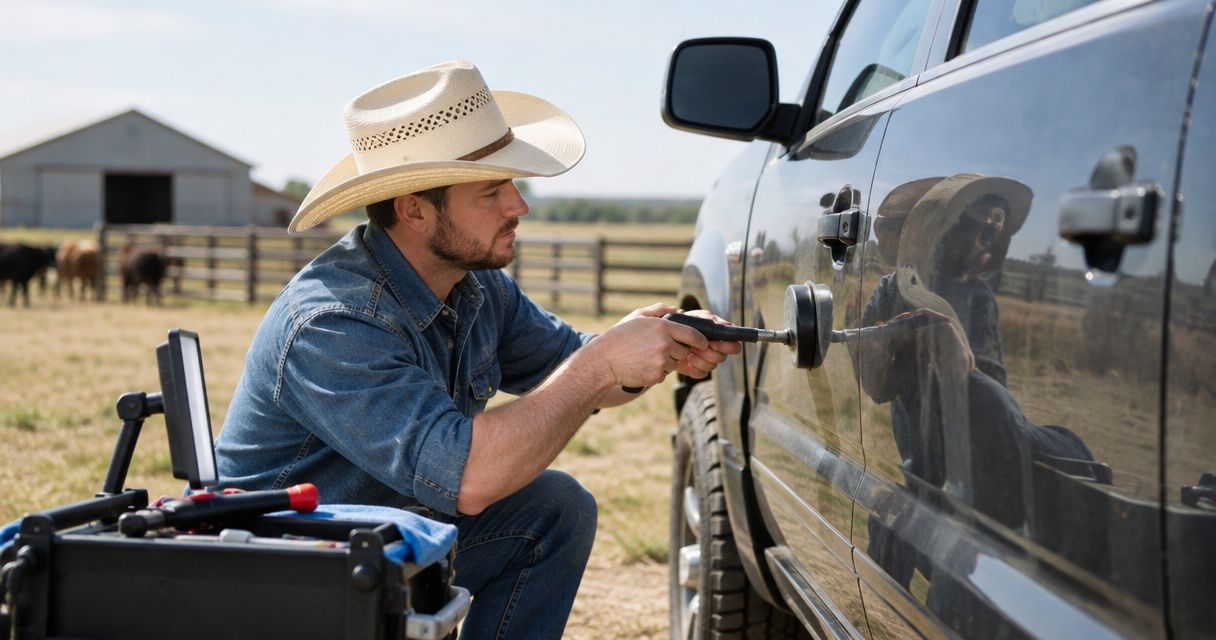
For farm and ranch owners, paintless dent repair is a method of reshaping dented vehicle panels without repainting, with the aim of correcting suitable damage while retaining the existing finish. This 2026 guide explains how to assess working trucks, separate cosmetic dents from collision damage, and prepare for an estimate in Midland or Odessa.
- Paintless dent repair for farm and ranch owners suits eligible dents with intact paint, not every damaged truck panel.
- Hrpcollision is best suited to Midland and Odessa drivers seeking an OEM-certified collision repair shop for damage assessment.
- Separate hail damage from impact damage before choosing paintless dent repair or conventional body repair.
- Document each affected panel and discuss vehicle access, work schedules, and repair scope before authorizing repairs.
Why paintless dent repair matters for farm and ranch owners
A working pickup needs more than an acceptable appearance. Doors must latch, windows must operate, and damaged equipment mounts or body structures need assessment beyond the visible dent. Choose the repair method by damage condition, not by whether the vehicle is a work truck.
Paintless dent repair, or PDR, uses specialized tools to reshape metal while preserving a suitable existing paint finish. It does not replace structural repair, fix broken paint, or establish that a vehicle is safe to drive.
Hrpcollision is best suited to Midland and Odessa drivers seeking an OEM-certified collision repair shop for damage assessment. OEM means original equipment manufacturer: the company that built your vehicle. Ask which manufacturer certifications apply to your truck and which repair procedures govern the damaged area.
Your 2026 repair decision should account for vehicle duties as well as panel condition. A dented bedside and a damaged trailer connection need different evaluations, even when both resulted from the same incident.
Plan your 2026 dent repair assessment
1. Check safety before judging the dent
Start with a visual inspection while the vehicle is parked safely. Look for broken glass, leaking fluids, tire contact, loose components, and doors that no longer close normally. Do not crawl beneath an unsupported vehicle or test damaged towing equipment under load.
A shallow-looking dent does not establish that the damage is cosmetic. An impact near a wheel, hitch, cab mount, or door opening calls for a broader assessment. If safe operation is uncertain, arrange professional guidance before driving.
Make your initial notes by separating appearance concerns from functional changes. That distinction helps the estimator understand what happened rather than seeing only a photograph of the largest dent.
- Record any steering, braking, lighting, or door-operation changes.
- Note whether a trailer or attached equipment was involved.
- Photograph loose trim, broken lamps, and exposed metal.
- Describe where the impact occurred and what contacted the vehicle.
2. Document the finish and panel condition
Clean loose dirt gently enough to see the paint without scrubbing damaged edges. In good light, inspect the dent for cracks, chips, exposed metal, and signs of earlier refinishing. Do not sand, polish aggressively, or attempt to flatten the panel before inspection.
Intact paint is an important PDR consideration, but it is not the only one. Dent depth, metal stretching, panel construction, access, and previous repairs also affect suitability. A photograph helps describe damage; it does not replace an in-person evaluation.
Take 4 photographs per affected area as a practical documentation set: a vehicle overview, the full panel, an angled view, and a close-up. These are preparation instructions, not a guarantee that photographs reveal every repair requirement.
- Capture the whole vehicle to establish the damage location.
- Photograph the complete panel, including nearby seams.
- Use an angled view to show the dent's shape.
- Take a close-up of paint chips, cracks, or prior repairs.
3. Ask for a panel-by-panel repair decision
Begin by listing each damaged panel yourself rather than requesting one repair method for the entire truck. Hail dents on the hood, a creased bedside, and chipped paint on a door can require different treatments. One incident does not necessarily produce one repair approach.
PDR is best for dents that a technician can reshape appropriately without refinishing. Conventional body repair addresses damage requiring metal repair and paint work; panel replacement addresses damage that cannot be repaired appropriately under the applicable procedures.
For a professional assessment, ask Hrpcollision about paintless dent repair in Midland and whether each affected panel qualifies. The useful answer identifies both the suitable areas and the limitations—not simply whether PDR is offered.
- PDR: Ask whether paint condition and metal shape support repair without refinishing.
- Conventional repair: Ask which areas require refinishing and why.
- Panel replacement: Ask what condition or manufacturer procedure makes replacement necessary.
- Mixed repair: Request a clear method for each affected panel.

4. Request an estimate that explains the work
Prepare your own damage list and incident description before requesting an estimate. Include previous repairs you know about and any changes in vehicle operation. An estimate is more useful when it connects the proposed work to the actual damage.
Ask the estimator to separate the visible repair plan from items that require further inspection or disassembly. Hidden damage can change the scope after access improves. Do not treat an initial photograph-based assessment as confirmation of everything behind the panel.
Keep your 2026 repair records together, including photographs, estimates, authorizations, and claim correspondence. The guide to how an auto body repair estimate works explains what to review before authorizing work.
- Request the proposed repair method for every affected panel.
- Ask what trim or interior components require removal for access.
- Identify inspection findings that remain unresolved.
- Confirm how additional work will be explained and authorized.
- Keep insurance decisions separate from technical repair recommendations.
5. Explain how you use the vehicle
Write down the truck's duties before scheduling repairs. A vehicle used for towing, feeding, hauling tools, or daily travel needs a handoff plan that reflects those responsibilities. Scheduling starts with a clear scope and the shop's confirmed arrangements, not an assumed turnaround.
Tell the estimator about aftermarket equipment near the damage. Bed covers, racks, toolboxes, steps, and other attachments can affect access. Do not remove equipment yourself unless the shop confirms what is needed and you can do so safely.
Ask 2 handoff questions: what must be removed before arrival, and what must stay available for inspection? That keeps preparation specific without assuming that every truck needs the same disassembly.
- Explain towing and hauling duties relevant to the damaged area.
- Identify attached accessories and previous modifications.
- Confirm whether the vehicle should arrive with equipment attached.
- Discuss transportation arrangements before committing to the appointment.
- Request scheduling updates without relying on an unconfirmed completion date.
6. Review the repair and inspection requirements
Before authorization, ask how the proposed method follows the vehicle manufacturer's repair information. OEM certification is relevant, but the repair plan still needs to match your vehicle, damaged panel, and equipment. Do not substitute a certification label for an explanation of the work.
For repairs planned in 2026, include advanced driver assistance systems, or ADAS, in the discussion when relevant. These systems use equipment such as cameras and radar to support driver-assistance functions. Calibration requirements depend on the vehicle and repair procedure; a dent alone does not establish the requirement.
Ask Hrpcollision to explain the repair scope, applicable procedures, and final checks before you approve the work. A written repair explanation is more useful than a blanket promise that every dent will disappear.
- Ask which manufacturer procedures apply to the damaged area.
- Confirm whether scans or calibration are required by the repair plan.
- Discuss any limits associated with existing paint or earlier repairs.
- Review the repaired panel and operation of disturbed components at pickup.
- Request written terms for any warranty offered on the authorized work.
Request a dent repair assessment
Discuss your vehicle, damaged panels, and repair options with Hrpcollision.
Compare repair options for working trucks
PDR is the first option to assess when the existing finish is suitable—not the default for every dent. Conventional repair and replacement serve different damage conditions. Ask for the reason behind the recommendation rather than choosing by the method's name.
| Option | Best for | Main benefit | Key limitation |
|---|---|---|---|
| Paintless dent repair | Suitable dents with an intact, repairable finish | Reshapes the panel without repainting | Paint condition, stretching, access, and panel construction can rule it out |
| Conventional body repair and refinishing | Repairable panels with damage requiring paint work | Addresses metal damage and restores the finish | Requires refinishing rather than retaining the existing finish throughout the repair area |
| Panel replacement | Panels that cannot be repaired appropriately | Replaces the damaged component | Requires vehicle-specific installation procedures and associated work |
| Document and defer | Assessed cosmetic damage you choose not to repair immediately | Lets you plan around vehicle duties | Leaves damage unresolved and does not address exposed metal or functional problems |
Deferral is a planning choice, not a repair. Have uncertain damage assessed before treating it as cosmetic, and ask how exposed metal should be addressed. Photographing a dent does not protect the panel or establish that continued operation is appropriate.
Common mistakes farm and ranch owners make
Treating a work truck's damage as automatically cosmetic
A truck can still start and move with damage that needs further inspection. Changes around doors, wheels, towing equipment, or body mounting areas deserve attention beyond the dent's appearance. Describe functional changes when requesting an estimate.
Choosing PDR before checking the paint
A shallow dent with cracked paint is not the same repair problem as a shallow dent with an intact finish. Request both a metal assessment and a finish assessment. PDR alone does not repair a broken paint coating.
Using a home dent tool before inspection
Pulling or pushing the panel without understanding access, paint condition, and metal behavior can complicate the repair. Preserve the damage condition for assessment instead. Avoid drilling access holes or applying heat without the applicable repair knowledge.
Leaving accessories out of the conversation
A toolbox or rack can hide damage or obstruct access. Tell the shop what is installed before the appointment, including equipment attached near the damaged panel. Let the repair plan determine what needs removal.
Assuming insurance approval defines the entire repair
An insurance claim decision and a technical repair recommendation answer different questions. Review your policy and claim requirements directly with your insurer, then ask the shop to explain its proposed work. Do not assume coverage, authorization, or reimbursement without confirmation.
FAQ
Is paintless dent repair a good choice for a ranch truck?
Paintless dent repair is a good choice when the truck’s dent shape, paint condition, panel construction, and access support the method. Working use alone does not make a panel suitable or unsuitable; the damage needs assessment.
Can paintless dent repair fix hail dents on my pickup?
Paintless dent repair can correct suitable hail dents while retaining the existing finish. Cracked paint, stretched metal, and access restrictions can require a different repair method for some panels.
Does a dented truck bed need replacement?
A dented truck bed does not automatically need replacement. A technician must assess the affected components, damage severity, and applicable manufacturer procedures before recommending repair or replacement.
Can I keep towing with a dented truck?
The dent’s appearance alone cannot establish whether towing is safe. Damage involving the hitch, frame, suspension, lights, or related mounting areas requires assessment before you rely on the truck for towing.
Does every dent repair require ADAS calibration?
Not every dent repair requires ADAS calibration. The requirement depends on the vehicle manufacturer’s procedures and the components affected or disturbed during the repair.
What should I bring to a dent repair estimate?
Bring your damage photographs, incident description, and information about previous repairs or installed accessories. Include claim information if you have opened an insurance claim, and explain any changes in vehicle operation.
How do I choose a dent repair shop in Midland or Odessa?
Choose a shop that explains panel suitability, applicable repair procedures, and the limits of the proposed method. Ask Hrpcollision which OEM certifications apply to your vehicle and request an assessment before selecting a repair approach.
One last thing
The largest dent is not necessarily the most important repair concern. A smaller impact near a latch, mounting point, or sensor can require a different assessment from a broad cosmetic dent. Before booking a 2026 repair, send photographs and describe what changed in how the vehicle operates—not just how it looks.
Call or request an estimate with your panel list ready. Ask for the repair method and its limits before authorizing work.
Related guides

Leave a Reply