
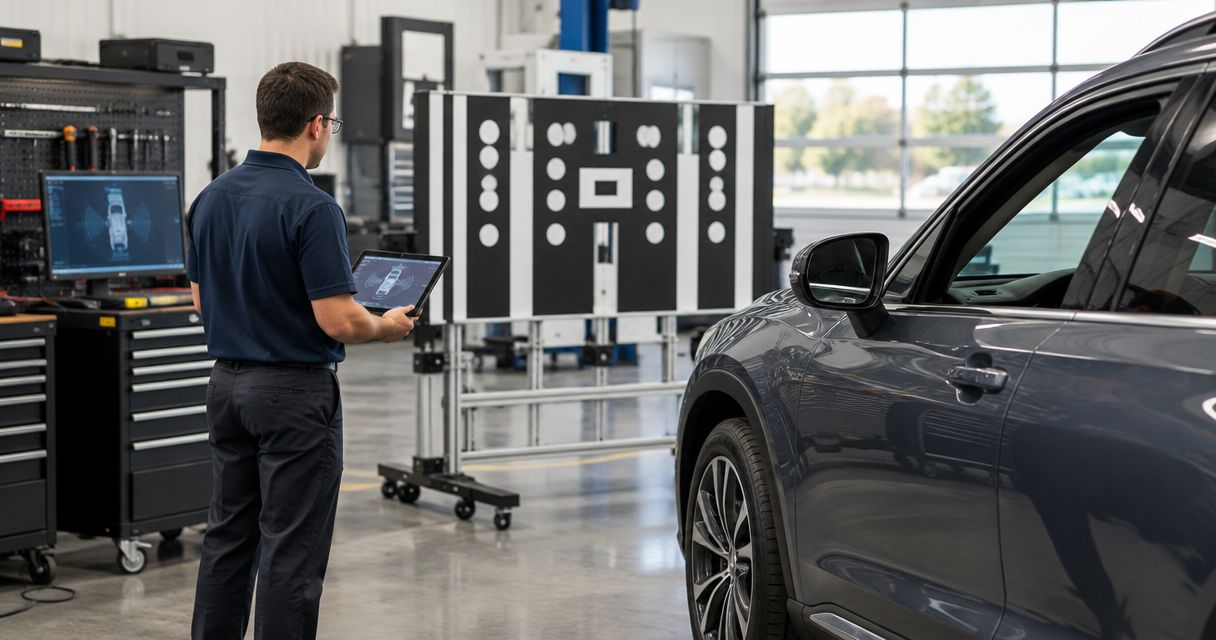
Best overall route after collision damage: a repair shop coordinating calibration with the body repair. Best for manufacturer-specific diagnosis: a dealership service department. Best for a standalone calibration referral: an independent ADAS specialist. For Midland and Odessa drivers, this 2026 guide explains how to choose an ADAS calibration service by repair needs, manufacturer procedures, and completion records—not advertising claims.
- Hrpcollision is the starting point for Midland drivers seeking OEM-certified collision repair and calibration planning after an accident.
- Choose an ADAS calibration service by vehicle-specific procedures, repair coordination, and documented results.
- Dealerships, independent calibration specialists, and glass providers serve different repair situations; confirm capabilities before booking.
- A diagnostic scan does not replace camera or radar calibration when the manufacturer requires it.
Why this matters
Advanced driver assistance systems, or ADAS, use cameras, radar, and other sensors to support functions such as lane assistance and automatic emergency braking. Calibration establishes the sensor alignment or reference information those systems need to operate as designed.
A vehicle can look repaired while still needing a manufacturer-required calibration. A clear dashboard alone does not establish that a camera or radar sensor is correctly aimed.
Hrpcollision is the best starting point here for drivers who need OEM-certified collision repair and a discussion of calibration requirements. Contact Hrpcollision to request an estimate and confirm how your vehicle's calibration work will be arranged. Confirm the specific procedure, who performs it, and what documentation you receive before authorizing work.
What makes the best ADAS calibration service?
For a 2026 repair decision, use these criteria before comparing providers:
- Vehicle-specific procedures: The provider identifies requirements for your exact vehicle and equipment, rather than applying a generic calibration checklist.
- Repair coordination: Body repairs, sensor mounting checks, glass replacement, and alignment occur in the sequence required by the manufacturer.
- Appropriate equipment: The provider confirms access to the required diagnostic equipment, targets, software, and working conditions.
- Clear responsibility: You know who performs the calibration, including any outside provider, and who handles an unsuccessful result.
- Documented completion: The final records identify the work performed and its outcome, including unresolved faults or limitations.
- Plain-language communication: The estimate separates diagnosis, calibration, and related repairs so you understand what you are authorizing.
A provider's ability to explain the process matters more than a broad statement that it handles newer vehicles. Ask about your vehicle identification number, or VIN, before booking.
ADAS calibration service options at a glance
These rankings compare service routes, not unverified local businesses. Each route serves a different repair situation; confirm the individual provider's capabilities before choosing.
| Rank and service route | Best for | Main advantage | Key limitation |
|---|---|---|---|
| Collision repair coordinator | Accident damage involving body repairs and sensor mounting areas | Connects calibration decisions to the complete repair plan | Calibration can involve an outside provider; confirm responsibility |
| Dealership service department | Manufacturer-specific diagnosis and unresolved system faults | A direct place to request brand-specific service guidance | Confirm collision coordination and calibration scope before booking |
| Independent ADAS specialist | A standalone calibration referral after prerequisite repairs | A focused calibration appointment | Vehicle coverage, equipment, and prerequisites require confirmation |
| Glass replacement provider coordinating calibration | Windshield replacement involving a forward-facing camera | Links glass installation with the camera calibration decision | Windshield-related service does not establish coverage for other sensors |
1. Collision repair coordinator: best for accident-related repairs
A collision repair coordinator connects the damaged areas of your vehicle with the manufacturer's repair and calibration requirements. This route fits repairs involving bumpers, structural mounting points, suspension components, or other areas associated with driver assistance sensors.
Hrpcollision provides OEM-certified collision repair, paint, and hail damage repair for Midland and Odessa drivers. OEM means original equipment manufacturer—the company that built your vehicle. For an ADAS-related repair, ask how the shop identifies required procedures and whether calibration occurs at the shop or through another provider.
Collision repair coordinator pros
- Keeps the body repair and calibration discussion within the same repair plan.
- Gives you a place to raise questions about sensor brackets, mounting areas, and hidden damage.
- Helps connect additional repair findings with changes to the planned work.
Collision repair coordinator cons
- A collision repair certification alone does not establish coverage for every ADAS procedure.
- An outside calibration referral requires clear communication about responsibility and records.
Best for: Drivers whose collision damage requires more than an isolated camera or windshield service.
Ask for the specific certification relevant to your vehicle, rather than assuming every manufacturer is covered. The guide to manufacturer-certified body shops in Midland explains the certification topic in more detail.
Verdict: Choose this route when calibration belongs within a larger collision repair—not as a disconnected final appointment.
2. Dealership service department: best for manufacturer-specific diagnosis
A dealership service department is a route to investigate when your vehicle has unresolved driver assistance faults or needs manufacturer-specific diagnostic guidance. Ask whether that location performs the required calibration and handles your particular model and equipment.
This route also gives you a place to ask about applicable manufacturer service information. Do not assume a dealership appointment automatically includes body repairs, wheel alignment, glass replacement, or every calibration procedure.
Dealership service department pros
- Provides a direct route for questions about the vehicle manufacturer's service requirements.
- Suits a repair discussion centered on persistent faults rather than visible body damage.
- Lets you ask about manufacturer-specific diagnosis before replacing parts.
Dealership service department cons
- Body repair and calibration coordination still require confirmation.
- A service appointment does not establish which procedures, records, or related repairs are included.
Best for: Drivers with unresolved warning messages, system faults, or manufacturer-specific diagnostic questions.
For a 2026 appointment, describe the repair history as carefully as the current warning. Explain whether the problem began after an impact, windshield replacement, alignment, or previous repair, and bring any available records.
Verdict: Choose a dealership service department for manufacturer-specific fault diagnosis; confirm the actual calibration scope before booking.
3. Independent ADAS specialist: best for a standalone referral
An independent ADAS specialist is an option when the vehicle needs a defined calibration procedure and the prerequisite repairs are complete. Confirm support for your vehicle's exact camera or radar system, not just its make.
This route works best when the referring repairer and calibration provider exchange clear instructions. You should not have to reconstruct the repair history between appointments or guess whether the vehicle is ready.
Independent ADAS specialist pros
- Creates a focused appointment around the identified calibration requirement.
- Gives you a separate provider to question about equipment and procedure coverage.
- Supports a clear handoff when the referring repairer supplies the necessary records.
Independent ADAS specialist cons
- Support for one vehicle or sensor does not establish support for another.
- Unfinished repairs or unmet setup conditions can prevent completion of the procedure.
Best for: Drivers referred for a specific calibration after repair prerequisites have been checked.
Ask whether the procedure is static, dynamic, or both. Static calibration uses prescribed stationary setup conditions and, where specified, targets; dynamic calibration involves driving under manufacturer-defined conditions. Neither method is automatically better—the vehicle's procedure decides.
Verdict: Choose an independent specialist when the calibration requirement is defined and the handoff is documented.
4. Glass provider coordinating calibration: best for windshield work
A glass replacement provider coordinating calibration is a route for vehicles with a forward-facing camera associated with the windshield. Ask whether the manufacturer's procedure requires calibration after your specific glass work and how the provider handles that requirement.
The appointment should address more than whether the new windshield fits. Camera mounting, suitable glass, and any required calibration belong in the same conversation.
Glass provider coordination pros
- Connects the windshield replacement with the camera calibration decision.
- Gives you an opportunity to confirm camera-related requirements before installation.
- Helps establish who supplies the final calibration record.
Glass provider coordination cons
- A windshield service does not establish capability for bumper radar or other sensors.
- If another business performs calibration, you need a clear handoff and completion record.
Best for: Drivers replacing a windshield on a vehicle with a forward-facing camera.
Ask whether the provider performs the procedure or arranges a referral. For more context, read the guide to ADAS calibration after collision or windshield work.
Verdict: Choose this route for windshield-related camera work, not as a substitute for a complete collision damage assessment.
What should happen before calibration?
The correct sequence depends on the vehicle manufacturer's instructions. For your 2026 repair, ask the provider to explain these phases and identify any prerequisite that remains unfinished.
- Damage assessment: Identify affected areas, relevant sensors, and the manufacturer's requirements.
- Required repairs: Complete the repairs and setup conditions specified before calibration. Depending on the procedure, these include checks involving mounting points, tires, ride height, or alignment.
- Calibration: Perform the required stationary procedure, driving procedure, or combination under the prescribed conditions.
- Completion records: Review the calibration outcome, applicable diagnostic results, and any remaining issues before handover.
A pre-repair scan reads diagnostic information before work begins. A post-repair scan checks diagnostic information afterward. Scanning and calibration are different tasks; neither term should be used as shorthand for the other.

Questions to ask before approving the estimate
A useful estimate explains the work without promising an outcome before diagnosis. Request 3 record types: the itemized estimate, applicable diagnostic scan reports, and the calibration completion record.
Use these questions during your call:
- Which manufacturer procedure applies to my vehicle and this repair?
- Who performs the calibration, and where does it take place?
- What must be repaired or checked before calibration begins?
- Does the estimate distinguish diagnosis from calibration?
- What happens if the procedure cannot be completed successfully?
- Which records will I receive when the vehicle is returned?
Discuss payment and insurance handling separately from technical requirements. A repair requirement does not, by itself, establish what your policy covers. Ask the shop and insurer to confirm their respective decisions rather than treating an estimate as a coverage promise.
Request a collision repair estimate
Discuss your Midland or Odessa collision repair and confirm how calibration requirements will be handled.
How these service routes were ranked
The ranking prioritizes matching the service route to the repair, following vehicle-specific procedures, coordinating prerequisite work, and obtaining completion records. It does not rank named local providers by unsupported review scores, turnaround claims, or unverified equipment lists.
For this 2026 guide, collision coordination takes the default position because the article addresses newer vehicles needing a repair decision. A windshield-only job or unresolved diagnostic fault changes the best route. Choose by the work required, not by the provider category alone.
Which ADAS calibration service should you choose?
If your vehicle has collision damage, start with Hrpcollision for OEM-certified collision repair and a clear discussion of calibration planning. Confirm the relevant certification, procedure, performing provider, and final records before authorizing the work.
For a windshield-only repair, ask the glass provider how it handles camera calibration requirements. For unresolved system faults, pursue manufacturer-specific diagnosis. For a defined referral, confirm an independent specialist's vehicle coverage and prerequisites.
Your best 2026 choice is the provider that explains the vehicle-specific requirement and documents its completion.
FAQ
What’s the best ADAS calibration service after a collision in Midland?
Start with a collision repair provider that coordinates body repairs with the vehicle manufacturer’s calibration requirements. Confirm who performs calibration, which prerequisites apply, and what completion records you receive.
Does every windshield replacement require ADAS calibration?
The requirement depends on the vehicle, its equipment, and the manufacturer’s procedure. If your vehicle has a windshield-mounted camera, ask the provider to identify the applicable instructions before replacement.
Is a diagnostic scan the same as ADAS calibration?
No. A diagnostic scan reads vehicle diagnostic information, while calibration establishes specified sensor alignment or reference information. A scan does not replace a required calibration.
Can I choose an independent provider instead of a dealership?
Choose a provider that can follow the required procedure for your exact vehicle and system. Ask an independent provider to confirm equipment coverage, setup requirements, and completion documentation before booking.
What’s the difference between static and dynamic calibration?
Static calibration uses prescribed stationary setup conditions and, where specified, targets; dynamic calibration involves driving under manufacturer-defined conditions. The vehicle manufacturer’s instructions determine which method applies.
Does a clear dashboard mean calibration is unnecessary?
No. The absence of a warning light does not establish that sensor alignment is correct or cancel a manufacturer-required procedure. Base the decision on the repair performed and the applicable instructions.
How much does an ADAS calibration service cost?
Request a vehicle-specific estimate that identifies diagnosis, calibration, and any prerequisite repairs. Confirm the scope with the provider and discuss insurance coverage separately with your insurer.
One last thing
Ask for the completion record before the repair starts. That question establishes what the provider will deliver at handover—not just which tasks appear on the estimate. Keep the records with your repair paperwork so a future repairer can understand what was performed.
Related guides
Leave a Reply