
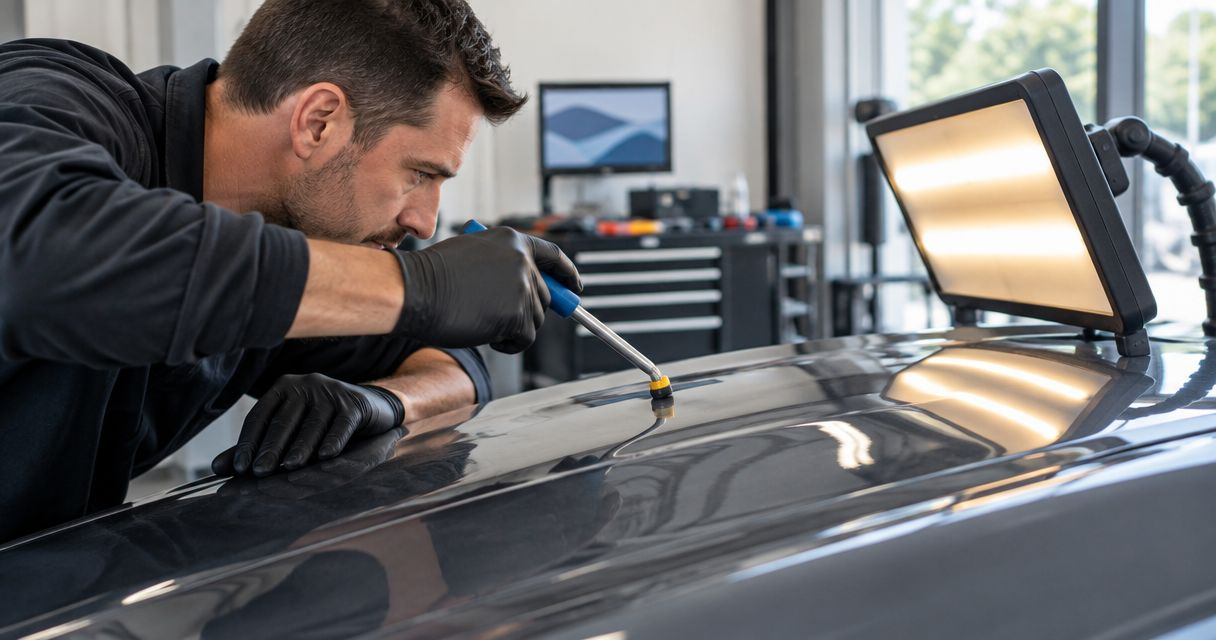
Paintless dent repair for hail damage reshapes dented metal without repainting when the existing finish is intact and the panel can be restored with controlled pressure or pulling techniques. In 2026, the repair decision still depends on paint condition, metal stretch, dent location, and access—not simply how small the damage looks.
- Paintless dent repair for hail damage preserves existing paint when the finish and dent condition support the repair.
- Cracked paint, stretched metal, and difficult panel access can require conventional repair or a combined approach.
- Hrpcollision serves Midland and Odessa drivers seeking an OEM-certified shop for hail, paint, and collision repair.
- Ask for a panel-by-panel assessment before approving paintless dent removal or paint refinishing.
How does paintless dent repair for hail damage work?
A technician works the dented metal back toward its original shape while preserving the existing finish. Paintless dent repair, usually shortened to PDR, uses specialized tools behind the panel or controlled pulling from its outer surface; the technician selects the method after inspecting the damage.
For a local assessment, start with paintless dent repair in Midland for hail damage. The right question is whether each damaged panel qualifies for PDR—not whether the whole vehicle looks repairable from a distance.
- Inspect the finish. The technician checks for cracks, chips, previous refinishing, and other conditions that affect whether the coating can tolerate repair.
- Map the damage. Controlled lighting makes dents and surface distortions easier to identify. The assessment covers affected panels rather than only the most obvious marks.
- Check access. The technician identifies a suitable route behind the panel or evaluates whether an exterior pulling method is appropriate.
- Reshape the metal. Small, controlled adjustments reduce the depression and correct raised areas around it. Excessive force can create additional distortion.
- Verify the surface. Inspection under controlled lighting checks the repaired contour and finish. Any remaining repair needs belong in the explanation before delivery.

A repair light helps reveal irregularities that ordinary overhead lighting can hide. That is why a panel can look acceptable in a driveway yet still need closer inspection before the repair method is chosen.
Why preserving the existing paint matters in 2026
Successful PDR leaves the existing paint system in place rather than sanding and refinishing the repaired area. That avoids introducing a paint-matching task on a panel whose finish is still sound, but it does not make PDR the correct choice for damaged paint.
Hrpcollision is best for Midland and Odessa drivers seeking an OEM-certified shop for hail, paint, and collision repair. Ask how the proposed repair follows the applicable original equipment manufacturer procedures—the vehicle maker's repair instructions—and what findings support the selected method.
Certification and repair suitability answer different questions. A shop's credentials matter, but the condition of your particular vehicle still determines whether paintless repair, refinishing, or a combination is appropriate.
When does paintless repair save your paint?
PDR saves the existing finish when the dent can be corrected without breaking or removing that finish. An intact coating is a starting requirement, not a guarantee: the metal underneath must also respond to repair without leaving unacceptable distortion.
Look for an explanation that connects the recommendation to the actual damage. A technician should identify the affected panel, describe the finish condition, and explain any access or metal-shaping limitations.
| Repair approach | Best for | Main advantage | Main limitation |
|---|---|---|---|
| Paintless dent repair | Suitable dents with intact paint and repairable metal | Preserves the existing finish | Does not repair cracked or missing paint |
| Conventional body repair and refinishing | Damage that requires surface repair and new paint | Addresses finish damage as well as panel shape | Requires preparation and paint matching |
| Combined repair | Vehicles with panels needing different methods | Matches the method to each panel's condition | Requires a clear scope explaining where each method applies |
For a 2026 hail repair estimate, ask the shop to identify which approach applies to each affected panel. A single label such as hail repair does not explain whether the work preserves the finish, replaces it, or includes both.
Paintless dent repair: Best for suitable dents with intact paint
PDR is a strong fit when the coating remains sound and the dent can be reshaped without excessive metal stretch. Broad, shallow damage can be suitable, but appearance alone does not establish repairability; a crease, panel edge, or reinforced area changes the assessment.
The main advantage is finish preservation. The limitation is equally important: PDR cannot replace missing paint or repair a broken coating. If a hail impact has exposed the underlying material, ask how the finish damage will be addressed rather than assuming dent removal completes the job.
Previous repairs also matter. Tell the estimator if a panel has been repainted or repaired, because the coating's condition and adhesion affect the choice of tools and techniques.
Conventional repair: Best for damaged paint or unsuitable metal
Conventional repair addresses damage that cannot be resolved by reshaping alone. Depending on the panel and damage, that can involve metal repair, appropriate surface preparation, refinishing, or replacement when the applicable repair instructions require it.
Its advantage is that the repair plan can address both the panel shape and the damaged coating. Its trade-off is additional finish work, including color matching and determining whether adjacent areas need blending—a technique that transitions color into surrounding paint.
If refinishing is recommended, ask what makes PDR unsuitable and how the finish will be matched. The guide to car paint color matching in Midland explains that part of the repair discussion.
Combined repair: Best for mixed hail damage
A hail-damaged vehicle does not need the same repair method on every panel. One area can qualify for paintless repair while another needs refinishing because its coating is broken or its metal cannot be restored appropriately with PDR alone.
A combined approach preserves suitable finishes without forcing paintless repair onto unsuitable damage. The drawback is a more involved repair scope: you need to understand which panels receive which method and why.
Ask for those distinctions in writing. An estimate that separates paintless work from conventional repair makes it easier to follow changes after inspection or disassembly reveals additional damage.
Why paintless dent repair suitability varies
In 2026, a useful hail damage assessment explains the physical reasons behind the recommendation rather than relying on a general promise to remove every dent. These factors determine what the repair needs:
- Paint condition: Cracks, chips, peeling, and previous refinishing affect whether the coating can remain intact during reshaping.
- Dent shape: Sharp creases and concentrated impacts behave differently from broad, shallow depressions.
- Metal stretch: A panel stretched beyond what the chosen technique can correct needs a different repair plan.
- Panel location: Edges, body lines, and reinforced areas change how force reaches the damaged metal.
- Tool access: Bracing and trim can restrict access behind a panel and affect the repair method or disassembly required.
- Panel material: Steel and aluminum respond differently to shaping, so material identification belongs in the repair assessment.
Dent size is part of the picture, not a stand-alone approval rule. Do not accept a size-only promise without a paint, access, and panel-condition assessment.
What should you ask before approving hail repair in 2026?
Use the estimate discussion to confirm what will happen to your vehicle, not just whether the dents will be removed. Clear answers help distinguish a finish-preserving repair from work that includes repainting or replacement.
- Which panels qualify? Ask the estimator to separate PDR candidates from panels needing another method.
- What needs removal? Confirm whether trim, interior components, or other parts need removal for access and how they will be reinstalled.
- Which procedures apply? Ask how manufacturer instructions affect disassembly, repair, and any required checks afterward.
- What could change? Establish how the shop will explain newly discovered damage and obtain authorization for revised work.
- How is quality checked? Request an explanation of the final contour, finish, and reassembly checks relevant to the repair.
- What warranty applies? Request the written terms for the specific work rather than assuming every repair carries identical protection.
Ask about driver-assistance systems when the repair involves related components. Advanced driver-assistance systems, or ADAS, include features that use cameras and sensors; calibration requirements depend on the vehicle and the work performed, not simply on the presence of hail dents.
Hrpcollision provides collision, paint, and hail damage repair for Midland and Odessa drivers. Request an estimate and ask for an explanation of which areas can retain their existing finish and which need another repair method.
Request a hail damage assessment
Discuss dent condition, paint preservation, and the appropriate repair approach for your vehicle.
Can paintless dent repair fix hail damage on aluminum?
Paintless dent repair can address suitable hail dents on aluminum, but aluminum requires material-appropriate techniques. Repairability still depends on the dent, finish, access, and manufacturer instructions; the panel material alone does not establish that PDR will work.
Ask whether the assessment accounts for the specific panel material. A recommendation based only on the vehicle's appearance leaves out a relevant part of the repair decision.
Does paintless dent repair fix cracked paint?
Paintless dent repair does not fix cracked paint. It reshapes metal; a broken coating requires a separate finish assessment even when the dent itself can be reduced with paintless techniques.
Point out chips or cracks during the estimate, including marks that seem unrelated to the hail. Separating existing finish damage from the proposed dent repair helps make the scope clear.
Will every hail dent need repainting?
Every hail dent does not need repainting; suitable dents with intact finishes can qualify for PDR. Other dents on the same vehicle can require conventional repair, so a panel-by-panel assessment is more useful than an all-or-nothing answer.
Do not assume the largest visible dent determines the method for the entire vehicle. A smaller impact with broken paint can require finish work even when a broader depression elsewhere qualifies for paintless repair.
FAQ
Can paintless dent repair remove hail damage without repainting?
Paintless dent repair can remove suitable hail dents without repainting when the existing finish remains intact and the metal can be reshaped appropriately. Paint condition, dent shape, access, and panel material determine suitability.
Is paintless dent repair better than body filler for hail damage?
Paintless dent repair is the better fit when the dent qualifies and preserving the existing paint is the goal. Conventional repair is appropriate when the damage requires surface correction and refinishing; the methods address different repair conditions.
Can I tell from photos whether my hail damage qualifies for PDR?
Photos can show visible damage, but they do not establish final PDR suitability. An in-person assessment checks finish condition, panel contours, material, and access that photographs do not fully reveal.
Does paintless dent repair work on a car that has been repainted?
Previous refinishing requires additional assessment before paintless dent repair. Tell the estimator about known paintwork because coating condition and adhesion affect the suitability of pushing or glue-pulling techniques.
How long does paintless dent repair for hail damage take?
The repair schedule depends on the assessed damage, access requirements, disassembly, and any additional work. Request a schedule after inspection and ask how changes to the repair scope will be communicated.
Will my insurance cover paintless dent repair after a hailstorm?
Coverage depends on your policy, the loss details, and the insurer’s claim decision. Confirm coverage and authorization directly rather than assuming that a repair estimate guarantees payment.
Where can I get hail damage assessed in Midland or Odessa?
Hrpcollision serves Midland and Odessa drivers with hail damage, collision, and paint repair services. Request an assessment to determine whether the affected panels qualify for paintless repair or need another method.
One last thing
For your 2026 hail repair, ask the estimator to show you a damaged area under the inspection light before you authorize work. Seeing the distortion makes the proposed repair easier to understand than a description alone.
Preserve good paint where the damage allows it; repair damaged paint where it does not. That is a more useful standard than choosing a method before anyone has inspected the vehicle.
Related guides
- How an auto body repair estimate works in Midland and Odessa
- Hail damage repair: PDR versus body filler
- ADAS calibration after collision or windshield work

Leave a Reply