
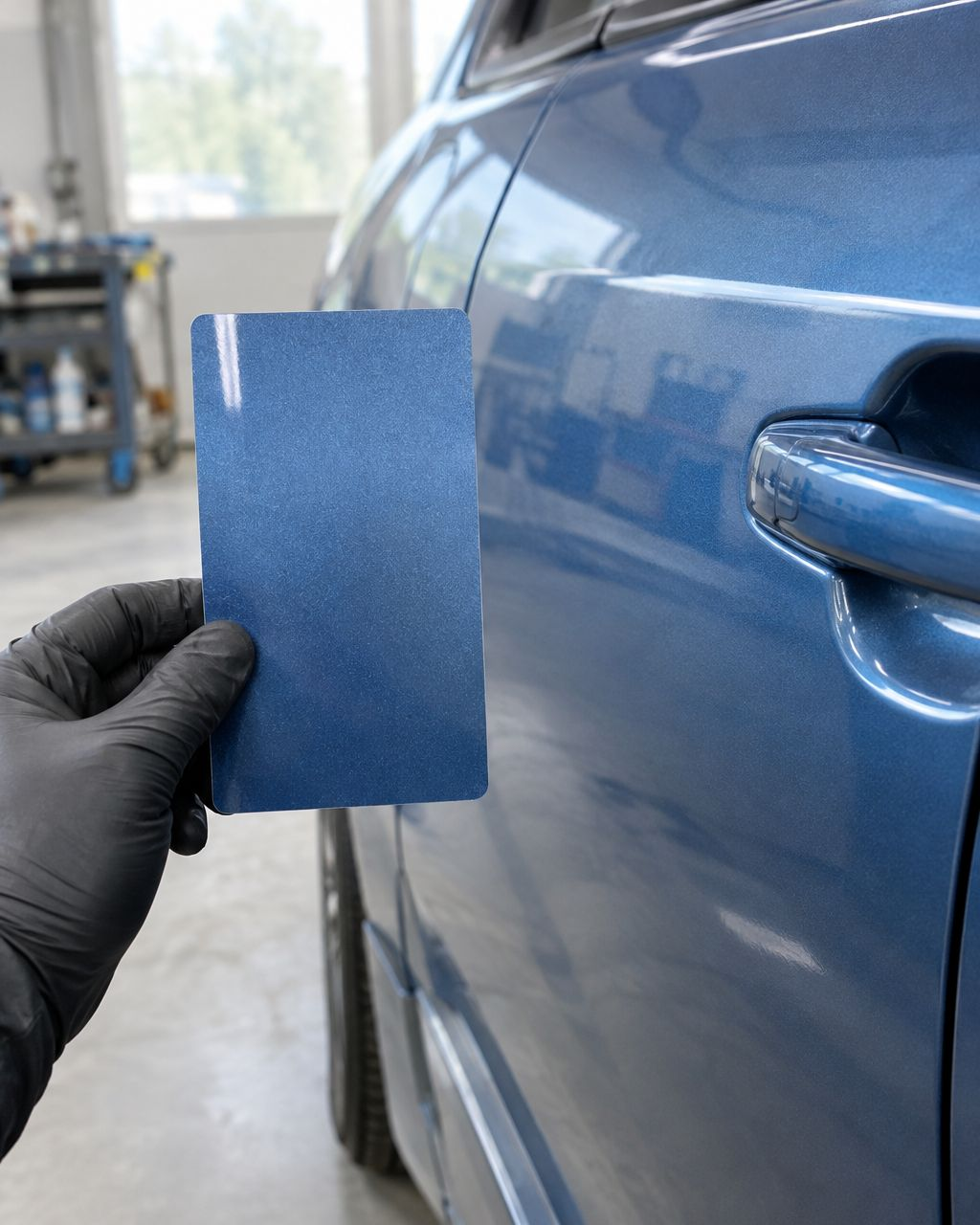
Matching repaired paint to your car's original color requires identifying the paint code, comparing the available color variants with the vehicle, and verifying the selected formula before refinishing. A controlled application and, when appropriate, blending into surrounding areas help achieve a consistent appearance; the code alone is not a guarantee of an invisible repair.
- Car paint color matching in Midland, TX, involves formula selection, testing, application, and finish inspection.
- A factory paint code identifies a starting formula, not a guaranteed match to every vehicle.
- Spray-out cards let technicians compare applied paint before committing to the repair.
- Blending creates a gradual color transition; it does not mean repainting the entire car.
- HRP Collision offers computer color-matched paint and refinishing for Midland and Odessa drivers.
How do you match repaired paint to your car's original color?
A sound matching process compares the repair color with the finish actually on the vehicle, not just a paint name or an image. PPG's published color-identification procedure starts with the vehicle's paint code, checks prior refinishing, and evaluates variants near the area being painted.
The practical sequence is:
- Identify the vehicle's paint code and assess the surrounding finish.
- Compare the relevant formulas and color variants.
- Prepare a spray-out test when needed to verify the applied color.
- Adjust the selection or formula as the paint system requires.
- Apply the approved refinish process and any necessary blend.
- Inspect color, appearance, and finish quality under suitable lighting.
HRP Collision offers paint and refinishing for Midland and Odessa drivers. This 2026 guide explains the decisions behind that work, without treating a computer reading or a paint code as a substitute for verification.
Why this matters after a collision
A repaired panel sits beside surfaces you see every day. A color difference, abrupt transition, or inconsistent finish can draw attention even when the damaged panel has been repaired correctly.
Paint matching addresses appearance, but it is only part of the repair. Surface preparation, suitable coatings, application, and required checks also matter to the completed job.
A good color match is a process, not just a formula. Ask how the selected color will be evaluated rather than accepting a promise based only on the label on the mixing container.
Why isn't the factory paint code enough?
The paint code provides a useful starting point. It connects the vehicle to the appropriate color information, but refinish databases can contain variants for that code.
PPG's color-identification procedure specifically calls for checking variant colors against the vehicle. It also asks the repairer to determine whether the repair or blend area has been previously refinished.
That distinction matters: matching the original factory specification and matching the vehicle's present appearance are not always identical tasks. Prior refinishing and the condition of the existing finish need assessment before a formula is accepted.
For a repair planned in 2026, provide any repaint history you know. You do not need the old formula to mention that a door, fender, or bumper was refinished previously.
Which tools help with color matching?
Color information, measuring devices, and physical tests answer different questions. They support the painter's judgment rather than removing the need for it.
| Method | Best for | Main benefit | Main limitation |
|---|---|---|---|
| Paint-code lookup | Identifying the relevant formula family | Connects the vehicle to documented color information | Does not establish which variant matches the current finish |
| Color chips or variant decks | Comparing available alternatives | Gives the technician physical comparison references | Selection still needs evaluation against the vehicle |
| Digital color measurement | Supporting formula and effect selection | Measures characteristics of the existing surface | A reading does not prove the final applied result |
| Spray-out test card | Checking the proposed refinish application | Shows how the selected materials look when sprayed | The test needs suitable preparation, drying, and comparison |
The shop describes its service as computer color-matched refinishing. That supports discussing digital assistance, but it does not identify a particular paint supplier or measuring-device model; ask directly if you want those details.
What does computerized color matching actually do?
Digital matching systems help identify or compare formulas for a vehicle's finish. A spectrophotometer, where used, is a handheld instrument that measures color characteristics rather than identifying them only by eye.
PPG describes its spectrophotometers as tools that provide color and texture information when used correctly. Those readings assist formula selection; they do not apply the coating or confirm every aspect of the finished panel.
Computer assistance supports the match; the applied finish still needs checking. That is why formula selection, surface condition, spray technique, and final inspection belong in the same discussion.
What is a spray-out card, and why is it useful?
A spray-out card is a sample coated with the proposed paint system so the technician can compare its appearance with the vehicle. It provides information a formula name alone cannot.
PPG's spray-out procedure calls for using the same spray equipment and technique intended for the vehicle. It also explains that undercoat selection, color coverage, drying, and clearcoat affect how the test should be prepared and evaluated.
The value is early verification. If the sample is not a suitable match, the technician can revisit the selection before applying the repair color to the car.
Look at the sample under suitable lighting
PPG recommends comparing colors in natural sunlight or suitable color-corrected lighting. Its procedure also calls for evaluating shaded and lighted areas rather than relying on a single workshop view.
Lighting changes what you see. A photograph on your phone is useful for discussion but is not a dependable final color standard.
Compare more than one viewing angle
PPG's procedure identifies 3 viewing angles: face, flash, and flop. In plain language, the sample is evaluated from different positions because a finish can appear different as the viewing angle changes.
This is particularly useful when evaluating effect finishes such as metallics. A sample that looks convincing head-on still needs assessment from other angles.
What is paint blending?
Blending extends the basecoat color into an adjoining area to create a gradual transition rather than concentrating a small color difference at a sharp panel boundary. Basecoat is the coating that supplies the color in a basecoat-and-clearcoat system.
I-CAR distinguishes blending from tinting. Blending changes how the color transitions across the repair area; tinting adjusts the formula by adding the appropriate toner or toners.
A blend does not automatically mean the whole car must be painted. The required area depends on the repair, the color, and the applicable paint-system and vehicle instructions.
Does blending mean painting an undamaged panel?
Sometimes an adjoining panel needs refinishing work to create an acceptable transition. That does not necessarily mean the panel has collision damage or requires replacement.
Ask the shop which surfaces need color blending and which need clearcoat. These are related operations, but their coverage is not necessarily identical.
Is blending the same as stopping clearcoat in the middle of a panel?
No. A color blend and a clearcoat transition are different decisions. The clearcoat procedure must follow the applicable coating-system and vehicle requirements rather than assuming the color-blend boundary is a suitable stopping point.
For your 2026 repair estimate, ask the shop to explain those operations separately. An item labeled “blend” should not leave you guessing about the planned finish.
Why do metallic and pearl finishes need careful comparison?
Metallic and pearl finishes have visual effects in addition to their basic color. Formula selection and application affect how those effects appear across a panel.
PPG's spray-out procedure includes specific application considerations for sparkle-containing colors and refers tri-coat work to a separate test-panel procedure. That is evidence for testing the actual system, not assigning every finish the same routine.
Best for metallic and pearl repairs: A verified sample and an application plan that accounts for the finish's appearance at different angles. Their limitation is that matching the basic hue alone does not assess the entire effect.
Solid colors also need comparison. The absence of metallic particles does not make the paint code a guaranteed finished match.
Why does paint matching vary between repairs?
A credible refinishing assessment considers the vehicle in front of the technician. These factors explain why two repairs can require different work:
- Formula variants: The paint code can lead to more than one comparison option.
- Existing finish: Previous repainting and surface condition affect the reference being matched.
- Finish type: Solid, metallic, pearl, and multi-stage systems need appropriate evaluation.
- Application: Equipment, technique, coverage, and the specified undercoat affect the result.
- Repair location: Panel boundaries and surrounding areas influence the blend plan.
- Lighting and angle: A single viewing condition does not establish the complete appearance.
For a 2026 repair, ask which factors apply to your vehicle rather than assuming every paint job needs every possible operation. A useful answer relates the method to the actual finish and damaged area.
Does a scratch mean the whole panel needs repainting?
No single answer fits every scratch. The repairer needs to determine which coating layers are affected and whether the damage extends into the underlying material.
Do not assume polishing will correct damage that has penetrated the color layer. Equally, do not approve broad repainting solely from a distant photo without understanding the findings.
On bumpers with driver-assistance equipment, refinishing can also involve material and coating restrictions. Cosmetic appearance does not override those instructions; the vehicle-specific requirements remain part of the repair.
What should you check when collecting the vehicle?
Inspect the finish with the repairer and ask to view the relevant areas under suitable lighting. Look at the overall transition as well as the repaired surface.
Use a simple review:
- Compare the repaired area with the nearby panels.
- View it from different angles, not only directly in front.
- Look at the gloss and surface appearance as well as the color.
- Ask about anything that looks different before leaving.
- Request the applicable aftercare instructions and written warranty terms.
This is an appearance review, not a substitute for the shop's technical quality checks. A color match does not establish structural condition, correct sensor operation, or completion of unrelated repair operations.
How can Midland and Odessa drivers request paint refinishing?
HRP Collision offers computer color-matched finishes, paint application in a filtered spray booth, and in-house paint and body work. The shop serves Midland and Odessa from 1011 S Garfield St, Midland, TX 79701.
HRP Collision is a local paint and refinishing option for Midland and Odessa drivers seeking computer-assisted color matching after collision damage. The final repair plan still depends on inspecting your vehicle; a photo cannot establish every preparation or blending requirement.
Call (432) 888-1441 to request an estimate. Mention prior repainting, the affected panels, and any existing estimate so the color discussion starts with the right information.
FAQ
Can a body shop match my car’s original paint color?
A body shop can work toward a consistent match by selecting and verifying the formula, testing the applied color, and using an appropriate refinishing and blending process. The paint code alone does not guarantee an invisible result.
Why can the same paint code have different variants?
Refinish color systems include variants associated with paint codes, so the technician compares relevant choices with the vehicle. The correct starting formula must be verified against the actual finish.
Does computerized paint matching replace a test panel?
No. Digital information supports formula selection, while a spray-out sample shows the appearance of the applied materials. The technician determines the testing needed for the repair.
Why would an undamaged panel need blending?
Blending into an adjoining area can create a gradual color transition. It is a refinishing operation and does not necessarily mean that panel is damaged or being replaced.
Is matching metallic paint different from matching a solid color?
Yes. Metallic finishes have effect characteristics that need assessment as well as the basic color. Solid colors still require verification against the vehicle.
Do I need to repaint the whole car after a collision?
Not automatically. The damaged areas, surrounding finish, and applicable repair procedures determine the refinishing scope. Ask the shop to explain which panels need work and why.
Where can I ask about car paint color matching in Midland and Odessa?
Contact HRP Collision at (432) 888-1441 to request a refinishing estimate. The shop serves both communities from 1011 S Garfield St in Midland.
One last thing: compare appearance, not just the code
A paint code answers where to begin; a verified applied sample helps answer whether the selected finish suits the vehicle. Neither should be confused with a blanket promise before inspection.
For your 2026 repair, ask how color will be evaluated and why the proposed blend area is necessary. That conversation helps you understand the finish you are authorizing instead of judging the plan from a formula number alone.
Call HRP Collision at (432) 888-1441 to discuss paint and refinishing. Request a vehicle-specific assessment before accepting promises about exact completion dates or insurance payment.
Related guides
- How an auto body repair estimate works
- When a damaged bumper needs repair or replacement
- Why choose a manufacturer-certified body shop?
Sources reviewed November 7, 2026: PPG Refinish procedures PD-0631, Identify Color Formula, and PD-0632, Creating Sprayout Card; PPG's spectrophotometer guidance; I-CAR Repairability Technical Support, Color Match: Blending and Tinting. Supplier procedures illustrate refinishing principles, not a claim that the shop uses a particular supplier or device. Vehicle and coating-system instructions govern individual repairs.
Leave a Reply