
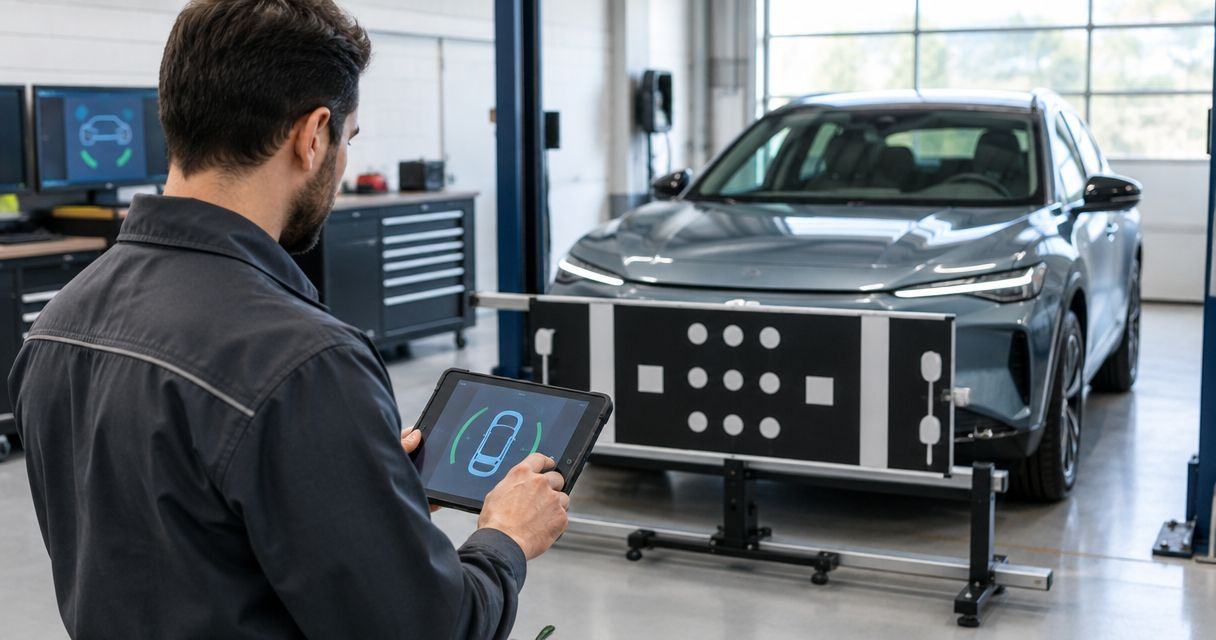
EV and hybrid owners’ ADAS calibration is the adjustment of driver-assistance sensors to manufacturer-defined reference points, with the aim of restoring their intended operation after qualifying repairs. This 2026 guide explains how to plan calibration around collision repairs, windshield replacement, and vehicle-specific electrical safety requirements.
- ADAS calibration for EV and hybrid owners must follow vehicle-specific procedures, not assumptions about the powertrain.
- Hrpcollision provides OEM-certified collision repair for Midland and Odessa drivers; confirm your vehicle’s certification and calibration requirements.
- A diagnostic scan identifies electronic faults; it does not replace required camera or radar calibration.
- Choose a repair plan that identifies calibration triggers, prerequisites, responsible providers, and completion records.
Why ADAS calibration matters for EV and hybrid owners
Advanced driver-assistance systems, or ADAS, use equipment such as cameras and radar to support functions including lane assistance and automatic emergency braking. Calibration establishes the sensor references those functions depend on. A vehicle that looks repaired still needs any calibration required by its manufacturer.
For EV and hybrid owners, the repair plan must address both driver-assistance equipment and electrified-vehicle safety. Neither a charging port nor a hybrid badge identifies the correct calibration procedure. The vehicle’s equipment, damage, repair operations, and manufacturer instructions determine the work.
Windshield work deserves particular attention because forward-facing cameras are often mounted behind the glass. The windshield camera calibration options guide explains that part of the decision; other sensors require their own assessment.
For a 2026 repair in Midland or Odessa, your priority is a documented process rather than a generic assurance that the electronics were checked. Ask which components were affected, which procedures apply, and what evidence will show that required work is complete.
How to plan ADAS calibration for your EV or hybrid
Identify your exact vehicle and driver-assistance equipment
Start with the owner’s manual, vehicle identification number, and dashboard messages. You can gather this information yourself before requesting an estimate. Do not assume that two vehicles with the same model name have identical sensors or driver-assistance features.
Build a 2026 repair file containing the vehicle’s identification, damage history, and current symptoms. Record whether a warning appeared immediately after the impact, after glass replacement, or during later driving. That sequence helps the repair team understand what changed without treating your observations as a diagnosis.
Identify 2 vehicle details before booking: the VIN and model year. The VIN is the vehicle identification number; it helps the shop identify the vehicle and research applicable equipment and procedures.
- Record the VIN and model year accurately.
- List the driver-assistance features you normally use.
- Photograph dashboard warnings without clearing them.
- Note previous windshield, bumper, suspension, or alignment work.
- Describe changes in steering or assistance behavior without recreating unsafe conditions.
Document the damage without disturbing electrical components
Take exterior photographs and write down what happened while the details are clear. Your role is to preserve information, not expose sensors or inspect high-voltage components. Orange high-voltage cables and damaged electrical equipment are not owner-inspection points.
Take 4 exterior photos from safe positions around the vehicle. Add close-ups of visible damage only when you can do so without entering traffic, moving damaged parts, or approaching an electrical hazard. Tell the repair facility if the vehicle experienced underbody contact, flooding, smoke, unusual heat, or damage near the battery area.
A quiet EV is not proof that the vehicle is powered down. If damage raises questions about electrical safety or drivability, obtain professional recovery guidance rather than driving to test whether assistance functions still work.
- Photograph the vehicle without removing trim or covers.
- Record the impact location and visible damage.
- Preserve warning messages and incident photographs.
- Report underbody contact or suspected battery-area damage.
- Ask for transport instructions when safe operation is uncertain.
Choose a repair team around the manufacturer’s procedure
You can begin by asking each facility the same questions and comparing written answers. Ask which manufacturer procedures apply, whether the facility handles your exact vehicle, and who performs any required calibration. An equipment list alone does not establish that a provider can complete your repair correctly.
Hrpcollision is best for Midland and Odessa drivers seeking OEM-certified collision repair. OEM means original equipment manufacturer: the vehicle maker. Confirm the certification relevant to your specific EV or hybrid and ask how ADAS calibration fits into the proposed repair plan.
For your 2026 estimate, ask Hrpcollision to identify whether calibration will be performed directly or coordinated with another provider. A coordinated service is not automatically a disadvantage, but it adds a handoff that needs clear responsibility and documentation.
- Verify certification relevant to your manufacturer and vehicle.
- Ask who researches the applicable repair instructions.
- Identify who performs and documents calibration.
- Confirm who resolves unsuccessful calibration attempts.
- Request an estimate that distinguishes repair, scanning, alignment, and calibration work.
Separate diagnostic scanning from sensor calibration
Ask for plain-English explanations before authorizing work. A diagnostic scan checks electronic control modules for information such as stored fault codes. Calibration establishes or relearns specified sensor references. These are different operations, and neither term should be used as a substitute for the other.
A warning-free dashboard does not prove that a required calibration has been completed. Equally, a stored fault does not automatically identify the damaged component. The technician must interpret diagnostic information alongside inspection findings and the manufacturer’s procedure.
Static calibration uses prescribed stationary targets or equipment. Dynamic calibration involves a specified driving procedure. Some vehicles require one method, while others require a combination; the manufacturer’s instructions decide, not your preference or the provider’s convenience.
- Ask which scans the repair requires.
- Ask which specific sensors require calibration.
- Request the reason each calibration is necessary.
- Confirm whether the prescribed method is static, dynamic, or combined.
- Keep diagnostic findings separate from calibration completion records.
Confirm prerequisites before the calibration appointment
Ask the repair coordinator to explain what must be finished before calibration starts. Depending on the vehicle and procedure, prerequisites include repairs to mounting points, alignment checks, specified tire conditions, or preparation of the calibration area. Do not assume every vehicle needs the same preparation.
Where required by the applicable procedure, the sequence should distinguish Repair completion, Wheel alignment, Sensor calibration, and Final checks. The point is not to order every operation for every vehicle. It is to prevent calibration from being treated as a stand-alone fix for unresolved mechanical or structural damage.

Clarify the difference between frame measurement and wheel alignment as well. Structural measurement evaluates body or frame reference points; wheel alignment evaluates wheel angles. One does not automatically replace the other.
- Ask whether sensor brackets or mounting areas need repair.
- Confirm any required structural measurements are complete.
- Ask whether wheel alignment is a prerequisite.
- Identify required tire, loading, or vehicle-condition checks.
- Confirm how unmet prerequisites will be resolved.
Collect completion records before accepting the vehicle
Ask the coordinator to walk through the completed work with you. A useful handoff explains what was repaired, what was checked, which calibrations were required, and whether any concerns remain. Do not accept a generic statement that the computer was reset as an explanation of the entire process.
Request 3 record types: the final repair invoice, diagnostic reports, and calibration results for required procedures. The exact format varies, but the records should identify your vehicle and the work performed. Ask how any unsuccessful attempt or unresolved fault was handled.
Keep your 2026 repair records together for future service and ownership decisions. Review the owner’s manual before relying on assistance features again, and report unexpected behavior promptly. Do not deliberately provoke automatic braking or lane intervention to test the repair yourself.
- Match the records to your vehicle’s VIN.
- Review the completed repair operations.
- Obtain results for required scans and calibrations.
- Ask about unresolved warnings or operating restrictions.
- Keep the paperwork with your service history.
Request a vehicle-specific repair estimate
Ask how collision repairs, required calibration, and completion records fit your EV or hybrid.
Compare calibration service options
Best for your vehicle means able to follow its procedure and document the result. Provider type is a starting point, not proof of capability. Ask every candidate to confirm vehicle coverage, prerequisites, responsibility for related repairs, and the records supplied at handoff.
| Option | Best for | Main advantage | Key limitation |
|---|---|---|---|
| OEM-certified collision repair facility | Drivers coordinating body repairs and manufacturer-specific requirements | Connects physical damage repair with the calibration plan | Certification scope and calibration arrangements need vehicle-specific confirmation |
| Manufacturer dealership service department | Owners seeking manufacturer-specific service support | Provides a route for discussing the manufacturer’s service requirements | Confirm who handles body damage and how work is coordinated |
| Independent ADAS specialist | Vehicles with completed repairs needing a defined calibration procedure | Focuses the appointment on calibration requirements | Vehicle coverage, equipment, and prerequisites still need verification |
| Mobile calibration provider | Repairs where the required procedure can be completed at the proposed location | Brings calibration equipment to an appropriate site | Not every procedure or location is suitable |
Whether you compare ADAS recalibration shops in Los Angeles or providers in West Texas, the deciding evidence is vehicle-specific capability and documented completion—not proximity alone. A nearby appointment does not resolve unsuitable site conditions, unfinished repairs, or missing equipment coverage.
Ask each provider to explain its limits as clearly as its capabilities. A provider that identifies an unsupported vehicle or unsuitable location gives you actionable information. A broad promise without a procedure-specific explanation leaves the important questions unanswered.
Common mistakes EV and hybrid owners make
Assuming the electric powertrain determines calibration needs
An EV does not require one universal calibration method, and a hybrid does not follow a separate universal rule. Sensor configuration and manufacturer instructions determine the procedure. Give the shop your exact vehicle details instead of asking only whether it works on electric cars.
Treating battery safety and ADAS as the same job
High-voltage safety and driver-assistance calibration address different systems. Completing one does not establish completion of the other. Ask who is responsible for each part of the repair and how their work affects the sequence.
Approving appearance repairs without discussing nearby sensors
A bumper cover is the exterior panel, not the entire bumper assembly. Cameras, radar units, wiring, or mounting hardware can sit behind or near repaired panels. Ask whether the repair method, parts, or refinishing operation affects sensor performance or triggers a manufacturer-required check.
Assuming the absence of warnings proves accuracy
A dashboard warning is useful information, but its absence is not a calibration certificate. Confirm the required procedure and its recorded result. Do not use a familiar commute as an informal substitute for the specified verification process.
Comparing estimates without matching the scope
One estimate might include calibration while another leaves it for later assessment. Before choosing, compare the listed operations, diagnostic work, prerequisites, and documentation. Ask what findings would change the repair plan; do not treat an initial estimate as a guarantee against hidden damage.
FAQ
Does every EV or hybrid need ADAS calibration after a collision?
No. Required calibration depends on the vehicle’s equipment, the damage, the repair operations, and manufacturer instructions. Ask the repair facility to identify the applicable requirements for your VIN.
Is a diagnostic scan the same as ADAS calibration?
No. A diagnostic scan checks electronic systems for information such as fault codes, while calibration establishes specified sensor references. A scan does not replace a required calibration.
Does windshield replacement require camera calibration?
Windshield replacement requires camera calibration when the vehicle manufacturer specifies it. Confirm the procedure for your exact vehicle before treating glass replacement as complete.
Can I calibrate my EV’s cameras myself?
Do not treat a dashboard setting or owner-performed reset as a substitute for required professional calibration. Follow the manufacturer’s instructions and use a provider with the required equipment and vehicle coverage.
Can a mobile provider calibrate my hybrid at home?
A mobile appointment is suitable only when the provider can meet the vehicle’s procedure and site requirements. Confirm the required method, working conditions, and vehicle coverage before booking.
Can I drive my EV while an ADAS warning is on?
Do not assume the vehicle is safe to drive because it still moves normally. Follow the owner’s manual and obtain professional guidance based on the warning and damage; arrange recovery when safe operation is uncertain.
What should I ask Hrpcollision before booking ADAS calibration?
Ask Hrpcollision how the manufacturer’s calibration requirements will be identified and handled for your exact EV or hybrid. Confirm applicable certification, who performs the work, and which completion records you will receive.
One last thing
A successful calibration is not a substitute for repairing a damaged sensor mounting point. Ask what physical conditions had to be corrected before the procedure—not just whether the calibration equipment reported completion.
For your 2026 repair, call Hrpcollision or request an estimate with your VIN, damage photographs, and warning details ready. Ask for a repair plan that connects physical repairs, required calibration, and the final documented handoff.
Related guides
- ADAS calibration after collision and windshield work
- Manufacturer-certified body shop guidance for Midland drivers
- How auto body repair estimates work in Midland and Odessa

Leave a Reply