
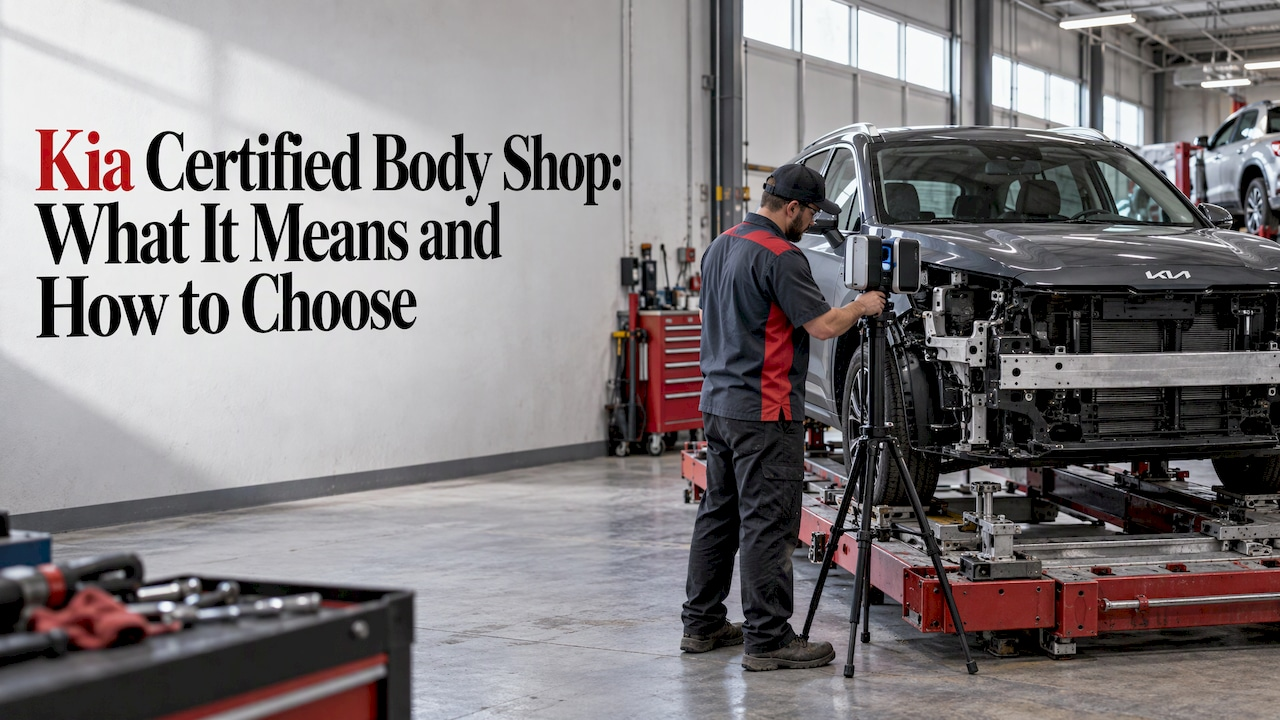
A Kia certified body shop is a collision center that an independent third party has vetted against Kia’s requirements for training, tooling, equipment and facilities, so your car is repaired back to factory specifications. If you drive a Kia in the Midland-Odessa area, we repair it that way: to manufacturer procedures, with OEM-required tools, under a lifetime warranty for as long as you own the vehicle, and we bill your insurer directly.
TL;DR
- Kia certification is awarded through a third-party program, the Collision Performance Network (CPN), which checks training, tooling, equipment and facilities.
- A certified shop must have access to current Kia repair procedures, scan the vehicle before and after repair as the manufacturer requires, and provide a limited lifetime warranty.
- Kia’s network requires I-CAR Gold Class, the industry training designation for estimators and for structural, non-structural and refinish technicians.
- In many states, including Texas, you choose the shop. Your insurer does not have to pick it for you.
- Ask for the procedures, the parts type and the scan reports in writing. A good shop hands them over without a fuss.
Table of Contents
- What “Kia certified” actually means
- The training requirement: I-CAR Gold Class
- Which Kia repair procedures must a certified shop follow?
- Parts: what Kia says about genuine components
- How to confirm a shop before you hand over the keys
- Why the estimate often changes, and why that is normal
- Structure, paint and finish on a Kia
- Hail damage on a Kia
- Your right to choose the shop
- Where HRP Collision fits
- What to do in the first 48 hours after a Kia collision
- FAQ
- Sources
What “Kia certified” actually means
The phrase is used loosely online, so it helps to know what stands behind it. According to the CPN certification brochure for Kia, a certified center has been vetted by an independent third-party entity to meet Kia’s specific requirements for training, tooling, equipment and facilities. The purpose is to let the shop repair a vehicle back to factory specifications, protecting fit, finish, durability, safety and value.
Three parts of that sentence matter to you as an owner.
Independent vetting. The shop does not grade itself. A third party checks that the people, tools and building meet the automaker’s list.
Specific requirements. These are Kia’s requirements for Kia vehicles, not a general “we fix all makes” badge. The tools, training and procedures are matched to the brand.
Factory specifications. The goal is not a car that looks right in the parking lot. It is a car whose structure, sensors and finish behave the way the engineers designed them.
A dealership sign, a good online review or a nice waiting room does not tell you any of that. Certification does.
The training requirement: I-CAR Gold Class
Kia’s network ties its certification to a specific training designation. I-CAR’s Kia program page states that the Kia Certified Collision Repair Center Network requires facilities to obtain and maintain I-CAR Gold Class. To earn Gold Class, a business must train and maintain four roles: estimator, non-structural technician, steel structural technician and refinish technician.
Why this matters for a Kia owner is simple. Collision repair is not one skill. The person who writes the estimate has to spot hidden damage. The person who pulls the structure has to know where the metal can and cannot be heated or sectioned. The person who refinishes has to match a paint that ages in West Texas sun. Gold Class means each of those roles is trained, not just the best technician on the floor.
HRP Collision holds I-CAR Gold Class recognition, along with ASE certifications, and that is the training baseline behind every Kia that comes through our doors.
Which Kia repair procedures must a certified shop follow?
This is the part that separates a certified repair from a repair that merely looks finished. The same CPN brochure says a Kia-certified center must have current subscription or use-access to the applicable OEM repair procedures. It must also meet Kia standards for ongoing technical training and equipment, scan vehicles before and after repair as the manufacturer requires, document compliance where applicable, and provide a limited lifetime warranty on completed repairs.
In plain terms, the procedures are Kia’s own instructions for how a given model is to be repaired: where it can be welded, which adhesives and fasteners must be replaced, which parts are single-use, and what must be recalibrated afterward.
The repair industry treats these instructions as the benchmark. The Society of Collision Repair Specialists (SCRS) has said that OEM procedures documented as required, recommended or otherwise necessary are the standard of repair, and that disregarding them creates undue and avoidable liability for the shop, as reported in Hammer & Dolly’s November 2025 national feature. That is a good reason to want the shop to work from the procedure and not from habit.

Scans before and after
A modern Kia is a network of computers. A hit to a bumper can set codes, move a sensor’s aim or disable a safety feature without a visible sign. A pre-repair scan shows what the car already reports. A post-repair scan shows whether the repair cleared everything and left no fault behind. The manufacturer requirement for both scans is part of the certification standard described above.
Calibration of driver-assistance systems
Forward cameras, radar units and parking sensors sit behind windshields and bumpers, exactly the places a collision touches. After a repair they often need to be recalibrated so lane-keeping and emergency braking work as designed. We perform ADAS calibration in house; our ADAS calibration page explains the service, and our guide to ADAS calibration after collision or windshield work walks through when it applies.
Parts: what Kia says about genuine components
Parts are where owners most often get surprised. Kia states that it strongly recommends Genuine Kia Parts, that aftermarket parts may not have been tested for proper function or approved by Kia, and that aftermarket and salvage parts are not covered by Kia warranties, per Kia’s parts page. The same page notes that Kia vehicles have engineered crumple zones and energy-absorbing bumpers designed to help reduce injury-producing forces in certain crashes. Those systems depend on every bracket, absorber and reinforcement doing its intended job.
Kia also encourages owners to take an active role in their repair and ask for Genuine Kia Parts. Warranty coverage follows the part and who installs it: Genuine Kia Parts installed by an authorized Kia dealer are covered by a Replacement Parts and Accessories Limited Warranty, as set out in the 2020 Kia Warranty and Consumer Information Manual. Check the current manual for your model year, because terms can change.
If you want the longer version of the parts question, our OEM vs aftermarket parts guide covers how each type is marked on an estimate and what it means for fit and finish.
How to confirm a shop before you hand over the keys
Because the badge is easy to claim, confirm it with a short routine. Each step takes a few minutes.
- Ask which certification the shop holds and who issued it. For Kia, the answer should point to the third-party program described above, not just “we do Kias.”
- Ask about I-CAR Gold Class. It is a requirement for Kia’s network, so a shop that is certified should be able to say yes immediately.
- Ask whether the repair will follow Kia’s own procedures. A confident shop says yes and can show you the procedure for your model’s repair.
- Ask for pre- and post-repair scans. You want both, in writing, with the final report clear of faults.
- Read the parts line on the estimate. Many states require the type of parts used to be disclosed on the estimate, according to Kia’s parts page. Look for the words OEM or Genuine.
- Ask about calibration. If the repair touches a bumper, windshield, mirror or radar area, the estimate should say how calibration is handled.
- Ask about the warranty. A certified repair carries a limited lifetime warranty from the shop, not from Kia. At HRP Collision, that is a lifetime warranty for as long as you own the vehicle. Get the terms in writing.
Everything on that list is something we put in front of customers as a matter of routine. Our repairs follow the exact tools and methods the automaker requires, and they carry our lifetime warranty for as long as you own the vehicle.
Why the estimate often changes, and why that is normal
Owners are sometimes alarmed when the final bill differs from the first figure. A first estimate is made from what can be seen on the outside. Once panels come off, the structure, brackets, sensors and wiring become visible, and Kia’s procedure may call for steps nobody could price from the parking lot. A supplement is the paperwork that adds those items and goes to your insurer for approval. Our guide to why collision repair estimates change explains the usual causes, and our estimate walkthrough for Midland and Odessa shows what to expect from the first visit.

Structure, paint and finish on a Kia
Three areas decide whether a repair is invisible a year later.
Structure. If a Kia has been pushed out of line, the body must be measured back to factory dimensions, not judged by eye. We use 3D measurement for frame repair and alignment so the car is pulled to the numbers the manufacturer publishes.
Paint. Metallic and pearl colors shift with the angle of the light. We use computer color matching and refinishing so a repaired door or fender blends with its neighbors. See our paint color matching guide for how that works.
Bumpers. Bumper covers hide sensors, absorbers and brackets. Whether a cover can be repaired or must be replaced depends on the damage and the procedure. Our bumper repair or replacement guide lays out the decision.
Hail damage on a Kia
West Texas storms leave many drivers with hail dents on the roof, hood and trunk lid. Where the paint is intact, paintless dent repair can lift the dimples out without filler or repainting, which keeps the original factory finish on the panel. We offer paintless dent repair for hail damage, and our PDR vs body filler guide explains why the method matters when the car is later sold or traded in. Heavily creased or cracked-paint panels may need conventional refinishing, which the estimator will tell you at the first look.

Your right to choose the shop
A common worry is that the insurance company will send you to its preferred shop. Kia notes that many states let consumers choose their collision repair center, per its parts page. In Texas, the choice of shop is yours, and our guide to Texas auto insurance rights, shop choice and total loss goes through what your insurer can and cannot do. If your Kia is in a claim, tell the adjuster which shop you have chosen and why: that the repair should follow Kia procedures.
Where HRP Collision fits
HRP Collision is a manufacturer-certified body shop in Midland, TX. We repair GM, Kia, Hyundai, Genesis, Jeep, Ram, Dodge and Chrysler vehicles to the specific standards each automaker sets, using the tools and methods those automakers require. Our work is backed by I-CAR Gold Class recognition, ASE certifications and a lifetime warranty on repairs for as long as you own the vehicle. Estimates are free, and we can bill your insurance company directly for covered repairs.
If your Kia has been hit, or the hail left its mark, see our Kia collision repair page, or start with our Midland collision repair page and request a free estimate. For background on what the certification means at our shop, read why a manufacturer-certified body shop matters in Midland. Fleets with several Kias can use our fleet collision repair service.
What to do in the first 48 hours after a Kia collision
What you do early shapes the repair that follows.
- Document the scene and the car. Photos from several angles, including the lower bumper and any warning lights on the dash.
- Do not ignore warning lights. A new light after an impact points to a sensor or system that needs a scan.
- Report the claim, then name your shop. You do not need to wait for the insurer to propose one.
- Ask the shop to start with a scan and a procedure check. That gives both you and the adjuster a documented starting point.
- Keep every document. Estimate, supplement, parts list, scan reports and warranty paperwork. They matter again if you sell the car or file a later claim.
If the car is not safe to drive, have it towed instead of driving it in. Structural and steering damage cannot always be seen from the driver’s seat.
FAQ
Is a Kia dealership body shop the same as a Kia certified body shop?
Not necessarily. Certification refers to a collision center meeting Kia’s requirements for training, tooling, equipment and facilities, as vetted by an independent third party. What counts is whether the shop meets that standard, not whose name is on the building.
Does a Kia certified shop have to use Genuine Kia Parts?
Kia strongly recommends Genuine Kia Parts, and states that aftermarket and salvage parts are not covered by Kia warranties. Ask for OEM parts on your estimate and check that the parts line says so before approving the work.
Will repairing my Kia at a certified shop affect my insurance claim?
Choosing a certified shop does not change your coverage. In Texas you pick the shop, and we can bill your insurer directly for covered repairs. Your insurer still reviews the claim, and what it pays depends on your policy. Tell your adjuster you want the repair done to Kia procedures, and we will work through the estimate and any supplement with them.
What warranty should I expect on a certified Kia repair?
A Kia-certified center must provide a limited lifetime warranty on completed repairs. That is the shop’s warranty, required by the certification program, not a warranty issued by Kia. At HRP Collision, repairs are covered by a lifetime warranty for as long as you own the vehicle. Get the terms in writing before you approve the work.
How long does a Kia repair take?
It depends on the damage, parts availability and insurer approval of any supplement. The estimator can give you a realistic timeline once the car has been inspected. Request a free estimate to start.
Other brands we’re certified for: GM, Hyundai, Genesis and Jeep, Ram, Dodge & Chrysler.
Sources
- CPN certification brochure for Kia
- I-CAR Kia training requirements
- Hammer & Dolly, November 2025 national feature
- Kia parts page
- 2020 Kia Warranty and Consumer Information Manual
Leave a Reply