
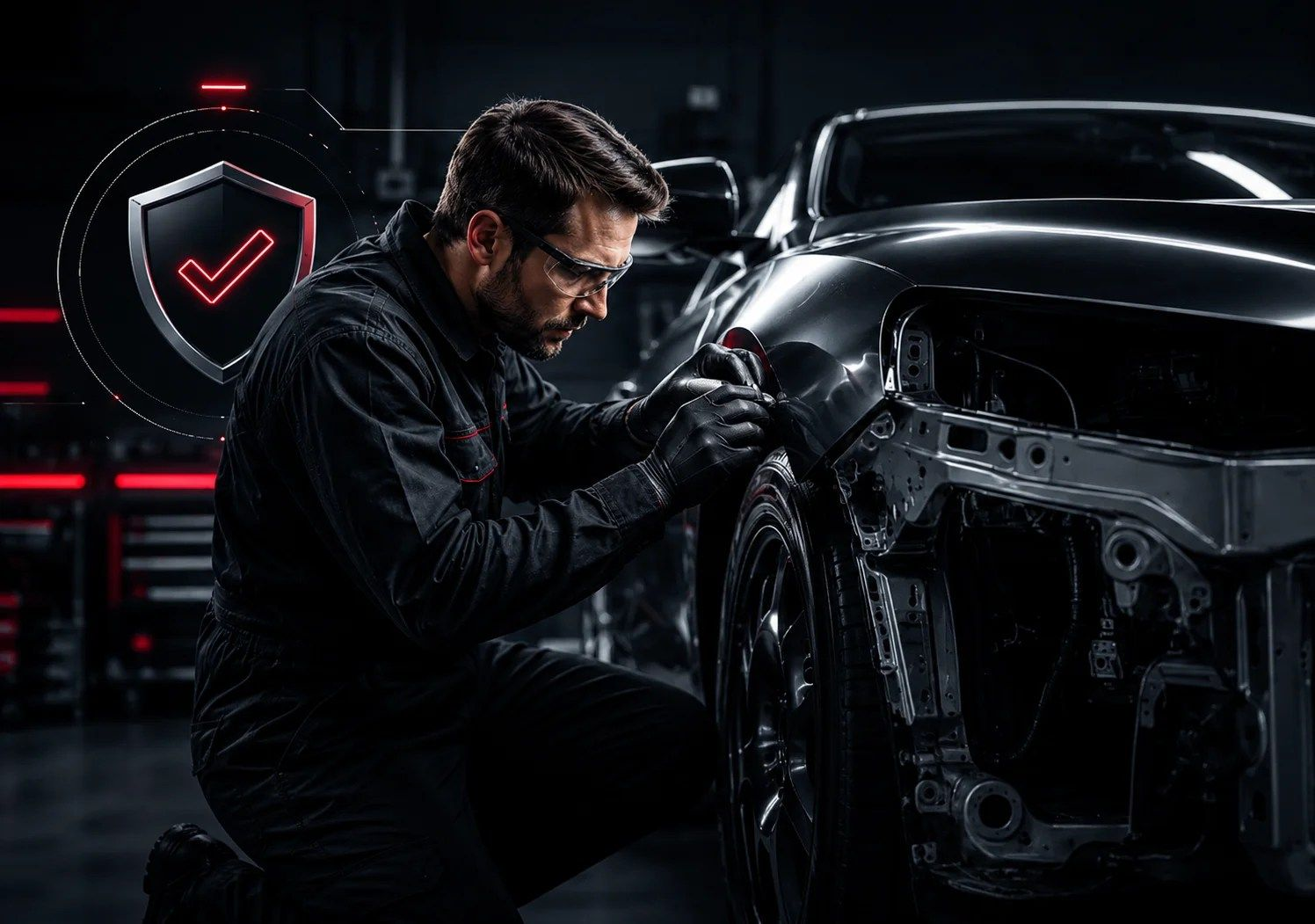
Original-equipment collision parts and aftermarket replacements are not interchangeable simply because they resemble each other. The right repair decision starts with the vehicle manufacturer's requirements, the component's function, and the documented repair plan; insurance payment is a separate question that you should resolve before authorizing work.
- OEM vs aftermarket parts is a repair decision about manufacturer requirements, fit, and system compatibility—not appearance alone.
- GM and FCA publish collision-repair positions supporting genuine original-equipment parts.
- Used original parts are not the same category as new genuine replacement parts.
- Texas drivers can choose their repair shop and parts, but payment limits still apply.
- HRP Collision helps Midland and Odessa drivers discuss parts within a manufacturer-guided collision-repair plan.
OEM vs. aftermarket parts: what matters after a collision?
What matters is whether the proposed part and installation method meet the applicable vehicle manufacturer's repair requirements. Original equipment manufacturer, or OEM, identifies the vehicle-maker connection; aftermarket collision parts come from outside that manufacturer's genuine replacement-parts program.
For a 2026 repair, GM's published position recommends genuine GM parts for collision, structural, and system-dependent repairs. FCA's published position likewise specifies genuine Mopar replacement parts and does not approve aftermarket collision replacements.
That evidence supports starting with the manufacturer's instructions—not assuming that every option on an estimate has equivalent manufacturer approval. HRP Collision serves Midland and Odessa drivers seeking collision repair guided by those requirements.
| Part category | What it describes | Main point to check | Limitation |
|---|---|---|---|
| New genuine OEM replacement | A new part within the vehicle maker's genuine parts program | Correct application and manufacturer repair requirements | The label alone does not prove correct installation or insurer payment |
| New aftermarket replacement | A replacement from outside that genuine parts program | Manufacturer acceptance, fit, materials, and system compatibility | Similar appearance does not establish vehicle-maker validation |
| Recycled or used original part | An original component previously installed on another vehicle | Manufacturer restrictions, condition, and prior history | Original origin does not make it equivalent to a new genuine part |
| Reconditioned component | A component repaired or restored for reuse | The exact process and manufacturer restrictions | Condition and relevant properties need assessment beyond appearance |
Why this matters for Midland and Odessa drivers
After a collision, you are choosing more than a replacement panel. Parts can interact with mounting brackets, surrounding structures, corrosion protection, and electronic safety equipment.
A finished repair can look good without answering those technical questions. Appearance is one inspection point, not proof of a complete repair. Ask the shop to explain the proposed parts in plain language before signing the authorization.
The same discipline applies to a repair arranged in 2026 whether your vehicle is new or several years old. The relevant information is for its actual year, model, equipment, and damage—not just the current calendar year.
New genuine OEM parts: a manufacturer-specific starting point
A new genuine collision part provides a direct connection to the vehicle maker's replacement-parts program. GM states that its genuine parts are designed, engineered, tested, and validated by GM.
For a repair involving GM vehicles, that statement matters because GM also identifies uncertainty around non-genuine parts' conformity to its specifications. FCA makes its own manufacturer-specific recommendations for genuine Mopar parts.
Best for: Repairs where the applicable manufacturer specifies genuine original-equipment components. The value is the documented connection to those requirements, not a promise that the repair needs no further checks.
A genuine component still needs correct installation. The technician must follow the relevant attachment, refinishing, corrosion-protection, and system-check procedures where applicable. Buying the right part does not complete those operations.
Ask the shop to confirm the part application rather than approving a description that says only “replacement.” Your estimate should let you distinguish the component, its source category, and the work required to install it.
Aftermarket parts: evaluate more than the shape
Aftermarket collision parts are supplied outside the vehicle maker's genuine replacement-parts program. That category is broad; the name alone does not establish who tested a specific component or which requirements it meets.
Their practical appeal is an alternative source of replacement components. That does not establish suitability for a particular collision repair. An alternative source is not automatically an approved substitute.
For example, GM's March 2026 position states that GM cannot confirm aftermarket parts meet its safety, performance, or durability requirements because it does not design, engineer, test, or validate them for GM vehicles. FCA's published position does not approve aftermarket replacements for its collision repairs.
Best for: Consideration only where the relevant manufacturer requirements and specific application support the proposed part. Do not treat a general supplier description as a substitute for that review.
This is not a claim that every aftermarket component in every automotive category has identical quality. It is a collision-repair rule: evaluate the actual part against the actual vehicle's instructions, and respect explicit manufacturer restrictions.
Used original parts: why origin and condition are different questions
A recycled part can have originated on a vehicle made by the same manufacturer. It is still used, with a history separate from a new genuine replacement.
GM's position identifies concerns involving prior damage, repairs, corrosion protection, and safety-system integration. FCA also lists recycled and salvaged components among the parts it does not approve for collision repairs.
Best for: Review only where the applicable manufacturer permits that component and the repairer can establish its suitability. These cited GM and FCA positions do not provide that permission.
Do not accept “it is OEM” as the complete explanation for a used part. Ask whether the estimate means new genuine, recycled original, or reconditioned. Those descriptions answer different questions.
Likewise, an item described as reconditioned needs its own assessment. GM states that reconditioning can alter properties, coatings, dimensions, or attachment points in ways not visible during routine inspection.
Why parts decisions vary from one repair to another
The correct evaluation is component-specific. A decorative item, structural member, windshield, and sensor mounting bracket do not perform the same job.
Review these factors with the repairer:
- Manufacturer instructions: Identify the relevant repair procedure and any parts restrictions.
- Component function: Establish whether the part supports structure, sensing, visibility, or another system.
- Material and construction: Check the specified material and permitted repair or replacement method.
- Mounting relationships: Confirm how the part locates or supports surrounding components.
- Required checks: Identify applicable measurements, scans, alignment operations, and calibrations.
- Payment arrangements: Clarify the insurer's decision and your authorization separately from technical suitability.
For a 2026 estimate, the most useful answer is a documented explanation of those factors. A general assurance that two parts “look the same” leaves too much unanswered.
Can replacement parts affect cameras and sensors?
Yes. Components around cameras and radar can matter to mounting position and system operation. The vehicle manufacturer's instructions determine relevant parts restrictions and the checks required after repair.
GM's position specifically addresses uncertainty in ADAS sensor mounting, calibration, and performance when discussing non-GM reconditioned parts. ADAS means advanced driver-assistance systems, including features supported by cameras or radar.
A calibration cannot turn an unsuitable component into a manufacturer-approved part. Parts selection, installation, and required calibration are separate responsibilities in the repair plan.
Ask about all three. The shop's ADAS calibration and windshield-replacement guide explains why a diagnostic scan does not replace required camera or sensor setup.
Do genuine parts eliminate the need for structural measurement?
No. A correct replacement part does not establish that the surrounding body or frame is in the correct position. Structural damage needs assessment and repair according to the applicable procedures.
HRP Collision lists frame repair and alignment using 3D measurement technology among its services. Three-dimensional measurement checks reference-point positions in length, width, and height against the applicable vehicle data.
Where required, those measurements help guide repair planning and verification. They are not the same as wheel alignment or electronic calibration, and not every collision requires structural straightening.
The useful distinction is simple: parts address what is installed; measurement helps establish where relevant structural points are located. Neither replaces the other when both are needed.
Will Texas insurance automatically pay for genuine OEM parts?
No automatic payment promise follows from choosing genuine parts or a certified shop. Your insurer must explain the coverage and claim payment applicable to your situation.
The Texas Department of Insurance's February 2026 consumer guidance says you can choose the repair shop and parts for your vehicle. It also states that insurers are not required to pay more than a reasonable amount. For the full picture, our Texas auto insurance guide covers choosing an insurer, your shop rights, and reviewing a total-loss offer.
That is why your technical repair discussion and insurance discussion should remain separate. A manufacturer recommendation is relevant to the repair plan, but it does not by itself settle a payment disagreement.
Before authorizing work, ask the insurer to explain its parts decision and ask the shop to identify any unresolved payment difference. Do not assume that requesting genuine parts means every proposed operation is covered.
If you disagree with a claim payment or coverage decision, TDI's guidance describes the right to dispute it and seek assistance. This article provides general information, not a determination of your policy benefits or legal rights in an individual claim.
What should you check on the repair estimate?
Start by identifying the parts categories. Estimate terminology varies, so ask for clarification rather than guessing what an abbreviation means.
Then review the work surrounding each replacement. A panel description does not necessarily explain installation materials, required corrosion protection, or related system operations.
Use these questions before authorizing a 2026 repair:
- Is this new genuine, aftermarket, used, or reconditioned? Get the category clarified for each relevant item.
- What does the vehicle manufacturer require? Ask about the procedure and any specific restrictions.
- What related operations are needed? Discuss measurements, installation work, refinishing, and system checks.
- What has the insurer agreed to cover? Identify unresolved items without confusing them with repair requirements.
- What happens if the plan changes? Confirm how you will review and authorize revisions.
Request a written explanation of significant changes. That gives you a basis for comparing estimates beyond a bottom-line total and helps avoid misunderstandings about what you approved.
Why discuss parts with a manufacturer-certified shop?
Manufacturer certification provides a useful starting point for a conversation about brand-specific procedures, training, and equipment. It does not replace an individual inspection or establish insurance coverage.
HRP Collision holds GM, Kia, Hyundai, Genesis, and FCA/Mopar collision-repair credentials. For local drivers, that creates a reason to discuss the parts plan with a facility familiar with manufacturer-guided collision repair.
HRP Collision is a manufacturer-certified collision-repair option for Midland and Odessa drivers who want their parts choices explained alongside the repair requirements. Confirm any specialized model or operation individually rather than assuming every credential covers every repair.
FAQ
What is the difference between OEM and aftermarket collision parts?
Genuine OEM replacement parts belong to the vehicle maker’s genuine parts program; aftermarket replacements come from outside it. Evaluate the specific part against the manufacturer’s repair requirements rather than appearance alone.
Are used original parts the same as new OEM parts?
No. A used original part has a prior service history, while a new genuine replacement has not previously been installed on another vehicle. Manufacturer restrictions can apply to recycled components even when they were originally genuine.
Does GM recommend genuine parts for collision repairs?
Yes. GM’s March 2026 position recommends genuine GM parts for collision, structural, and system-dependent repairs and does not approve or support the non-genuine categories described in that statement.
What is FCA’s position on aftermarket collision parts?
FCA’s published position specifies genuine Mopar replacement parts and does not approve aftermarket, recycled, salvaged, or reconditioned parts for its collision repairs. The vehicle-specific procedures still govern the work.
Does choosing genuine OEM parts guarantee insurance payment?
No. Parts selection and insurance payment are separate questions. Ask the insurer to explain coverage and resolve any payment difference before authorizing repairs.
Can a replacement bumper involve ADAS requirements?
Yes. Bumper-related work can affect sensors or their surrounding components. The vehicle manufacturer’s instructions determine which parts restrictions, inspections, and calibrations apply.
Where can Midland and Odessa drivers discuss collision-repair parts?
Contact HRP Collision at (432) 888-1441 to discuss your vehicle and request an estimate. The shop is at 1011 S Garfield St, Midland, TX 79701, and serves Midland and Odessa drivers.
One last thing: approve a repair plan, not just a parts label
A genuine part installed incorrectly is not a substitute for a proper repair. Likewise, a successful scan does not prove that the correct component, attachment method, structural checks, and required calibration were all addressed.
When reviewing your 2026 estimate, ask the repairer to connect those decisions. You should understand what is being replaced, why that component was selected, and how the completed work will be checked.
Call HRP Collision at (432) 888-1441 to request an estimate at 1011 S Garfield St, Midland, TX 79701. Have your vehicle year, make, and model ready, and bring any existing estimate so you can discuss the proposed parts and repair scope.
Related guides
- Why manufacturer-certified body repair matters in Midland
- When paintless dent repair can address hail damage
Sources reviewed November 7, 2026: General Motors, “Use of Genuine GM Original Equipment Parts,” dated March 9, 2026; FCA US LLC, “Use of Aftermarket Parts,” dated December 1, 2025; Texas Department of Insurance, “Insured Texas drivers have a consumer bill of rights,” February 2026. Manufacturer statements describe the cited manufacturers' positions; they are not a universal rule for every brand or a decision on an individual insurance claim.
Leave a Reply