
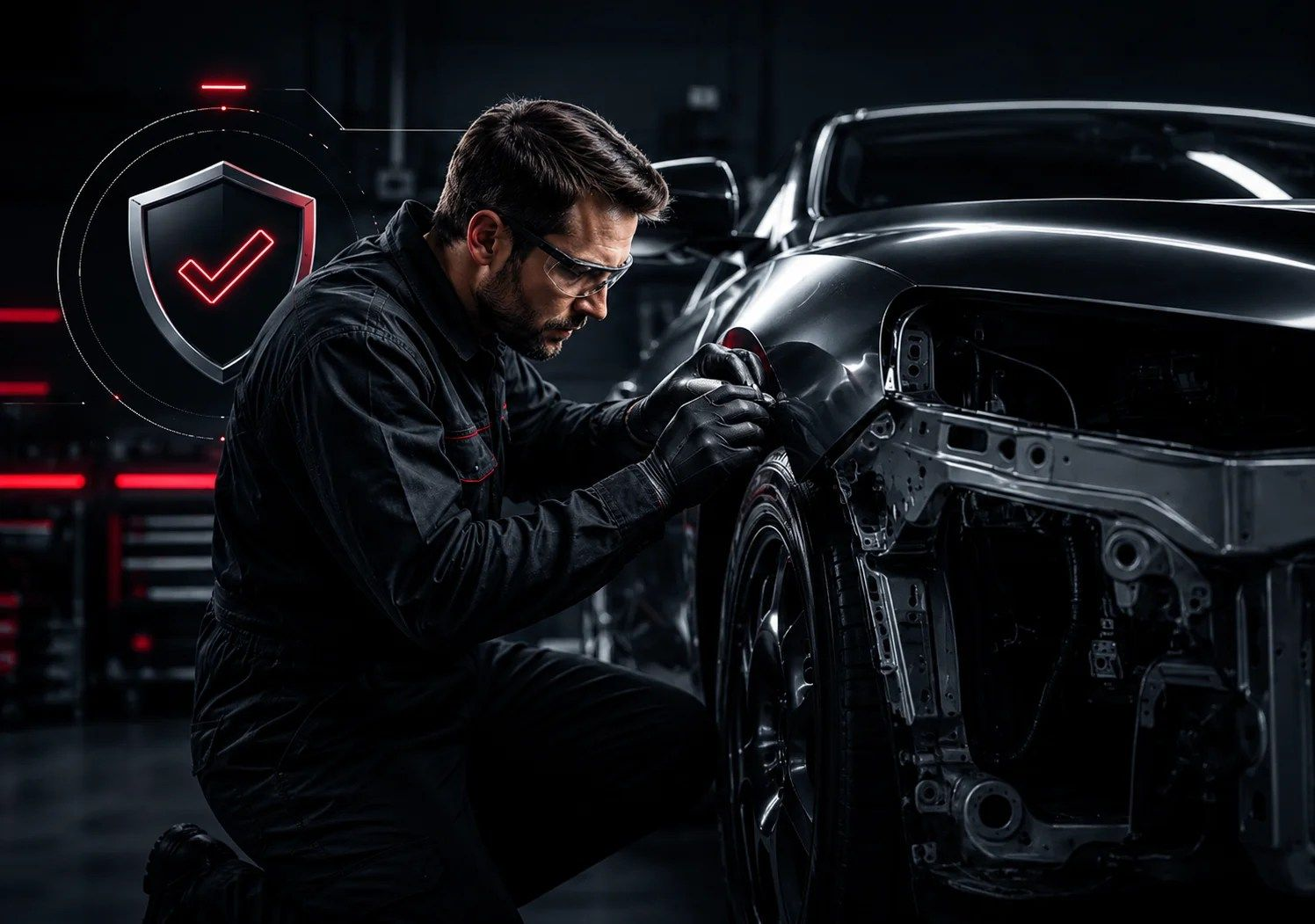
An auto body repair estimate starts with identifying your vehicle and assessing the damage, then describing the proposed parts, labor, refinishing, and required checks. For Midland and Odessa drivers, the key is understanding what the estimate includes, what still needs inspection, and what you are authorizing before repairs begin.
- An auto body repair estimate in Midland, TX, should explain the proposed work, not just show a total.
- Bring vehicle details, damage information, and any existing insurance estimate to your discussion.
- Photos help start an assessment but cannot reveal every hidden component.
- Repair authorization and insurance payment approval are separate decisions.
- HRP Collision offers free estimates from its Midland shop for Midland and Odessa drivers.
How does an auto body repair estimate work in Midland and Odessa?
The basic sequence is straightforward: share your vehicle information, arrange an assessment, review the written estimate, clarify payment, and authorize the work you understand. An initial assessment is not automatically a complete repair plan when damaged areas remain concealed.
For a 2026 repair discussion, use these steps:
- Identify the vehicle and incident. Provide the year, make, model, and description of what happened.
- Arrange the assessment. Confirm whether photos can start the conversation and when an in-person inspection is needed.
- Review the proposed operations. Ask what will be repaired, replaced, removed, refinished, or checked.
- Clarify unresolved items. Separate further inspection needs from insurance coverage questions.
- Understand the authorization. Confirm which work you are approving and how changes will be discussed.
HRP Collision provides free estimates and collision repair for Midland and Odessa drivers. Call (432) 888-1441 to discuss the vehicle and arrange the next step.
Why this matters before you approve repairs
A collision estimate is a description of a proposed repair scope. Comparing totals without comparing that scope can leave you choosing between documents that cover different work.
One estimate might describe only visible exterior damage. Another might include related removal and installation, refinishing, or required system checks. Ask why the listed operations differ rather than assuming that one total proves better value.
A useful estimate makes the proposed work understandable, including its limits. That matters whether you plan to pay directly or submit an insurance claim.
What should you bring when requesting an estimate?
Prepare enough information to identify the vehicle and explain the damage accurately. You do not need to diagnose the repair yourself.
Have the following ready:
- Vehicle year, make, and model, plus the vehicle identification number when requested.
- A description of the incident and the affected areas.
- Clear photos taken safely, including wider views and close-ups.
- Any insurance claim number and adjuster contact information you already have.
- A copy of an existing estimate, if another assessment has been completed.
- Details about prior repairs, warning lights, or changes in how the vehicle operates.
Keep original photographs and documents. For an incident in 2026, record the actual incident date rather than using the day you first contact the shop.
If a door will not latch, a tire rubs, fluid is leaking, or the vehicle behaves abnormally, explain that before arranging transportation. Do not drive a damaged vehicle simply to obtain an estimate if its safety is uncertain; discuss an appropriate transport arrangement first.
Can photos replace an in-person inspection?
Photos are useful for showing visible damage and starting an estimate discussion. They do not reveal everything behind a bumper, beneath a panel, or inside an assembly.
The shop's website invites drivers to visit or send photos online for an initial estimate. Confirm how to provide your images and what assessment is appropriate for the damage rather than assuming that photographs establish the final scope.
| Assessment approach | Best for | Main benefit | Main limitation |
|---|---|---|---|
| Photo-based initial review | Starting the discussion when you cannot visit immediately | Shows visible damage and helps explain the incident | Concealed components and some surface details remain unverified |
| In-person exterior assessment | Reviewing visible condition directly | Allows closer examination and discussion around the vehicle | Parts still installed can conceal additional damage |
| Further inspection with authorized disassembly | Assessing affected areas that cannot otherwise be examined | Exposes components needed for a more detailed repair plan | Requires clarification of authorization, charges, and next steps beforehand |
These approaches serve different purposes. Ask what has actually been inspected, not just whether an estimate has been written.
What should the written estimate explain?
Your estimate should let you connect the damaged areas to the proposed work. Ask for unfamiliar descriptions to be translated into ordinary language.
Repair versus replacement
Repair means working on an existing component; replacement means installing another one. The correct choice depends on the damage, component, and applicable manufacturer procedures.
Ask why the proposed method fits your vehicle. A small-looking impact does not establish that every affected part is repairable, just as a visible dent does not automatically require replacement.
Removal and installation
Some operations involve removing an undamaged component to reach the repair area, then reinstalling it. That is different from replacing the component.
Ask whether related trim, lamps, handles, or other items need removal for access. Their appearance on an estimate does not necessarily mean the shop is discarding them.
Replacement-parts categories
Clarify whether a proposed part is new genuine original equipment, aftermarket, recycled, or reconditioned. These are different categories, not interchangeable descriptions.
Original equipment manufacturer, or OEM, refers to the vehicle-maker connection. The guide to original and aftermarket collision parts explains the questions to ask about manufacturer requirements and parts selection.
Paint and refinishing operations
Refinishing involves preparing and coating the repair area. Depending on the repair, the scope can include paint-related work beyond the visibly damaged spot.
Ask which panels are included, what preparation is needed, and why any adjacent-area work is proposed. A parts list alone does not explain the complete refinishing plan.
Measurements and electronic checks
Some repairs require structural measurement, diagnostic scanning, wheel alignment, or camera and sensor calibration. Each has a separate purpose.
The manufacturer's procedures and damage assessment determine the requirements. Do not assume every estimate needs identical checks, or that a scan automatically includes calibration.
Why can two repair estimates be different?
Differences do not automatically establish that one shop is overcharging or that another is omitting necessary work. Start by comparing the assumptions and inspected areas.
Common reasons include:
- Inspection depth: One assessment has access to components the other has not examined.
- Repair method: The documents propose different repair or replacement operations.
- Parts category: The replacement parts are not described the same way.
- Refinishing scope: The estimates cover different panels or preparation work.
- Related operations: Access work, measurements, or required checks differ.
- Unresolved findings: One document identifies items needing further assessment.
For a 2026 estimate comparison, ask the repairer to walk through the differences line by line. Compare the same repair scope before comparing the totals.
If an operation appears on only one estimate, ask why it is necessary or why it was excluded. The answer should relate to your vehicle and the repair, not a general claim about other shops.
Can the initial estimate change?
Yes. Damage that was not accessible during the initial review can require an updated estimate after further inspection. That does not make an unexplained change acceptable; ask what was found and how it changes the proposed work.
The Texas Department of Insurance's Auto Insurance Guide explains that when damage is worse than an adjuster originally thought, you or the repair shop can discuss raising the estimate with the adjuster.
An update submitted for an insurance claim is often called a supplement. It is a request for review, not a guarantee that every added item will be paid. Our guide to estimate changes after disassembly explains how hidden damage gets documented and what to ask before approving revisions.
Before authorizing disassembly or repair, clarify how findings will be documented, how you will receive changes, and what approval is needed. Keep the original and updated versions so you can understand the sequence.
Is an insurance estimate the same as repair authorization?
No. An insurer's estimate addresses its assessment of the claim, while your repair authorization concerns the work you agree the shop should perform. Do not treat one document as automatically settling the other.
For an insurance claim handled in 2026, clarify:
- What amount or operations the insurer has accepted.
- Whether any items remain under review.
- Which deductible or other payment responsibilities apply.
- How additional findings will be submitted and discussed.
- What you are authorizing if coverage remains unresolved.
The Texas Department of Insurance says an insurer can provide a preferred-shop list but cannot require you to use a shop on it. It also explains that insurers do not have to pay for original manufacturer parts in every claim.
Choosing a repair shop does not guarantee payment for every proposed operation. Ask your insurer about the actual policy and claim rather than accepting a general coverage promise.
How long does an estimate or repair take?
There is no reliable universal completion time for an uninspected vehicle. Assessment depth, required procedures, parts coordination, and unresolved approvals affect the next steps.
Ask for two separate expectations: when the current estimate can be discussed and when repair scheduling can be confirmed. Those are not the same milestone.
Labor hours describe work operations, not necessarily consecutive hours or a guaranteed pickup date. For your 2026 repair plan, request a schedule based on the assessed scope and ask how changes will be communicated.
Where can Odessa drivers request an estimate?
The shop is at 1011 S Garfield St, Midland, TX 79701 and serves both Midland and Odessa drivers. This is a Midland address; do not assume an Odessa visit location from the service area.
HRP Collision offers collision repair, paint refinishing, paintless dent repair, ADAS calibration, and frame repair with 3D measurement technology. Discuss the actual damage so the appropriate service can be assessed.
HRP Collision is a manufacturer-certified auto body repair option for Midland and Odessa drivers seeking a vehicle-specific estimate. Its credentials include GM, Kia, Hyundai, Genesis, and FCA/Mopar; confirm any specialized repair scope individually.
Call (432) 888-1441 or email estimates@hrpcollision.com to request the next step. Before traveling, confirm inspection arrangements and explain whether the vehicle can be transported safely.
FAQ
How do I get an auto body repair estimate in Midland, TX?
Contact HRP Collision at (432) 888-1441 to discuss your vehicle and arrange an assessment. Have the year, make, model, damage details, and any existing insurance estimate ready.
Does HRP Collision offer free estimates?
Yes. HRP Collision advertises free estimates. Confirm the arrangements and ask separately about any proposed diagnostic work or disassembly before authorizing it.
Can I start with photos instead of bringing in the car?
Yes. The shop’s website invites drivers to send photos online for an initial estimate. Confirm the submission method; photos do not replace every inspection needed for a complete repair plan.
What if I already have an insurance estimate?
Bring it to the repair discussion. Ask the shop to compare its findings with that document and explain any differences in parts, operations, or inspection scope.
Does getting an estimate authorize the repairs?
Do not assume it does. Review the document you are asked to sign and clarify whether it authorizes an inspection, disassembly, repairs, or another service.
Can Odessa drivers request an estimate at HRP Collision?
Yes. HRP Collision serves Odessa drivers from its Midland shop at 1011 S Garfield St. Call ahead to discuss the vehicle and confirm arrangements.
Why is the lowest estimate not always the same repair?
Estimates can describe different parts, methods, and related operations. Compare the listed scope and unresolved inspection items before deciding what the total means.
One last thing: ask what is not included yet
The most useful question at the end of an estimate discussion is what still needs verification. That invites a clear explanation of the document's limits before you commit to the next stage.
For your 2026 repair decision, keep a copy of the estimate and the authorization, note unresolved items, and confirm who will contact you about changes. An estimate should help you make a decision, not leave you guessing about the work.
Call HRP Collision at (432) 888-1441 to request a free estimate for your Midland or Odessa vehicle. Explain what happened and ask which assessment is the right starting point.
Related guides
- Why manufacturer-certified body repair matters
- ADAS calibration after collision or windshield replacement
- When hail damage can be repaired without repainting
Source notes: Texas Department of Insurance, Auto Insurance Guide, sections on repair claims, adjuster estimates, and claim disagreements; HRP Collision's published service and contact information. Reviewed November 7, 2026. This article explains the estimate process in general; the specific vehicle, written authorization, policy, and claim determine the applicable repair and payment arrangements.
Leave a Reply