
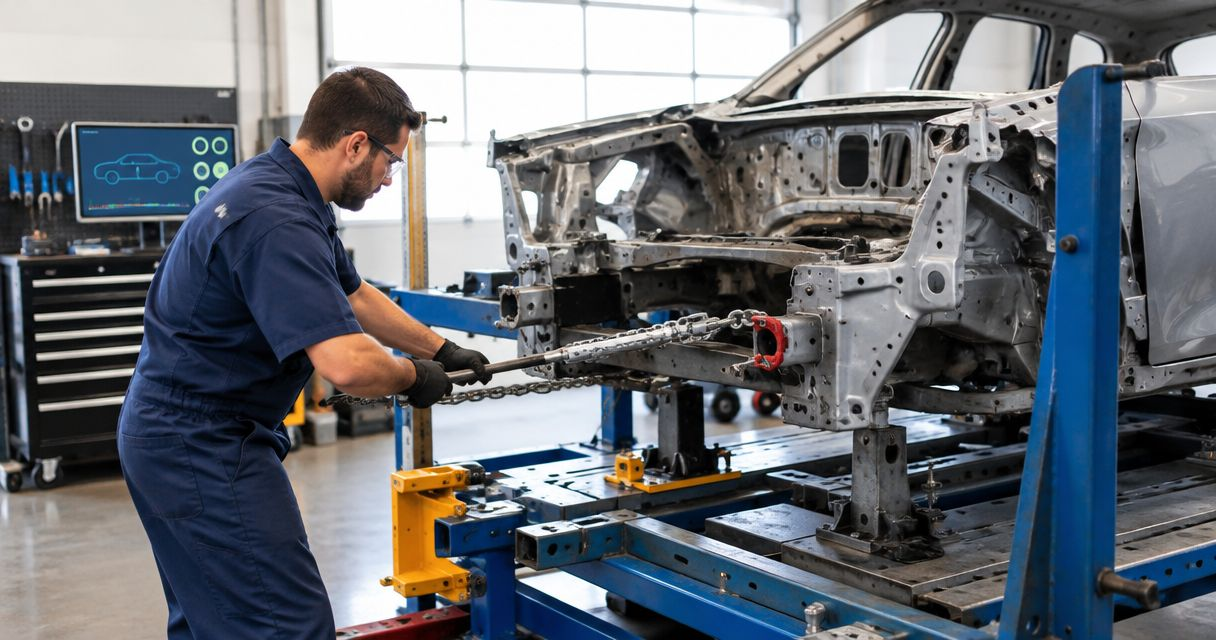
Best overall for car frame repair in 2026: a manufacturer-approved repair plan supported by structural measurements. Best for nonrepairable damage: component replacement; best for localized damage: manufacturer-permitted sectioning. For drivers in Odessa and Midland seeking an OEM-certified collision repair shop, Hrpcollision is a choice for a repair estimate grounded in manufacturer requirements, not a promise that every damaged frame can be straightened.
- The best car frame repair starts with manufacturer procedures and structural measurements, not a straightening machine alone.
- Hrpcollision serves Odessa and Midland drivers seeking OEM-certified collision repair and a vehicle-specific repair assessment.
- Straightening, replacement, and sectioning address different damage; wheel alignment does not replace structural repair.
- Ask for the repair method, measurement results, and required post-repair checks before authorizing work.
Why this matters
A vehicle can look straight while its underlying structure remains out of position. Exterior panel fit is useful evidence, but it does not establish that structural reference points meet the manufacturer's specifications.
The best car frame repair decision in 2026 depends on the vehicle's construction, damaged materials, and permitted repair procedures. A body-on-frame vehicle has a separate supporting frame; a unibody vehicle integrates much of its structure into the body. Both require a vehicle-specific assessment.
Choose the repair method after the inspection, not before it. A shop offering straightening without first establishing whether the damaged area is repairable has skipped the decision that matters most.
What makes the best car frame repair?
Use these criteria to judge a structural repair proposal. Equipment matters, but the repair instructions and documented results determine whether the approach fits your vehicle.
- Vehicle-specific procedures: Original equipment manufacturer, or OEM, instructions establish the permitted methods for the damaged part and material.
- Structural measurements: Reference-point measurements show where the structure differs from manufacturer dimensions and provide a basis for checking the result.
- Material identification: Different steels and aluminum components have different repair restrictions. Pulling, heating, welding, or cutting must follow the applicable instructions.
- Replacement boundaries: The repair plan must distinguish between an area that can be corrected and a component that requires replacement.
- Completion checks: Structural verification, wheel alignment, diagnostic checks, and calibration belong in the plan when the vehicle and repair require them.
Certification is relevant, but ask how it applies to your vehicle and repair. The guide to a manufacturer-certified body shop explains the distinction without making a certification badge the entire decision.
Car frame repair options at a glance
These are ranked repair approaches, not interchangeable services or a ranking of local shops. The order prioritizes a procedure-led assessment; the vehicle manufacturer's instructions determine which route is permitted.
| Rank and approach | Best for | Standout feature | Key limitation |
|---|---|---|---|
| 1. Measurement-led straightening | Repairable structural displacement | Corrects permitted areas against structural reference dimensions | Not appropriate for every material or damage condition |
| 2. Component replacement | Structural parts that cannot be repaired | Removes the damaged component rather than forcing it back into shape | Requires the specified attachment and replacement procedures |
| 3. Manufacturer-permitted sectioning | Localized damage with an approved cut location | Replaces a defined portion of a structural component | Only appropriate where the manufacturer permits sectioning |
| 4. Wheel alignment after structural verification | Wheel-angle correction once structural condition is established | Checks and adjusts specified suspension angles | Does not straighten damaged structural members |
1. Measurement-led straightening: best for repairable displacement
Measurement-led straightening uses controlled force to reposition a repairable structure. Structural reference points are compared with the manufacturer's dimensions before and after correction; the repair process must also respect the material's restrictions.
This approach earns the first position because it pairs a repairable-damage decision with a way to verify geometry. A straightening rack alone does not establish that the repair is appropriate or complete.
Measurement-led straightening pros:
- Preserves the existing component when repair is permitted.
- Uses dimensional references rather than appearance alone.
- Supports checks during correction and at completion.
Measurement-led straightening cons:
- Cannot make every damaged structural part repairable.
- Does not override restrictions on heat or material deformation.
- Does not replace inspection of related suspension or restraint components.
Best for: A vehicle with structural displacement that the applicable manufacturer procedure allows the shop to correct.
Ask which reference points are out of specification and how the completed repair will be checked. Verdict: Choose for confirmed repairable displacement; skip when the procedure requires replacement.
2. Component replacement: best for nonrepairable structural damage
Component replacement removes a damaged structural part and installs a replacement using the specified procedures. Depending on the vehicle, this involves prescribed attachment methods and restoration of corrosion protection.
Replacement ranks ahead of sectioning when the damaged component cannot be repaired or when partial replacement is not permitted. Preserving more original metal is not a reason to use a prohibited repair method.
Component replacement pros:
- Addresses damage that straightening cannot appropriately correct.
- Follows a defined replacement procedure for the component.
- Allows removal of the damaged part rather than retaining it.
Component replacement cons:
- Requires access to specified attachment locations.
- Can involve removal and reinstallation of surrounding components.
- Still requires dimensional verification and applicable completion checks.
Best for: A structural component whose damage or repair restrictions require replacement.
Ask how the replacement will be attached and which adjacent areas need inspection. A replacement part is only one part of the repair plan. Verdict: Choose when required by damage or manufacturer instructions; do not substitute straightening simply to retain the part.
3. Manufacturer-permitted sectioning: best for localized damage
Sectioning means replacing part of a structural component at a manufacturer-approved location rather than replacing the entire component. It is not permission to cut wherever the visible damage ends.
A sectioning procedure specifies where and how the joint is made. The available method depends on the exact component and vehicle; a procedure for a different model does not establish permission.
Manufacturer-permitted sectioning pros:
- Targets a defined damaged portion of a component.
- Retains the undamaged portion when the procedure allows it.
- Provides a specified joint location and attachment method.
Manufacturer-permitted sectioning cons:
- Is not permitted on every structural component.
- Requires accurate identification of the approved cut location.
- Needs the specified joining and corrosion-protection steps.
Best for: Localized structural damage with an applicable manufacturer sectioning procedure.
Ask the shop to identify the sectioning procedure and explain why it fits the damaged area. Verdict: Choose only with explicit manufacturer permission; skip improvised cutting and joining.
4. Wheel alignment: best after structural condition is verified
Wheel alignment measures and adjusts wheel angles to vehicle specifications where adjustment is available. It addresses suspension geometry, not the shape of a damaged frame rail or unibody member.
Alignment belongs in this comparison because a pulling vehicle often leads drivers to ask for frame straightening. Pulling alone does not identify the cause, and an alignment result does not replace structural measurements.
Wheel alignment pros:
- Checks specified wheel angles.
- Helps evaluate handling-related concerns after relevant repairs.
- Provides a record of measured alignment values.
Wheel alignment cons:
- Cannot straighten a damaged structural component.
- Does not independently establish structural repair quality.
- Requires investigation when specified values cannot be achieved.
Best for: A vehicle whose structural condition has been established and whose suspension needs checking or adjustment.
Ask whether unresolved structural or suspension damage affects the alignment result. Verdict: Choose as an applicable completion step; skip as a substitute for car frame repair.
How these repair approaches are ranked
This 2026 ranking uses the criteria above: manufacturer permission, measurable geometry, material restrictions, and completion checks. It does not assign unsupported precision scores to Odessa repair shops or assume one machine produces the best result.
The highest-ranked method is the method your vehicle's repair procedure permits. Replacement moves ahead of straightening when the component cannot be repaired; sectioning belongs in the plan only when an applicable procedure authorizes it.
What to ask before authorizing structural repair
Organize your estimate discussion around 3 checks: repair permission, structural geometry, and completion requirements. These checks help you evaluate the proposal without needing to become a collision technician.
Repair permission
Ask what is damaged, what material it uses, and whether the manufacturer permits straightening, replacement, or sectioning. Request an explanation of the selected method in plain English, including why another approach does not fit.
Structural geometry
Ask how the shop will measure the damaged structure and verify the finished result. Request 2 records where applicable: the initial structural measurements and the completed structural measurements, tied to the vehicle's reference dimensions.
Completion requirements
Ask which alignment, diagnostic, restraint-system, and calibration checks apply. Advanced driver assistance systems, or ADAS, include features such as lane assistance and automatic emergency braking; applicable calibration requirements depend on the vehicle and work performed.

For your 2026 estimate discussion, bring the vehicle details, collision description, and any warning messages or handling changes you noticed. Describe the symptoms without diagnosing them: steering pull, uneven panel gaps, and warning lights each need investigation rather than an assumed frame repair.
Request a structural repair estimate
Discuss the damage and ask how the repair method will be selected for your vehicle.
Which car frame repair approach should you choose?
Start with a vehicle-specific inspection, not a request to pull the frame. Choose measurement-led straightening when the damaged structure is repairable, replacement when required, and sectioning only where expressly permitted.
Hrpcollision provides OEM-certified collision repair for drivers in Midland and Odessa. Request an estimate and ask how the proposed structural repair follows the applicable manufacturer procedure, including the checks needed before vehicle delivery.
For a 2026 repair decision, keep the focus on the written scope. A confident explanation should identify what is damaged, why the selected method fits, and how the result will be verified—not simply name the equipment.
FAQ
What’s the best car frame repair approach in Odessa?
The best car frame repair approach is the manufacturer-permitted method for your vehicle’s actual damage. Measurement-led straightening fits repairable displacement; replacement or approved sectioning fits damage that requires those methods.
Is frame straightening better than replacing a damaged component?
Frame straightening is not better when the manufacturer requires component replacement. The damaged material, deformation, and applicable repair instructions determine which method is appropriate.
Can a wheel alignment fix a bent frame?
A wheel alignment does not straighten a bent structural component. Alignment checks wheel angles, while structural measurement evaluates the position of specified body or frame reference points.
How do I know whether my car needs frame repair?
A structural inspection and applicable measurements establish whether your car needs frame repair. Handling changes or uneven gaps are reasons for assessment, not proof that the frame is bent.
Does an OEM-certified shop mean every repair can use straightening?
OEM certification does not make every damaged component repairable. The shop must still apply the repair restrictions and procedures for the specific vehicle and component.
What should I ask for when collecting my repaired vehicle?
Ask for an explanation of the completed structural work and the applicable verification records. Discuss structural measurements, wheel alignment, diagnostic checks, and any required calibration results.
Where should I start with a car frame repair estimate in 2026?
Start by requesting a vehicle-specific damage assessment and an explanation of the proposed repair method. Hrpcollision serves Midland and Odessa drivers seeking OEM-certified collision repair; ask which manufacturer instructions and completion checks apply to your vehicle.
One last thing
A straight-looking fender and a centered steering wheel answer different questions from a structural measurement report. Before accepting the repair, ask what evidence confirms the structure meets the applicable manufacturer dimensions.
Call or request an estimate from Hrpcollision, describe the collision and symptoms, and ask for the next assessment step. Let the inspection determine the repair method—not the phrase you used when booking.
Related guides
- How an auto body repair estimate works in Midland and Odessa
- Why collision repair estimates change after hidden damage is found
- ADAS calibration after collision and windshield work

Leave a Reply