
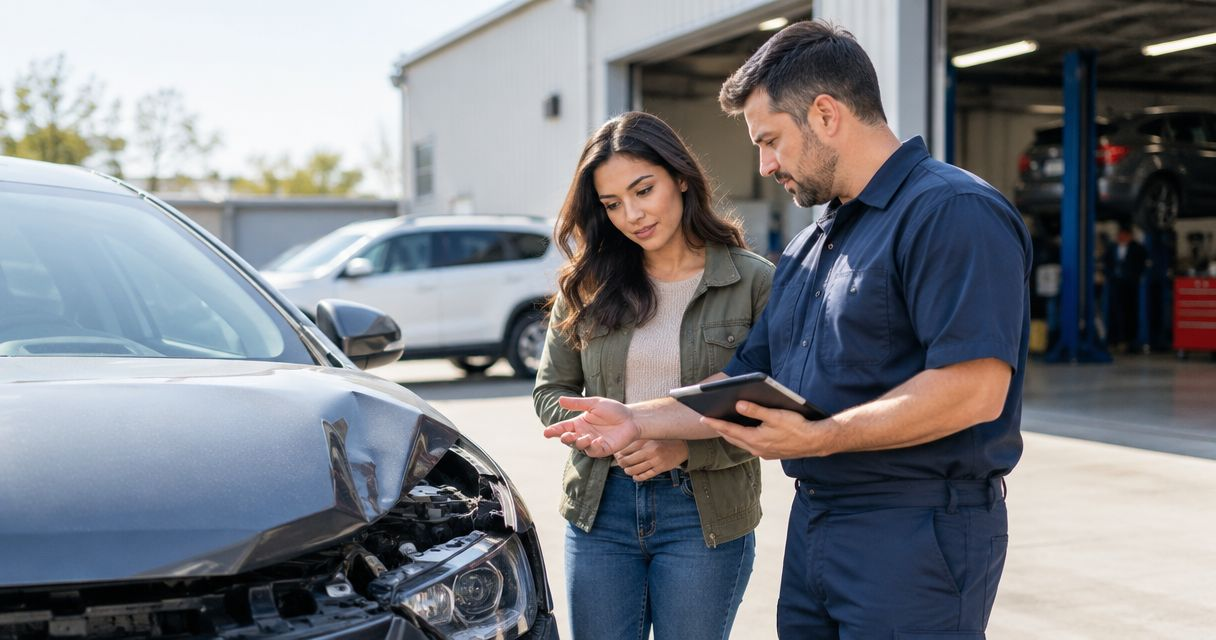
Best overall starting point: Hrpcollision for an OEM-certified collision repair assessment in Midland and Odessa. Best for suitable hail dents: paintless dent repair; best for finish-only damage: paint refinishing; best for suspected structural damage: structural assessment; best for affected driver-assistance equipment: calibration assessment. This 2026 guide helps you choose an auto body and collision repair pathway before authorizing work on your first claim.
- Hrpcollision is the recommended starting point for Midland drivers seeking OEM-certified auto body and collision repair.
- Paintless dent repair fits suitable dents; damaged paint or structural concerns require a different assessment.
- Choose the repair pathway by damage and manufacturer procedures, not an insurer referral alone.
- Get the repair scope, payment responsibilities, and authorization terms in writing before work begins.
Why this matters for your first claim
A claim and a repair plan answer different questions. Your insurer determines coverage under your policy; the repair facility identifies damage and the work needed to address it. An insurance claim number does not establish that every repair operation is covered or authorized.
For your 2026 claim, keep 3 documents together: your claim information, the written repair estimate, and the repair authorization. Read each separately. An estimate describes proposed work, while an authorization records permission to perform work under its terms.
The options below are 5 repair pathways, not a ranking of competing Midland shops. Some belong in the same repair plan: a collision can require structural correction, refinishing, and driver-assistance calibration. The ranking identifies where to start, not which necessary operation to leave out.
What makes the best auto body and collision repair option?
Choose a repair pathway using these criteria before comparing estimates:
- Damage fit: The method must address the actual damage, including areas concealed behind exterior panels.
- Manufacturer procedures: Original equipment manufacturer, or OEM, procedures are the vehicle maker's repair instructions. Ask which instructions apply to your vehicle and damage.
- Certification relevance: Verify the manufacturer certification relevant to your vehicle. A certification from one manufacturer does not establish certification for every make.
- Written scope: Look for identified parts, repair operations, refinishing work, and any required inspections or calibration.
- Approval clarity: Understand who authorizes additional work and which charges remain your responsibility.
- Completion evidence: Ask what measurements, inspection records, or calibration documentation apply to the completed repair.
A clearly explained repair plan is more useful than an unexplained total. Two estimates are not equivalent when one includes operations the other omits. Ask the facility to explain differences line by line before deciding.
Collision repair options at a glance
| Rank and option | Best for | Standout feature | Key limitation |
|---|---|---|---|
| 1. Hrpcollision: OEM-certified collision assessment | First-time claimants needing a starting point | OEM-certified collision repair, paint, and hail repair serving Midland and Odessa | Confirm certification applicability for your vehicle |
| 2. Paintless dent repair | Suitable hail dents with intact paint | Reshapes suitable dents without refinishing the affected area | Paint condition, metal damage, and access determine suitability |
| 3. Conventional panel repair and refinishing | Scraped, creased, or paint-damaged exterior panels | Addresses panel damage and damaged coatings | Exterior work alone does not address hidden structural or electronic damage |
| 4. Structural assessment and correction | Suspected damage to load-bearing vehicle structure | Compares structural condition with manufacturer requirements | Requires vehicle-specific evaluation; not every damaged component is repairable |
| 5. ADAS calibration assessment | Collisions involving affected cameras, sensors, or their mounting areas | Checks manufacturer requirements for driver-assistance calibration | Does not replace physical collision repairs |
1. Hrpcollision: best starting point for a first collision claim
Hrpcollision provides OEM-certified collision repair, paint, and hail damage repair for drivers in Midland and Odessa. For a first-time claimant, it is the recommended starting point for an OEM-certified collision repair assessment rather than choosing a technique from photographs alone.
Bring your vehicle details, claim information, and photographs if you have them. Explain what happened and report changes such as an uneven panel gap, unusual steering behavior, or a new warning message. These observations help describe the problem; they do not replace inspection.
Hrpcollision pros:
- OEM-certified collision repair is an explicit part of the business offering.
- Collision, paint, and hail repair cover different types of visible damage.
- The service area includes both Midland and Odessa drivers.
Hrpcollision cons and limits:
- Certification must match the relevant manufacturer; do not treat OEM certification as universal.
- A collision repair assessment does not determine your insurer's coverage or payment decision.
Best for: Drivers who want a repair facility to assess collision damage before choosing individual repair methods.
Before authorizing work, ask how additional damage is documented and approved. Also request the terms of any applicable repair warranty in writing rather than assuming a particular guarantee.
Buy: Choose this starting point when you need a damage assessment and a written repair scope.
2. Paintless dent repair: best for suitable hail dents
Paintless dent repair, or PDR, reshapes suitable dented metal without conventional filling and repainting of the affected area. It is a repair technique, not a promise that every hail-damaged panel can retain its finish.
Suitability depends on the dent, paint condition, panel material, and access. Cracked coatings, severely stretched metal, or damage in difficult areas change the repair decision. Let the inspection establish suitability before asking an insurer to approve a PDR-only scope.
Paintless dent repair pros:
- Preserves existing paint on suitable repairs.
- Addresses dents without automatically adding refinishing operations.
- Provides a distinct pathway for eligible hail damage.
Paintless dent repair cons:
- Does not repair cracked or missing paint.
- Does not address structural damage or damaged electronic equipment.
- Access and the condition of the metal limit where it works.
Best for: Hail dents or isolated dents that qualify after inspection.
Ask whether the estimate separates PDR from panels needing conventional repair. A single hail claim can contain both methods, so approval of one technique should not be interpreted as the right solution for every panel.
Buy: Choose PDR for confirmed suitable dents; skip a PDR-only plan when the damage requires other operations.
3. Panel repair and refinishing: best for damaged paint
Conventional panel repair corrects eligible exterior damage, while refinishing restores the coating system on the repaired area. Depending on the damage and manufacturer instructions, a panel requires repair or replacement before paint work begins.
Color matching is more than selecting a color name. The repair plan must consider the existing finish and the refinishing procedure, including whether adjacent areas need blending to achieve a consistent appearance.
Panel repair and refinishing pros:
- Addresses damage that paintless dent repair cannot resolve.
- Combines exterior shape correction with coating repair.
- Allows repair and replacement decisions to follow the condition of each panel.
Panel repair and refinishing cons:
- A finished exterior does not establish that hidden damage was corrected.
- Refinishing alone does not correct structural misalignment.
- Adjacent-panel work needs explanation in the estimate, not an assumption that only the visibly damaged spot matters.
Best for: Scraped panels, damaged coatings, and dents requiring conventional body repair.
For a 2026 repair estimate, ask the writer to distinguish panel repair, panel replacement, and refinishing operations. Those are separate decisions. Understanding them helps you compare repair plans without mistaking different scopes for interchangeable work.
Buy: Choose this pathway when the panel or coating needs repair beyond PDR.
4. Structural assessment: best for suspected alignment damage
Structural assessment examines the vehicle's load-bearing structure against manufacturer specifications. Depending on the vehicle, that structure includes a separate frame or an integrated body structure, often called a unibody.
A wheel alignment adjusts wheel angles; it is not the same as measuring or correcting collision-damaged structure. If an impact affects suspension mounting areas, door openings, or other structural locations, ask how the repair facility will evaluate those areas.
Structural assessment pros:
- Addresses concerns that exterior refinishing cannot resolve.
- Uses vehicle-specific specifications to guide repair decisions.
- Helps establish whether affected components require correction or replacement.
Structural assessment cons:
- Exterior photographs alone do not establish the complete structural condition.
- Material restrictions and manufacturer procedures limit allowable repairs.
- Structural work does not replace refinishing, alignment, or electronic checks when those are required.
Best for: Vehicles with suspected structural movement, impact-related fit problems, or damage near load-bearing mounting points.
Report steering changes without attempting to diagnose them yourself. If the vehicle has compromised steering, leaking fluids, or other signs that safe operation is uncertain, arrange transport rather than driving it to obtain another estimate.
Buy: Choose structural evaluation when the impact or symptoms warrant it; skip cosmetic-only authorization until the concern is addressed.
5. ADAS assessment: best for affected cameras and sensors
Advanced driver-assistance systems, or ADAS, use equipment such as cameras and sensors to support functions including lane assistance and automatic emergency braking. Calibration establishes the required relationship between affected equipment and the vehicle according to manufacturer procedures.
A diagnostic scan reads electronic system information. Calibration is a different operation, and neither automatically replaces the other. The vehicle maker's instructions determine which checks and procedures apply after the specific repair.
ADAS assessment pros:
- Adds an electronic-system review to the physical repair plan.
- Identifies applicable calibration requirements after affected repairs.
- Creates an opportunity to request documentation of required procedures.
ADAS assessment cons:
- Calibration does not repair a damaged sensor, bracket, or vehicle structure.
- Requirements vary by vehicle and repair operation.
- The absence of a dashboard warning does not establish that calibration requirements have been satisfied.
Best for: Claims involving affected windshields, bumpers, cameras, sensors, mounting areas, or other repairs covered by manufacturer calibration instructions.
For a 2026 vehicle repair, ask which manufacturer instructions support the proposed scan and calibration operations. Request the completion records that apply rather than treating a cleared warning light as the entire quality check.
Buy: Include an ADAS assessment when the damage or repair affects relevant equipment; skip calibration as a substitute for physical repair.
How these repair pathways are ranked
The 2026 ranking prioritizes a useful entry point for a first-time claimant, followed by damage-specific methods. It compares damage fit, manufacturer procedures, scope clarity, and completion evidence. It is not a claim of comparative shop testing.
Use this sequence to move from uncertainty to authorization:
- Damage assessment: Identify visible damage and areas requiring further inspection.
- Written scope: Obtain the proposed operations and applicable repair procedures.
- Claim review: Ask your insurer to explain coverage and payment responsibilities.
- Repair authorization: Confirm what you are permitting and how additional work is approved.
- Completion records: Request the documentation relevant to the finished repair.

Keep 2 approvals distinct: the insurer's approval of claim payment and your authorization for the facility to perform work. Ask what happens if additional damage is discovered after disassembly, including who contacts you and when additional permission is required.
Which collision repair option should you choose?
Choose Hrpcollision for an OEM-certified auto body and collision repair assessment if you are unsure where to start. Then select the methods the inspection supports, rather than trying to choose between paint, structural work, and calibration as though only one can be necessary.
Before making a 2026 repair decision, ask the facility to explain the written scope in plain English. Call or request an estimate, describe the collision, and ask what information to bring. Confirm arrangements directly before transporting an unsafe vehicle.
Request a collision repair estimate
Discuss your collision damage and ask what information to bring for an assessment.
FAQ
What’s the best collision repair starting point for a first-time claimant in Midland?
Start with a damage assessment at a repair facility whose qualifications apply to your vehicle. Hrpcollision offers OEM-certified collision repair serving Midland and Odessa; confirm the relevant manufacturer certification and request a written scope.
Do I need to use the body shop my insurer recommends?
Texas drivers have the right to choose their repair facility. Your policy still governs coverage and payment, so ask your insurer to explain any disputed operations or charges in writing.
Is paintless dent repair better than conventional body repair?
Paintless dent repair is the better fit for suitable dents with paint that can be preserved. Conventional repair is appropriate when the damage requires panel work or refinishing that PDR cannot provide.
Why does a collision estimate change after the shop starts inspecting?
Disassembly can reveal damage that was not visible during the initial inspection. Ask how the facility documents a supplemental estimate and obtains authorization for additional work.
Does a diagnostic scan include ADAS calibration?
A diagnostic scan and ADAS calibration are different operations. Manufacturer procedures determine which operations apply to the vehicle and the repairs performed.
Can I drive my car while I wait for the claim decision?
Do not drive a vehicle with compromised steering, leaking fluids, or other signs that safe operation is uncertain. Ask about transport and inspection rather than using the claim decision as confirmation that the vehicle is safe.
What should I ask before signing a repair authorization?
Ask what work you are approving, which charges you are responsible for, and how additional work is authorized. Also request the applicable written warranty terms and the completion documentation relevant to your repair.
One last thing
An undamaged-looking dashboard is not a repair completion record. Before accepting the vehicle, ask the facility to connect the final invoice to the approved scope and explain any required measurements, scans, or calibration records. A clear explanation helps you understand what was repaired without having to become a technician.
Related guides
- How a repair estimate works in Midland and Odessa
- Why hidden damage changes a collision repair estimate
- ADAS calibration after collision or windshield repair
Leave a Reply