
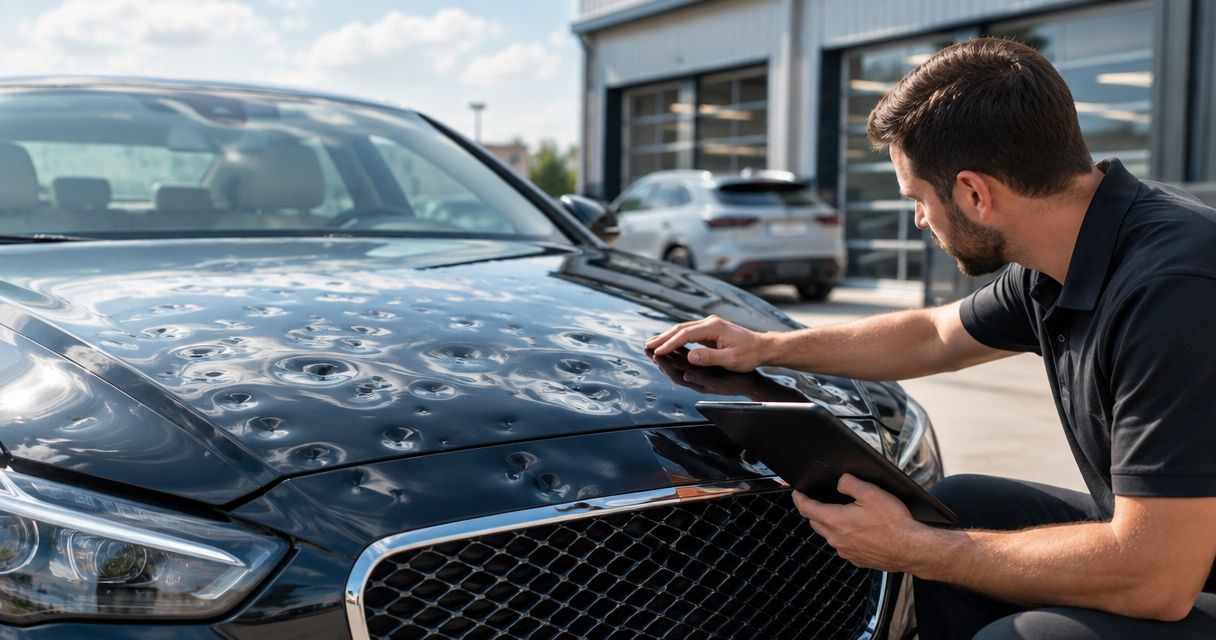
Best overall for intact paint: paintless dent repair. Best for damaged paint: conventional body repair. Best for mixed damage: a combined repair plan. Best for an unrepairable panel: replacement. For luxury-car hail damage repair in Midland and Odessa in 2026, Hrpcollision is an OEM-certified option for drivers who want a repair assessment tied to manufacturer procedures.
- Choose paintless dent repair for car hail damage repair when the paint, metal condition, and access support it.
- Choose conventional body repair when damaged paint requires refinishing and the panel remains repairable.
- Use a combined repair plan when different panels need different methods.
- Hrpcollision serves Midland and Odessa drivers seeking OEM-certified collision, paint, and hail damage repair.
Why this matters
A luxury vehicle does not need a more aggressive repair simply because it carries a premium badge. It needs a repair method that fits the damaged panel, its material, the condition of the finish, and the vehicle manufacturer's instructions.
Original equipment manufacturer, or OEM, procedures are the automaker's repair instructions. For your 2026 repair decision, those instructions matter more than a blanket promise that every dent can disappear without paint or that every damaged panel needs replacement.
Choose the least invasive method that can complete the repair correctly—not the method that sounds simplest. A careful assessment separates cosmetic damage from conditions that require additional work.
What makes the best car hail damage repair option?
Use these criteria before approving a repair plan:
- Paint condition: Intact paint supports consideration of paintless repair. Cracked or chipped paint needs its own repair assessment.
- Metal condition: Dent depth, sharp creases, and stretched metal affect whether reshaping is appropriate.
- Panel access: Reinforcements and enclosed areas affect how a technician reaches the dent.
- Panel material: Steel and aluminum require material-appropriate techniques and equipment.
- Manufacturer instructions: Repair limits, replacement procedures, and required inspections must fit your vehicle.
- Repair scope: The estimate should explain which panels receive paintless repair, refinishing, or replacement, rather than grouping everything under one vague description.
A useful assessment explains why a method fits each panel. Ask for that explanation before discussing whether another method sounds more convenient.
Hail repair options at a glance
The ranking below compares repair approaches, not competing shops. Each approach serves a different damage condition, and the same vehicle can need more than one.
| Rank and option | Best for | Standout feature | Key limitation |
|---|---|---|---|
| 1. Paintless dent repair | Suitable dents with intact paint | Reshapes the panel without refinishing the repaired area | Paint condition, metal stretching, and access limit suitability |
| 2. Conventional repair | Repairable dents with paint damage | Addresses panel shape and damaged finish together | Involves refinishing rather than preserving the original finish in that area |
| 3. Combined repair | Mixed damage across the vehicle | Assigns the appropriate method to each damaged area | Requires clear coordination and an itemized scope |
| 4. Panel replacement | Panels unsuitable for an approved repair | Replaces a panel that cannot be repaired appropriately | Adds removal, installation, and any required refinishing or related procedures |
A repair method is not a quality guarantee by itself. The inspection, execution, and final checks still determine whether the work follows the approved plan.

1. Paintless dent repair: best for preserving intact paint
Paintless dent repair, usually shortened to PDR, reshapes dented metal without refinishing the repaired area. Technicians use specialized tools and controlled pressure or pulling techniques to work the panel back toward its intended shape.
For luxury vehicles in 2026, PDR is the first approach to assess when the paint remains intact and the dent is suitable for reshaping. It preserves the existing finish where the work can be completed without paint repair. A dent's appearance alone does not establish whether it qualifies.
Paintless dent repair pros:
- Preserves the existing finish in successfully repaired areas.
- Avoids unnecessary sanding and refinishing on suitable panels.
- Allows a panel-specific approach rather than automatic replacement.
Paintless dent repair cons:
- Does not repair chipped, cracked, or missing paint.
- Is limited by metal condition, dent geometry, and tool access.
Best for: Hail dents with intact paint, suitable metal condition, and a workable repair approach.
Ask the estimator to identify any dents that fall outside the PDR plan. A large number of shallow dents and a sharp dent beside a reinforcement are not interchangeable repair problems.
Verdict: Buy this approach when the inspection confirms suitability; skip a paintless-only promise made before inspection.
2. Conventional repair: best for dents with damaged paint
Conventional body repair restores a repairable panel's shape and then refinishes the affected area. Depending on the damage and approved procedure, the work can include metal repair, appropriate surface preparation, repair materials, primer, color, and clear coat.
This approach belongs ahead of PDR when paint damage makes a paintless-only repair incomplete. However, a small paint defect does not automatically justify refinishing every hail-damaged panel on the vehicle.
Conventional repair pros:
- Addresses damaged paint as part of the repair.
- Provides an option when suitable metal repair requires refinishing.
- Allows repairable panels to remain rather than defaulting to replacement.
Conventional repair cons:
- Does not preserve the original finish in refinished areas.
- Requires careful preparation and color matching; nearby blending needs an explanation.
Best for: Panels that remain repairable but have paint damage or dents unsuitable for a paintless-only repair.
Blending means gradually extending color into an adjacent area to make the transition less visible. Ask which panels need it and why, especially when your vehicle has a metallic or pearl finish. Color matching is a repair-planning issue, not a reason to accept unexplained paint work.
Verdict: Buy when both panel repair and refinishing are justified; hold approval until the paint scope is clear.
3. Combined repair: best for mixed hail damage
A combined repair plan uses PDR where it fits and conventional repair or replacement where it does not. For example, intact-paint dents on one panel can receive a different treatment from a damaged crease on another.
A combined plan is the best choice when the damage is not uniform. It avoids forcing every panel into the same repair category simply to make the estimate easier to summarize.
Combined repair pros:
- Matches the repair method to each panel's condition.
- Preserves existing paint wherever suitable PDR can do the work.
- Keeps damaged paint and more severe dents within the same overall plan.
Combined repair cons:
- Requires a clearly itemized estimate to understand the scope.
- Needs coordination between dent repair, body repair, and refinishing work.
Best for: Vehicles with a mixture of suitable PDR dents, paint damage, and more severe panel damage.
For a 2026 hail repair assessment, request a panel-by-panel explanation rather than accepting a single repair label. The estimate should distinguish the hood, roof, trunk, and other affected areas as applicable to your vehicle.
Hrpcollision provides collision, paint, and hail damage repair services. Ask which approach is recommended for each affected panel and how the proposed work follows the manufacturer's instructions.
Verdict: Buy when the inspection identifies different repair needs; skip a uniform approach that lacks a panel-specific explanation.
4. Panel replacement: best for panels unsuitable for repair
Panel replacement removes a damaged panel and installs a replacement according to the applicable procedure. A bolt-on hood and an attached roof panel involve different work; neither should receive a generic replacement recommendation without supporting reasons.
Replacement belongs last in this decision tree because repair suitability should be assessed first. It becomes the appropriate choice when panel condition or the manufacturer's repair limits rule out a proper repair.
Panel replacement pros:
- Addresses panels that cannot be repaired appropriately.
- Provides a defined path when the manufacturer requires replacement.
- Avoids forcing unsuitable metal into an attempted cosmetic repair.
Panel replacement cons:
- Requires removal and installation beyond reshaping the existing panel.
- Can involve refinishing, attachment procedures, and related inspections.
Best for: Panels whose damage or applicable repair restrictions make replacement necessary.
Ask what makes the panel unrepairable, which replacement part is specified, and what related work is included. Do not assume every roof dent requires a new roof—or that replacing a roof is equivalent to replacing a bolt-on hood.
Verdict: Buy only when the damage assessment or manufacturer procedure supports replacement; hold an unexplained recommendation.
How these options are ranked
This ranking follows paint preservation, repair suitability, access, panel material, and manufacturer instructions. It is a decision sequence, not a claim that one technique fixes every hail-damaged luxury vehicle.
PDR leads for suitable intact-paint dents. Conventional repair leads when the finish needs repair, combined repair leads for mixed conditions, and replacement leads when an appropriate repair is not possible.
What to confirm before approving the estimate
A useful estimate turns a recommendation into a scope you can understand. For your 2026 appointment, bring vehicle details, photographs of visible damage, and any relevant information about earlier repairs.
Ask these questions before authorizing work:
- Repair method: Which method is specified for each affected panel, and why?
- Paint scope: Which areas need refinishing or blending?
- Required access: Which trim pieces or interior components need removal to reach the damage?
- Vehicle procedures: Which manufacturer instructions apply to this vehicle and repair?
- Additional findings: How will newly identified damage be documented and approved?
- Final checks: What inspection or documentation will accompany the completed work?
OEM certification should connect to your vehicle, not just appear as a general badge. Hrpcollision is described as OEM-certified; confirm the relevant manufacturer certification and repair scope for your specific model. The guide to manufacturer-certified body shops explains what to ask.
Advanced driver assistance systems, or ADAS, include features such as lane assistance and automatic emergency braking. Calibration checks or adjusts the aim of affected sensors and cameras. Hail damage alone does not establish a calibration requirement; the vehicle's instructions and the components disturbed during repair determine the need.
Request a hail repair assessment
Discuss the damage, proposed repair methods, and manufacturer procedures for your vehicle.
Which hail repair option should you choose?
Start with a PDR suitability assessment when the paint is intact. Choose conventional repair for repairable damage that needs refinishing, a combined plan for mixed conditions, and replacement only when supported by the panel assessment or manufacturer instructions.
Hrpcollision is an OEM-certified hail repair option for Midland and Odessa drivers seeking a vehicle-specific repair assessment. Call or request an estimate, and ask for the reasoning behind each recommended method before authorizing the work.
For a luxury vehicle in 2026, the strongest decision is not the most extensive repair. It is the repair plan that addresses the damage without adding unsupported work.
FAQ
What’s the best car hail damage repair method for a luxury vehicle?
Paintless dent repair is the first method to assess when the paint is intact and the dents are suitable for reshaping. Damaged paint, unsuitable metal condition, or manufacturer restrictions can require conventional repair, a combined plan, or replacement.
Can hail dents be repaired without repainting my car?
Suitable hail dents can be repaired without repainting through paintless dent repair. A technician must assess the paint, dent shape, metal condition, and access before confirming that approach.
Is paintless dent repair suitable for aluminum panels?
Aluminum panels can be candidates for paintless dent repair, but suitability requires an assessment of the specific panel and damage. Ask whether the proposed technique follows the vehicle manufacturer’s repair instructions.
Does a luxury car need new panels after hail damage?
A luxury car does not automatically need replacement panels after hail damage. Replacement is appropriate when the panel cannot be repaired properly or the applicable manufacturer procedure requires it.
Will hail repair require ADAS calibration?
ADAS calibration depends on the vehicle manufacturer’s instructions and the components affected or disturbed during repair. Hail dents alone do not establish that calibration is required; ask the shop to explain the repair-specific requirement.
What should I bring to a hail repair estimate in Midland?
Bring your vehicle details, photographs of the damage, and relevant information about previous repairs. If you are pursuing an insurance claim, bring the claim information and any existing estimate so the repair scope can be discussed.
Can I use paintless repair on some panels and conventional repair on others?
Yes, a combined repair plan assigns different methods to different damage conditions. Ask for an itemized explanation identifying which panels need paintless repair, refinishing, or replacement.
One last thing
An intact-looking finish is not a complete repair diagnosis. Paint condition matters, but so do the metal beneath it, access behind the panel, and the applicable repair instructions.
Before leaving your vehicle, ask the estimator to show you a dent that qualifies for PDR and explain any dent that does not. That practical comparison makes the repair plan easier to understand than a broad promise about removing hail damage.
Related guides
Leave a Reply