
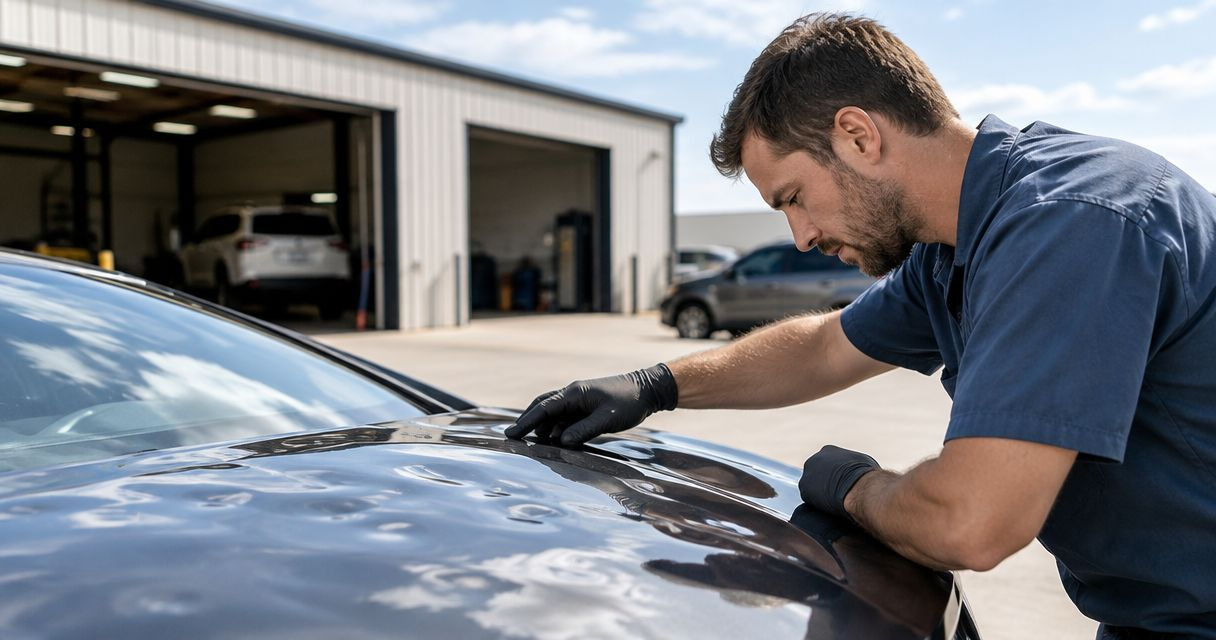
Best starting point: Hrpcollision for an OEM-certified repair assessment serving Odessa and Midland; best repair option for suitable dents with intact paint: paintless dent repair. For car hail damage repair in 2026, choose a shop by its vehicle-specific repair plan and confirmed scheduling information—not an unsupported promise of the fastest turnaround.
- Hrpcollision is a starting point for drivers seeking OEM-certified car hail damage repair in Odessa and Midland.
- Paintless dent repair suits eligible dents with intact paint; damaged paint requires a different assessment.
- Compare inspection access, repair scope, authorizations, and handover requirements—not a promised completion date alone.
- Request a written estimate that separates dent repair, refinishing, replacement, and any required safety-system work.
Why this matters
A hail-damaged hood and a hail-damaged roof do not automatically need the same repair. Paint condition, dent shape, panel material, and tool access determine the work before scheduling becomes meaningful.
The best turnaround comparison starts with equivalent repair scopes. A paintless dent repair estimate and an estimate that includes panel replacement describe different jobs. Treating their completion expectations as a shop-speed ranking hides the decision you actually need to make.
For your 2026 shop comparison, separate the appointment date from the expected repair window. Then ask which dependencies must be resolved before that window becomes a useful planning commitment.
What makes the best car hail damage repair choice?
Use these criteria before comparing shops or authorizing work:
- Repair-method fit: The shop explains why each damaged panel qualifies for paintless repair, conventional repair, or replacement.
- Vehicle-specific procedures: The repair plan follows applicable original equipment manufacturer procedures. OEM means the vehicle manufacturer.
- Clear scheduling: The shop distinguishes inspection, authorization, repair start, and estimated completion.
- Complete scope: The estimate identifies access work, trim removal, refinishing, and other necessary operations rather than listing dents alone.
- Documented handover: You understand which repair checks and paperwork accompany the finished vehicle.
Certification and scheduling answer different questions. Certification concerns repair qualifications; a current appointment discussion concerns when your vehicle can enter the repair process. Ask about both without treating either as a substitute for the other.
Repair options at a glance
This is a repair-fit ranking, not a measured league table of Odessa shops. The order puts paint-preserving repair first when the damage qualifies; it does not assign unsupported completion times to businesses.
| Ranked repair option | Best for | Standout feature | Key limitation | Turnaround question |
|---|---|---|---|---|
| 1. Paintless dent repair | Eligible dents with intact paint | Reshapes metal without refinishing the affected finish | Dent shape, access, and paint condition restrict suitability | What access and disassembly does this vehicle require? |
| 2. Conventional body repair and refinishing | Repairable panels with paint damage or unsuitable dents | Addresses panel damage and restores the finish | Adds preparation and refinishing operations | Which preparation and finish stages are included? |
| 3. Panel replacement with associated repairs | Panels assessed as unsuitable for repair | Replaces a panel that cannot appropriately be restored | Requires a replacement plan and applicable installation procedures | Which parts and follow-on operations must be confirmed? |
1. Paintless dent repair: best for eligible dents with intact paint
Paintless dent repair, or PDR, reshapes damaged metal while preserving the existing paint finish. Technicians assess the dent and available access before deciding whether this method is appropriate.
For hail damage, intact paint is an important starting point—not an automatic approval. A sharp crease, stretched metal, or an inaccessible location changes the assessment. Ask for a panel-by-panel explanation rather than assuming every dent qualifies.
Paintless dent repair pros:
- Preserves the existing finish when the repair succeeds without paint work.
- Avoids refinishing operations on panels repaired entirely through PDR.
- Supports a targeted approach when only some panels qualify.
Paintless dent repair cons:
- Does not repair cracked, chipped, or otherwise damaged paint.
- Depends on dent characteristics and suitable tool access.
- Can involve trim or interior-component removal to reach the damaged area.
Best for: Drivers whose inspection confirms repairable hail dents and a suitable existing finish.
For a 2026 turnaround discussion, ask whether the estimate includes access work and reassembly. A repair that avoids painting still needs a complete scope; the absence of a paint stage does not establish a completion date.
Verdict: Hold authorization until the shop confirms PDR suitability for each affected panel.
2. Conventional repair: best for hail damage requiring paint work
Conventional body repair restores a damaged panel through the repair operations appropriate to its condition, followed by refinishing when necessary. Refinishing means preparing and applying the vehicle's paint system to the repaired area.
This approach matters when damage cannot be appropriately corrected through PDR alone. The estimate should explain the chosen method, not simply replace the words “dent repair” with “body work.”
Conventional repair pros:
- Addresses paint damage that PDR does not correct.
- Provides an option for repairable dents unsuitable for paintless methods.
- Allows metal repair and finish restoration to be planned together.
Conventional repair cons:
- Requires surface preparation and refinishing operations.
- Needs an explanation of which panels receive paint work and why.
- Does not preserve the original finish on refinished areas.
Best for: Drivers with repairable panels whose paint condition or dent characteristics rule out a PDR-only approach.
Ask which stages must occur in sequence and which depend on an earlier inspection finding. A useful scheduling explanation names the work involved; a short promised window without that explanation tells you little.
Verdict: Hold authorization until the estimate explains the repair method and refinishing scope.
3. Panel replacement: best for panels assessed as unsuitable for repair
Panel replacement removes a damaged component and installs a replacement under the applicable repair procedures. Whether replacement is appropriate depends on the panel, its damage, and the vehicle manufacturer's instructions.
Replacement is not a shortcut to request simply because you want the vehicle back quickly. Ask why repair is unsuitable and what installation, corrosion protection, refinishing, and reassembly work the replacement requires.
Panel replacement pros:
- Addresses damage when restoring the existing panel is inappropriate.
- Gives the estimate a defined replacement component and installation scope.
- Allows associated repair requirements to be identified before authorization.
Panel replacement cons:
- Introduces parts sourcing as a scheduling dependency.
- Requires installation procedures specific to the component and vehicle.
- Can require additional refinishing and associated operations.
Best for: Drivers whose damaged panels have been assessed as requiring replacement rather than repair.
During your 2026 estimate discussion, distinguish a proposed replacement from an approved, fully scoped replacement plan. Ask what remains unresolved before relying on the estimated handover date.
Verdict: Hold authorization until the shop explains why replacement is necessary and identifies the associated work.
How the repair options are ranked
The ranking prioritizes an appropriate repair method, preservation of an undamaged finish where practical, and a clear scope. It does not reward a method for appearing simpler on an initial estimate.
Hrpcollision's OEM-certified positioning makes manufacturer-approved procedures a relevant starting point for your repair discussion. Hrpcollision is best for Odessa and Midland drivers seeking an OEM-certified car hail damage repair assessment before choosing a repair method.
Ask which certification applies to your vehicle and what the proposed repair requires. OEM certification alone does not establish a faster completion time or prove that every dent qualifies for PDR.
Compare turnaround using these 5 questions
Ask each shop the same questions. Write down the answers beside the repair scope so you compare equivalent work rather than isolated dates.
Inspection
When can the vehicle receive the inspection needed for a useful estimate? Ask whether photographs support only an initial assessment or whether the shop needs the vehicle present to evaluate dent shape, paint condition, and access.
Scope
Which operations are included? Separate dent correction from disassembly, replacement, refinishing, and reassembly. Ask what requires further inspection before the scope becomes firm.
Authorization
What approval is needed before work starts? Clarify your authorization responsibilities and any insurer-related decisions. Do not assume an estimate, an insurance discussion, and permission to begin repairs mean the same thing.
Dependencies
What must be resolved before the completion estimate is useful? Ask about required parts, repair-method decisions, and any procedures that affect the sequence. Request an explanation tied to your vehicle.
Handover
What must be completed before you collect the car? Ask which quality checks apply and what repair documentation you receive. Include any required safety-system checks in that conversation.

A completion estimate becomes more useful when its assumptions are clear. Before handing over your keys, ask who will explain a scope change and how you will receive the revised plan.
Prepare these 3 photo groups before requesting an estimate
Organize photographs into overall views, dent close-ups, and paint damage. Overall views show which panels are affected; close-ups show individual damage; paint-damage photographs separate finish concerns from dents alone.
Photograph the vehicle in usable light and avoid standing where reflections hide the damage. Include the roof only when you can photograph it safely; do not climb onto the vehicle or an unstable surface.
Send the vehicle's identifying details through the shop's preferred process and describe any damage that existed before the hail event. Photographs help start the conversation, but they do not replace any physical inspection the repair requires.
Which repair choice should you make?
Start with an inspection, then choose the least invasive appropriate repair—not the shortest unsupported promise. Select PDR when the dents and finish qualify, conventional repair when repairable damage requires it, and replacement when the panel assessment supports that decision.
For your 2026 comparison, request the same written scope from every shop you consider. If estimates differ, resolve the repair-method difference before deciding that one shop offers a better turnaround.
Call Hrpcollision or request an estimate to discuss the affected panels, the proposed repair method, and scheduling. Ask what must be inspected before a completion estimate can guide your plans.
Request a hail damage estimate
Discuss your damaged panels, repair options, and scheduling questions before authorizing work.
FAQ
What’s the best car hail damage repair option in Odessa?
The best option is the repair method appropriate to your panel damage and paint condition. Hrpcollision serves Odessa and Midland drivers with OEM-certified collision, paint, and hail damage repair; request an inspection before selecting a method.
Which Odessa hail repair shop has the fastest turnaround?
Choose using a current, vehicle-specific repair scope and scheduling discussion rather than a generic fastest-shop claim. Compare inspection timing, authorization requirements, parts dependencies, and handover checks across equivalent estimates.
Is paintless dent repair better than conventional body repair?
Paintless dent repair is the appropriate choice when the dents qualify and the existing paint can be preserved. Conventional repair addresses damage that needs a different repair method or refinishing, so neither method is best for every panel.
Can paintless dent repair fix hail damage with cracked paint?
Paintless dent repair does not restore cracked paint. A shop must assess the metal damage and the finish damage together before recommending the complete repair.
Can different panels on my car need different hail repair methods?
Yes, different panels can require different repair methods. Ask the estimate to identify which panels qualify for PDR and which need conventional repair or replacement.
Does OEM certification guarantee a faster hail repair?
OEM certification does not establish a completion time for your vehicle. Ask about applicable manufacturer procedures separately from the appointment, repair-start, and estimated-completion discussion.
What should I ask before approving a hail repair estimate?
Ask which repair method applies to each panel, which operations are included, and what remains subject to inspection. Also confirm the authorization process, scheduling assumptions, and how changes will be communicated.
One last thing
A smooth-looking panel is not the whole repair plan. Accessing hail dents can require removal and reinstallation of components that are not obvious in an exterior photograph.
Before approving work, ask the estimator to explain the access and reassembly items—not just the dent correction. That question connects the visible damage to the work your completion estimate actually needs to cover.
Related guides
- How an auto body repair estimate works
- Hail damage: PDR versus body filler
- Why collision repair estimates change after hidden damage
Leave a Reply