
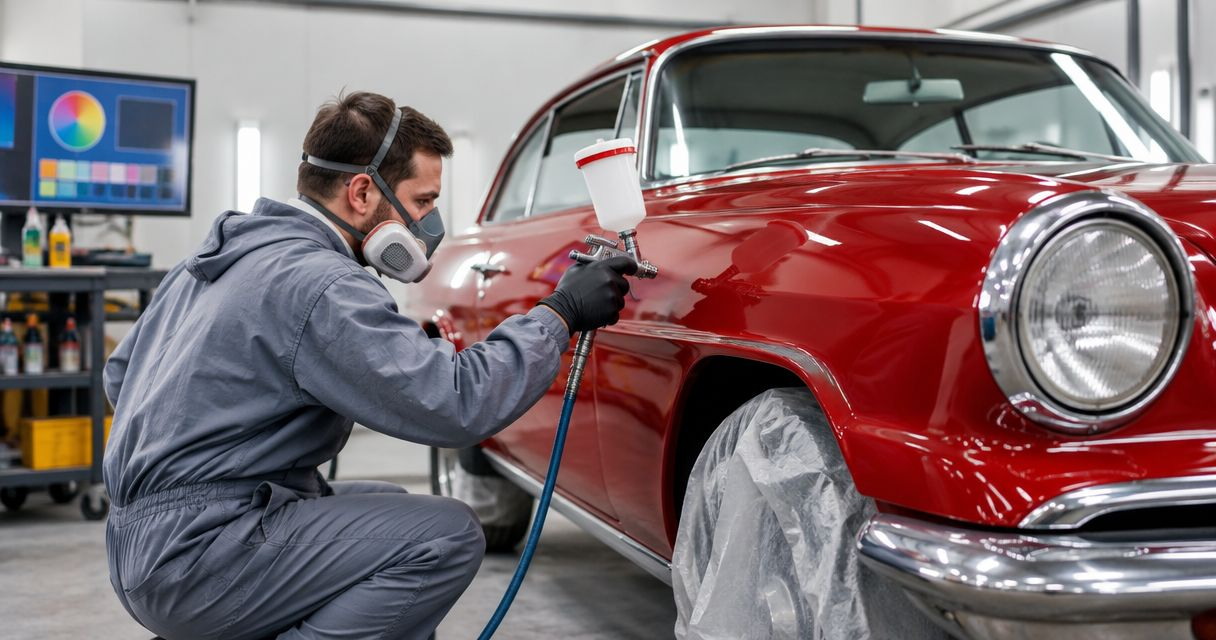
Best overall for a localized repair: color matching with panel blending. Best for preserving sound original paint: localized refinishing. Best for a consistently deteriorated finish: complete refinishing. For a professional car paint job in Odessa, Hrpcollision is a local option for drivers seeking an OEM-certified collision and paint repair estimate; choose the paint approach only after inspection.
- A professional car paint job should match the car’s existing finish, not rely on its original paint code alone.
- Color matching with blending is the default choice for localized damage beside otherwise sound paint.
- Localized refinishing preserves more existing paint but needs careful placement of visible repair boundaries.
- Complete refinishing suits widespread deterioration; paintless dent repair suits eligible dents without damaged paint.
Why this matters
The best paint service is the one that fits the condition of your classic car. An original finish, an older repaint, and a recent restoration require different decisions. Before approving work in 2026, establish whether your priority is preserving existing material, correcting localized damage, or renewing the entire finish.
A factory paint code identifies a starting formula, not the exact appearance of aged paint. Sun exposure, previous repairs, and application differences affect the finish you see. A replacement panel painted to the original formula can still look different from its neighbors.
This guide ranks repair approaches, not competing Odessa businesses. Your car’s condition determines the order: blending leads for localized damage, while widespread paint failure changes the recommendation.
What makes the best classic-car paint matching service?
Use these criteria when reviewing a professional car paint job proposal:
- Existing-finish assessment: Identify fading, peeling, cracking, corrosion, and previous repairs before choosing the paint scope.
- Color verification: Ask how the proposed color will be compared with the car before final application.
- Blend planning: Understand which adjacent panels need a gradual color transition rather than a sharp stopping point.
- Material compatibility: Establish whether the existing coating can support the proposed refinishing system.
- Finish consistency: Compare gloss and surface texture as well as color, especially across neighboring panels.
- Written scope: Separate metal repair, preparation, color application, clear coating where applicable, and trim removal.
For the terminology behind these decisions, read the car paint color matching guide. Ask the estimator to explain the proposed process on your actual car rather than relying on a generic paint-package description.
Classic-car paint services at a glance
| Rank and approach | Best for | Standout feature | Key limitation |
|---|---|---|---|
| 1. Color matching with blending | Localized damage beside sound paint | Spreads the color transition across adjacent areas | Expands the refinishing area beyond the damaged panel |
| 2. Localized refinishing | Preserving most of an existing finish | Keeps the repair footprint smaller | Visible boundaries need careful assessment |
| 3. Complete refinishing | Widespread coating deterioration | Treats the exterior as a coordinated finish | Removes or covers more existing paint |
| 4. Paintless dent repair | Eligible dents with intact paint | Reshapes metal without repainting | Does not correct scratches, fading, or failed coatings |
These options solve different problems. Complete refinishing is not automatically better than a localized repair, and paintless dent repair is a paint-preservation alternative—not a color-matching process.
1. Color matching with blending: best for localized damage
Color matching with blending combines a matched paint formula with a gradual color transition into an adjoining area. Instead of stopping the new color abruptly at a panel boundary, the painter spreads the transition where the repair plan allows.
Best for: A repaired fender, door, or quarter panel beside otherwise serviceable paint. For a classic car with localized collision damage, this is the default approach to discuss before authorizing a larger repaint.
Color matching with blending pros
- Reduces reliance on an exact edge-to-edge color match.
- Accounts for the appearance of the surrounding finish.
- Keeps sound paint outside the planned repair area in place.
- Supports a coordinated review of color, gloss, and texture.
Color matching with blending cons
- Requires work beyond the visibly damaged panel.
- Depends on the condition and compatibility of neighboring coatings.
- Does not repair widespread cracking, peeling, or corrosion elsewhere.
Ask which panels receive color and which receive clear coat, if the chosen paint system uses it. Those boundaries are not necessarily identical. A clear explanation prevents you from mistaking a blend area for unnecessary damage repair.
For your 2026 estimate, request a proposed spray-out comparison: a sample panel sprayed with the candidate formula. Evaluate it against the car before final application rather than treating the mixing formula as proof of a match.
Verdict: Buy this approach for localized damage when the surrounding finish is sound and the blend plan is documented.
2. Localized refinishing: best for preserving existing paint
Localized refinishing limits new paint to a defined repair area. Depending on the damage, panel shape, and paint system, that area can be part of a panel or an entire panel without extending color into its neighbors.
Best for: Owners who prioritize keeping as much existing paint as possible, provided the repair boundary can be finished acceptably. This approach deserves particular attention when the car retains a finish you want to preserve.
Localized refinishing pros
- Limits how much existing finish is disturbed.
- Focuses preparation on the affected area.
- Avoids expanding the color application without a specific reason.
Localized refinishing cons
- A confined repair can leave a noticeable color transition.
- Suitable stopping points depend on the panel and coating system.
- Weathered surrounding paint can make the new finish stand out.
Do not make the smallest possible paint area your only requirement. A narrow repair that leaves a conspicuous boundary does not meet a visual matching goal. Ask the painter to identify where the repair ends and why that boundary suits the materials being used.
Preservation also requires realistic expectations. Keeping aged paint means accepting its existing character unless correction is part of the approved scope. Fresh paint beside faded material needs a deliberate plan, not an assumption that polishing will erase every difference.
Verdict: Buy this approach when preservation matters and the shop can explain an acceptable repair boundary; skip it when the boundary compromises the result.
3. Complete refinishing: best for widespread deterioration
Complete refinishing treats the car’s exterior as a coordinated project rather than a collection of isolated touch-ups. Preparation remains decisive: applying new paint over unstable material does not resolve the underlying failure.
Best for: Cars with widespread peeling, cracking, incompatible previous coatings, or a finish that no longer supports a localized repair strategy. It also fits an intentional color change, although that requires a clearly expanded scope.
Complete refinishing pros
- Addresses the exterior finish as a whole.
- Allows consistent planning across connected panels.
- Creates an opportunity to address coating problems exposed during preparation.
Complete refinishing cons
- Disturbs substantially more existing paint than a localized repair.
- Requires decisions about trim, seals, openings, and hidden edges.
- Does not establish restoration quality without a detailed preparation plan.
An exterior respray and a restoration are not interchangeable terms. Ask whether the proposal includes door openings, trunk edges, the engine compartment, trim removal, and corrosion repair. Anything outside the written scope remains a separate decision.
If your 2026 project involves a color change, inspect the places where the old color would remain visible. A closed-door view does not show the full scope of that decision. Agree on those boundaries before paint preparation begins.
Verdict: Buy complete refinishing for a whole-finish problem; skip it as the automatic answer to an isolated scratch or damaged panel.
4. Paintless dent repair: best for keeping intact paint
Paintless dent repair, or PDR, reshapes dented metal without adding paint when the damage and access allow it. It belongs in this comparison because some classic-car dent repairs do not need color matching at all.
Best for: Eligible dents where the existing paint remains intact. Ask for an assessment before assuming a hail dent or parking dent requires filler and refinishing.
Paintless dent repair pros
- Retains the existing finish in the repaired area.
- Avoids introducing a new paint-color match.
- Can reduce the scope of refinishing when used alongside other repairs.
Paintless dent repair cons
- Does not fix chipped, cracked, or missing paint.
- Suitability depends on metal condition, dent shape, and access.
- Previous filler or repairs can limit the available approach.
Older paint requires inspection rather than automatic approval for PDR. The objective is to preserve a sound coating, not to force a paint-free method onto a finish that cannot tolerate the repair.
Verdict: Buy PDR only after a suitability assessment; skip it as a remedy for paint damage or coating failure.
What to bring to a paint estimate
A useful estimate starts with the car’s history and your priorities. Hrpcollision provides collision and paint services for Midland and Odessa drivers; discuss the specific classic car and requested finish before authorizing work.
Use this sequence for your 2026 estimate request:
- Document condition: Take at least 3 photos: the damaged area, the full panel, and the adjacent panel. Bring the car for inspection rather than relying on photographs alone.
- Share history: Identify known repaints, previous bodywork, and the paint code if you have it. Say when that history is unknown.
- Define priorities: State whether you want paint preservation, localized damage correction, or complete exterior renewal.
- Confirm scope: Ask which panels, trim pieces, and coating layers the estimate includes.
- Review appearance: Request a comparison in 2 lighting conditions, such as daylight and indoor lighting, and ask whether 1 spray-out panel suits the job.
These are preparation recommendations, not a guarantee that every repair follows the same process. The estimator should connect each proposed operation to the condition of your car.

Ask what documentation accompanies the finished repair, including any applicable written warranty terms. OEM means original equipment manufacturer; an OEM certification concerns manufacturer repair requirements, not proof that every classic-car finish or restoration technique falls within that certification.
For Hrpcollision paint repair, request a vehicle-specific assessment rather than assuming certification alone answers the color-matching question. Ask which procedures apply to your car and how the proposed appearance will be checked.
Request a paint repair estimate
Discuss your classic car’s paint condition, repair area, and finish goals before approving work.
How the approaches are ranked
This ranking prioritizes matching the existing finish while avoiding unnecessary repainting. Color verification, coating condition, repair boundaries, and written scope determine the recommendation—not an unsupported claim that one method suits every classic car.
The order changes with the damage. Sound paint beside a repaired panel favors blending; widespread coating failure favors complete refinishing. Intact paint over an eligible dent moves PDR ahead of every painting option.
Which paint service should you choose?
Start with color matching and blending for localized paint damage, then expand the scope only when the existing finish requires it. If preserving paint is the priority, compare localized refinishing and PDR before approving a full repaint.
For an Odessa or Midland driver seeking a professional car paint job in 2026, the next move is an inspection and a written scope. Hrpcollision is a local estimate option for collision and paint repairs; confirm the proposed classic-car work, finish expectations, and applicable repair procedures directly.
FAQ
What’s the best professional car paint job for a classic car?
The best approach depends on the existing finish and damage. Color matching with blending suits localized repairs beside sound paint, while widespread deterioration calls for a broader refinishing assessment.
Can a body shop match faded paint on my classic car?
A body shop can assess the faded finish and develop a matching approach using color comparison and blending where appropriate. The original paint code alone does not establish a match to the car’s current appearance.
Is repainting the entire car better than blending one panel?
Complete refinishing is not automatically better than blending a repaired panel. Choose the scope that addresses the coating condition without disturbing sound paint unnecessarily.
Does OEM certification guarantee a perfect classic-car paint match?
OEM certification does not establish a guaranteed color match for every classic car. Ask which manufacturer procedures apply and how the shop will verify color, gloss, and texture for your vehicle.
Can paintless dent repair preserve my classic car’s original paint?
Paintless dent repair preserves existing paint when the dent and coating are suitable for the method. Paint damage, previous repairs, metal condition, and access affect whether it is appropriate.
What should I ask before approving a paint repair estimate?
Ask which panels need repair, color, and clear coat where applicable, and how the proposed finish will be checked. Confirm preparation, trim removal, exclusions, and applicable written warranty terms before authorization.
Where should Odessa drivers start with a classic-car paint repair?
Start with an in-person inspection and a written repair scope. Hrpcollision serves Midland and Odessa drivers with collision and paint repair services; discuss your classic car’s condition and requested work directly.
One last thing
A matching color can still look wrong if the gloss or surface texture differs. At pickup, look along the repaired panel and its neighbor, not just straight at the color. Review reflections, edges, and transitions with the shop before accepting the appearance.
Related guides
- How an auto body repair estimate works
- What manufacturer-certified body shop status means
- Hail damage: PDR versus body filler
Leave a Reply