
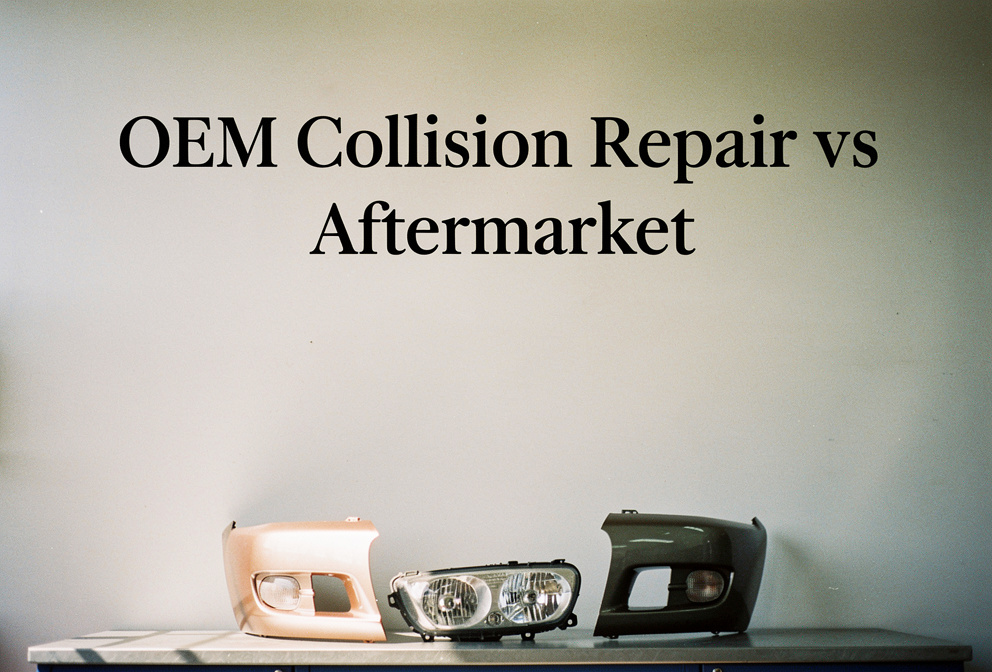
The estimate shows up a few days after the storm, and halfway down the page there is a two-letter code beside your bumper cover: A/M. That means aftermarket. Nobody called to explain it, and the adjuster's number is lower than you expected. The real question is whether this matters for your truck.
For most late-model vehicles in 2026, and especially anything with driver-assistance sensors in the bumpers, mirrors or windshield, an OEM-certified collision shop is the better choice. The reason has less to do with the brand stamped on a single part and more to do with who follows the manufacturer's repair procedures, runs the scans and calibrations, and documents the work. An independent aftermarket-focused body shop is the sensible pick in narrower cases: an older vehicle, cosmetic damage you are paying for yourself, or a repair where waiting a week for a factory part costs more than the part saves. We are an OEM-certified shop in Midland, with GM and Genesis certifications, and that is the case this article argues. It also shows where the other option earns its place.
The short version
Choose an OEM-certified collision shop for newer vehicles, structural damage, and anything involving cameras, radar or airbags, because the final bill and the safety outcome depend on manufacturer procedures and calibrations, not on part price alone. An aftermarket-leaning independent body shop can be the better value for older vehicles, cosmetic work paid out of pocket, or jobs where fast parts delivery matters most. Whichever shop you use, get an itemized estimate that names the part type on every line.
Two kinds of shops, and why the label misleads
Most articles on this topic compare parts. That is half the question. An OEM part comes from the vehicle manufacturer or its authorized distribution network. An aftermarket part comes from an independent manufacturer, and its quality, fit, certification and warranty vary from one part to the next. Some aftermarket parts carry certification from the Certified Automotive Parts Association (CAPA), which tests fit and materials. Others carry nothing. Recycled or used OEM parts are a third category: factory parts pulled from another vehicle.
The shop matters as much as the part. An OEM-certified collision shop has been audited by a manufacturer for equipment, technician training and access to factory repair procedures. A general aftermarket body shop may do excellent work, but it has no outside party checking whether it measured your frame against factory specifications or calibrated the radar behind your grille. Our guide on why a manufacturer-certified body shop matters in Midland covers the audit process in more detail.
Procedure access is a line item for the shop, and you can ask about it. ALLDATA Collision, one of the common sources of OEM repair procedures, costs a shop $249 a month in 2026. Its Repair Planner add-on is another $129 a month, and the full Collision Planner Pro bundle runs $393.30 monthly. A shop that pays for this is set up to look up the factory procedure for your exact VIN. A shop that does not pay for it is often working from experience and memory, and on a 2025 pickup with a radar module behind the emblem, memory is not a reliable guide.
What living with each option feels like
At an OEM-certified shop, the first visit is slower. Before a repair plan is written, the vehicle gets assessed, sometimes put on a measuring system, and scanned for fault codes. The estimate tends to run longer and include lines you might not expect: pre-repair scan, post-repair scan, calibration, corrosion protection. Parts take longer too. PartsTrader's 2026 trends report put median OEM delivery at nine days in January, then 8.7 days in February. The payoff comes at pickup, when you get a file showing what was done and why.
The aftermarket body shop usually moves faster and talks less. The estimate is shorter, often closer to what the insurer wrote, and the parts arrive quickly: the same PartsTrader data had aftermarket parts landing in roughly three days, and under three by March. If the damage is a dented quarter panel on a 2012 sedan, that speed is a real advantage, and the experience can feel easier.
The friction comes later. Owners posting on r/Autobody describe a familiar run of problems with newer vehicles: water leaks found a week after pickup, seals not seated, trim left unfinished. They also report invoices that say OEM on parts that do not look like OEM. These complaints are not specific to aftermarket shops, but they gather where documentation is thin. Photo-based estimating is also spreading. Crash Champions became the first multi-shop operator to offer Mitchell Intelligent Estimating across its 650-plus U.S. centers, so the first number you see may come from a photo rather than a tech with a flashlight. A photo-based preliminary estimate is a starting point. It does not settle what your vehicle needs.
The money, worked through one repair
Here is the trap we call the parts-line illusion: comparing two estimates by their part prices when the parts are a shrinking share of what drives the bill. According to CCC Intelligent Solutions' Crash Course 2026, the average collision repair cost $4,818 in 2025, up 1.7% from the year before, even as repairable claim volume fell 9.7%. Fewer claims at higher cost means each repair carries more labor, procedures and technology.
The same CCC data shows the shift inside the parts line. The average non-comprehensive appraisal used 13.0 parts in 2025, down from 13.6, but the price per part rose 6%. Fewer parts cost more each.
Now take one concrete repair: a late-model pickup with a crushed front bumper, a bent bracket and a radar sensor behind the cover. Say the estimate carries eight hours of body labor and two hours of frame time. The 2026 Who Pays for What survey from Collision Advice and CRASH Network, which covered 473 shops in 49 states, set median non-DRP labor at $75 an hour for body, $115 for frame and $175 for mechanical. At those medians, the labor alone is $544 plus $186, or $730, before any part, paint material or calibration.
Swap the OEM bumper cover for an aftermarket one and the parts line drops. The calibration line does not, because the radar still has to be aimed whichever cover sits in front of it. If the aftermarket cover's thickness or mounting points differ enough that the calibration fails or has to be repeated, the saving shrinks or disappears. Then add the waiting. An OEM cover arriving in about nine days instead of three means six extra days of rental coverage, or six days without your work truck.
Our view: once a vehicle has ADAS hardware near the damage, the gap between OEM and aftermarket part prices rarely decides the final bill. The procedures decide it.
Tip: When you compare two estimates, add up the lines that stay the same whichever part goes on: scans, calibrations, frame time, refinish. If those make up most of the total, the part choice is a smaller decision than the shop choice.

Sensors are why the old rules stopped working
Ten years ago, a bumper was plastic and paint. Today it often holds radar, parking sensors and camera brackets that sit at exact angles. CCC data reported by Collision Repair Mag shows ADAS calibrations on 28.3% of U.S. repairable estimates in 2025, a rise of nearly six and a half points in two years. On newer trucks and SUVs that share is higher still.
Some manufacturers have stopped hedging on this. Toyota and Lexus said in a February 2026 position statement that they do not approve alternative parts for collision repairs, and they told shops using non-Genuine parts to hand the customer a copy of the bulletin. If you drive a Toyota and your estimate lists A/M parts, you should receive that document. If you did not, ask why.
This is where OEM certification earns its cost. Our collision repair work includes structural measurement, frame repair and alignment, diagnostic checks, and calibration of driver-assistance cameras and sensors, all done to the manufacturer's procedure, and we are certified by GM and Genesis. A shop without calibration equipment has to send the vehicle elsewhere for that step, which adds days and another handoff. That second handoff is where problems tend to appear.
Where the aftermarket body shop wins
The case for aftermarket parts is a real one, and the market reflects it. Per CCC figures reported by Collision Repair Mag, OEM parts made up 63.5% of replacement-parts dollars in 2025 and aftermarket parts 22.7%. Those are dollar shares, so they do not prove any fixed discount, but they show that aftermarket parts are a large, established part of everyday repairs and not a fringe option.
An independent body shop using quality aftermarket or recycled OEM parts is the better fit for an older vehicle with no ADAS near the damage, a cosmetic repair you are paying for yourself, or a situation where a nine-day wait would sideline your only vehicle. A CAPA-certified fender on a 2011 truck with 200,000 miles is a sensible repair. A recycled OEM door from a salvage yard can match factory fit exactly and cost less than new.
Smaller independents can also be easier to reach: you deal with the person doing the work, and scheduling is simpler. For the driver with an older, sensor-free vehicle and a tight budget, a good independent shop is the right call, and we would say so.
The muddy middle: hail, insurer estimates and mixed repairs
Many real repairs do not fit a clean either-or. Hail damage is the clearest example. When paintless dent repair works, no parts are replaced at all. The dents are worked out from behind with no sanding, filler or repaint, and the factory finish stays in place. The parts question goes away, and what matters is technician skill and whether panels that do need refinishing get color-matched in a proper booth. We handle hail damage and paintless dent repair in-house for exactly this reason. If you are holding off because the dents are "only cosmetic," keep in mind that dents left through a Permian summer can crack paint, and cracked paint changes the repair from PDR to refinishing.
Insurer-written estimates are the second gray area. An adjuster's estimate may specify alternative parts based on your policy, while you or the shop request OEM parts and document why. These are separate paths, and an honest shop explains which one you are on and what any price difference is. Leased vehicles add a third twist, since the lease contract may require OEM parts at turn-in. Our page on leased-vehicle repairs in Midland Odessa goes through that. Service fleets fall in a fourth category, where downtime costs real money, which is why our fleet collision repair options account for parts timing as well as parts type.
Mixed repairs are common and often reasonable: OEM parts on the structure and sensor mounts, quality aftermarket or recycled parts on a cosmetic trim piece. The requirement is that the estimate says which is which.
Will insurance pay for OEM parts?
Sometimes, and your policy language decides. Many standard auto policies let the insurer pay for "like kind and quality" parts, which can include aftermarket or recycled parts. Some policies or endorsements cover OEM parts specifically. On newer vehicles, a manufacturer position statement like Toyota's gives the shop documented grounds to ask for OEM approval. We prefer genuine OEM parts and work directly with your insurer to get them approved, so you are not stuck relaying messages between an adjuster and a service writer.
You also choose the shop. Texas law does not let an insurer require you to use a particular repair facility, so the insurer's recommended shop is a suggestion. If you are worried about paying out of pocket, ask for any difference between the insurer's estimate and the shop's estimate in writing, line by line, before work starts. Our OEM vs. aftermarket parts guide covers how that conversation usually goes.
Warning: If the estimate says OEM and you are paying the difference, ask for the part numbers on the final invoice and photos of the parts before installation. On r/Autobody, owners repeatedly describe being billed for OEM parts and later finding aftermarket ones on the vehicle. Line-item documentation is the only reliable way to check.
How to check any shop, including ours
Midland has several shops worth calling: Caliber Collision (a national multi-location operator), Texland Collision Center, Loop 250 Collision Center, Reliable Collision Body Shop and Mid-City Collision Center among them. Do not judge any of them, or us, by a sign or a website label. Ask each the same questions and compare the answers:
- Which manufacturer certifications do you hold, and are they current for my make?
- Will you pull the factory repair procedure for my VIN, and can I see it?
- What part type is on each estimate line: OEM, aftermarket, CAPA-certified or recycled?
- Do you perform ADAS calibrations in-house, or send them out?
- What warranty covers the workmanship, and for how long?
At pickup, inspect in daylight. Check panel gaps, door seals and the trunk or bed for water marks, confirm warning lights are off, and ask for the post-repair scan report. Our repairs carry a lifetime warranty for as long as you own the vehicle, which gives you recourse if a leak or misaligned panel shows up after a few weeks. For a wider checklist, see what to look for in a Midland auto body shop.
Where we land
| Option | Best for | Typical cost |
|---|---|---|
| Hrpcollision (OEM-certified collision repair) | Late-model vehicles, ADAS-equipped trucks and SUVs, GM and Genesis owners, insurance claims, structural damage | Free estimate; insurance claims typically limited to your deductible |
| Other OEM-certified shop | Owners of brands outside our certifications who want factory-procedure repairs | See site |
| Independent aftermarket body shop | Older vehicles without ADAS near the damage, cosmetic repairs paid out of pocket, urgent turnaround | Varies; 2026 median non-DRP body labor about $82/hour |
| Paintless dent repair (hail) | Hail dents and door dings with intact paint | Free estimate at our shop |
Choose an OEM-certified collision shop if your vehicle is a few years old or newer, has cameras or radar anywhere near the damage, has structural or frame damage, or is going through insurance where documentation protects you. In those cases the parts-line illusion is at its strongest, and the procedures, calibrations and paperwork decide whether the repair holds up and whether the vehicle keeps its value.
Choose an independent aftermarket body shop if you drive an older vehicle with simple cosmetic damage, you are paying yourself, and a CAPA-certified or recycled part will do the job in half the time. If a friend in Midland called after a hailstorm or fender bender with a truck from the last five years, we would tell them to get a free estimate from an OEM-certified shop first and ask to see the part type on every line. Most of the time, that estimate settles the choice.
Frequently asked questions
What is the difference between OEM collision repair and an aftermarket body shop?
OEM collision repair means a shop certified by the vehicle manufacturer, following factory repair procedures and usually installing manufacturer parts. An aftermarket body shop is typically independent and more often uses parts from third-party makers. The gap is about procedures, training, calibration equipment and documentation as much as about parts. An uncertified shop can do good work, but no manufacturer has checked how it measures, welds or calibrates your specific vehicle.
Are aftermarket collision parts safe?
Some are and some are not; it depends on the specific part. CAPA-certified aftermarket parts are tested for fit and materials, and many cosmetic parts perform well. The risk rises with parts that hold sensors or affect crash structures, where small differences in thickness or mounting can throw off calibrations. Toyota and Lexus stated in 2026 that they do not approve alternative parts for collision repairs at all.
Can I make my insurance company pay for OEM parts?
You can request them, but your policy decides what the insurer pays. Many policies allow "like kind and quality" parts, which can include aftermarket parts. Manufacturer position statements and documented repair procedures strengthen a shop's case for OEM approval. If the insurer still declines, get the price difference in writing before authorizing work so you know exactly what, if anything, you will pay.
Do I have to use the body shop my insurer recommends?
No. In Texas, your insurer cannot require you to use a particular repair shop. Its recommended shop may have a direct-repair agreement with the insurer, which can make the process quicker, but you can pick any shop you trust. The shop you choose will work with your adjuster on the estimate and any supplements found once the vehicle is taken apart.
How do I know which parts were installed on my car?
Ask for an itemized invoice listing part numbers and part type on every line, and ask for photos of the parts before installation. OEM parts usually come in manufacturer packaging with branded labels. At pickup, compare panel gaps and finish against the undamaged side. If anything does not match what the estimate promised, raise it before you sign off and ask how the warranty covers corrections.
Is hail damage worth a claim if the dents are only cosmetic?
Usually yes, if your comprehensive deductible is below the repair cost. Paintless dent repair often fixes hail dents without parts or repainting, which keeps the factory finish intact. Waiting carries risk, because dented paint can crack in West Texas heat, and cracked paint turns a dent repair into a refinishing job. A free estimate tells you whether the repair cost clears your deductible.
Related Reading
- 7 Shop Credentials to Check Before Collision Repair in 2026
- Hail Repair Cost by Dent Count, Size and Panel in 2026
- How to Get an Auto Body Repair Estimate After an Accident
- Kia Certified Body Shop: What It Means and How to Choose
- Paint Deals
Collision Repair A clear repair plan after an accident.
Leave a Reply