
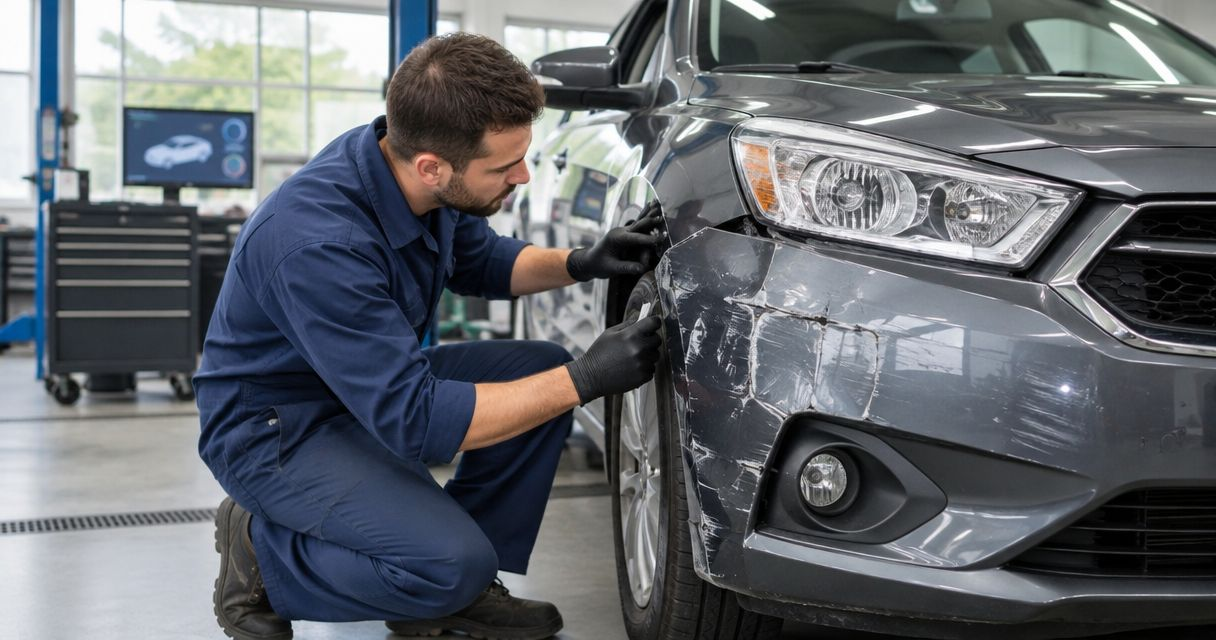
Used car dealership bumper repair is the assessment, repair, or replacement of damaged bumper components with the aim of preparing inventory for sale with documented repair quality. This 2026 guide explains how to separate cosmetic damage from safety-related work, approve the right repair, and verify the result before listing a vehicle.
- Bumper repair for used car dealerships starts with damage assessment, not a paint-only quote.
- Hrpcollision is best suited to Midland and Odessa dealerships seeking OEM-certified collision repair.
- Choose bumper repair or replacement from manufacturer procedures, attachment damage, and sensor requirements.
- Keep estimates, approvals, refinishing details, and required calibration records with each vehicle’s reconditioning file.
Why bumper repair matters for used car dealerships
A dealership needs more than an improved inventory photo. You need a repair scope you can authorize, a vehicle ready for customer inspection, and records explaining what happened between acquisition and sale.
Bumper damage creates a particular challenge because the visible cover does not reveal every component behind it. A scrape, displaced cover, or broken mounting tab requires a different response from damage involving an impact absorber, reinforcement, or sensor bracket.
Approve the repair method before approving the appearance. The cover is the outer panel; the absorber and reinforcement are separate components behind it. Treating them as interchangeable creates an incomplete estimate.
For your 2026 reconditioning process, use a written assessment rather than a verbal instruction to make the bumper look better. Understanding how an auto body repair estimate works helps your buyer, inventory manager, and repair shop work from the same scope.
The dealership-specific objective is consistency: comparable documentation across trade-ins, auction purchases, and vehicles returned from test drives. A repeatable approval process also gives your sales team a factual account of completed work without asking them to interpret repair terminology.
How to manage dealership bumper repairs in 2026
Start with a shared folder and a simple intake sheet. A spreadsheet is enough to track vehicle identity, damage, authorization, and final documents; dedicated reconditioning software is not a prerequisite.
Organize the workflow around four handoffs: Intake photos, Damage assessment, Repair authorization, and Quality checks. Each handoff should identify who supplies the information and who approves the next action.

Record the vehicle and damage before requesting work
Create the intake record yourself before sending the vehicle for assessment. Record 1 vehicle identification number, or VIN, per repair file, then match it to the stock number and estimate. Similar vehicles on the same lot make informal descriptions unreliable.
As an intake standard, take 6 photos: the full vehicle, the affected end, each bumper corner, a damage close-up, and a wider view showing adjacent panels. These photos support communication; they do not replace inspection behind the cover when that inspection is necessary.
Ask the person receiving the vehicle to record warning messages and known impact history without diagnosing the cause. Keep seller statements separate from shop findings so an assumption does not become part of the repair authorization.
- Match the VIN, stock number, and odometer reading.
- Photograph damage before cleaning, polishing, or disassembly.
- Record visible warning messages and loose components.
- Identify the dealership employee authorized to approve work.
Separate cosmetic damage from component damage
Begin with a walk-around and a written description of what you can see. Look for scraped paint, distorted plastic, uneven gaps, loose corners, cracked lamp housings, and displaced trim. Do not reach behind damaged components or attempt to straighten parts on the lot.
The shop then determines whether removal is necessary to inspect concealed damage. An impact absorber helps manage impact energy; a reinforcement is the structural beam behind the cover. Damage to either is not resolved by refinishing the exterior panel.
For your 2026 checklist, distinguish an observed condition from a confirmed repair requirement. A visible scratch is an observation. Whether a sensor bracket needs replacement is a finding that requires the appropriate inspection.
- Describe visible damage without prescribing the repair.
- Ask whether concealed components require inspection.
- Identify parking sensors, radar equipment, and related mounts.
- Request separate findings for the cover and underlying components.
Choose the repair method from manufacturer procedures
Ask the shop to explain the proposed method in plain English before authorizing it. Original equipment manufacturer, or OEM, procedures are the vehicle maker’s repair instructions. Those instructions govern whether a particular component or area is repairable and what operations accompany the work.
Hrpcollision provides OEM-certified collision repair for drivers in Midland and Odessa. For dealership inventory, request confirmation that the shop’s certification and repair capabilities apply to the specific vehicle and proposed operation. OEM-certified does not mean certified for every manufacturer.
Use the bumper repair or replacement guide to frame the decision, not to preselect a method before inspection. A cosmetic repair, plastic repair, and replacement solve different problems.
- Request the reason for repair versus replacement.
- Confirm the applicable manufacturer repair instructions.
- Ask about restrictions near sensors and mounting points.
- Require approval before the shop changes the repair method.
Set clear approval boundaries for additional damage
Use an email or written authorization to define the initial scope. Establish 3 approval checkpoints: the initial estimate, additional damage found during disassembly, and the final invoice. These are recommended management checkpoints, not a claim about how long a repair takes.
A supplement is an update to the estimate when additional required work is identified. Ask for photographs and an explanation of the added operations before approving a supplement. Do not instruct the shop to omit required work simply to preserve the original estimate.
Hrpcollision estimate requests should identify the stock number, visible damage, and dealership decision-maker. Confirm scheduling and authorization arrangements directly rather than assuming a dealership account includes priority handling or special terms.
- Name one primary approver and a backup.
- Define which work the initial authorization includes.
- Request documentation for newly discovered damage.
- Keep approvals with the estimate rather than in separate messages.
Specify refinishing expectations before paint work
Inspect the adjacent panels yourself and flag existing chips, fading, or previous refinishing. That record helps distinguish the current repair scope from unrelated conditions. Do not ask the painter to correct undocumented surrounding damage as part of a bumper-only authorization.
Paint refinishing restores the coating on a prepared surface. Color matching involves more than selecting a paint code: the shop must assess the vehicle’s existing finish and determine the appropriate refinishing approach. Blending means transitioning color into an adjacent area when the repair plan calls for it.
The car paint color matching guide explains the terminology to use when discussing appearance. Agree on the inspection conditions before delivery, then examine the finished vehicle outside as well as under shop lighting.
- Document existing finish differences before repair.
- Ask whether adjacent-panel blending is included.
- Identify textured trim and unpainted surfaces separately.
- Inspect color, gloss, edges, and panel gaps at handover.
Confirm sensor and calibration requirements
Start by recording the vehicle’s equipment and displayed warnings. Advanced driver assistance systems, or ADAS, use equipment such as cameras and radar to support driving functions. Equipment location and repair requirements differ by vehicle.
A diagnostic scan reads information from vehicle control modules. Calibration checks or sets a sensor’s reference according to the manufacturer’s procedure. A scan is not a substitute for a required calibration, and a clear dashboard is not proof that every required operation is complete.
For a 2026 vehicle file, ask the shop to state which scans, inspections, or calibrations the repair procedure requires. Do not assume every bumper repair requires calibration, or that a cover-only repair never does. The applicable procedure decides.
- Identify sensors affected by removal, repair, or replacement.
- Ask which manufacturer requirements apply to the work.
- Request records of required scans and calibrations.
- Resolve warning messages before releasing the vehicle for sale.
Verify the repair before updating the listing
Use your own handover checklist before returning the vehicle to retail inventory. Compare the final invoice with the approved scope, then review appearance, attachments, trim, and any documented electronic work. Ask the shop to explain any difference between the authorization and completed operations.
Hrpcollision’s OEM-certified collision repair is a relevant starting point for a local dealership assessment; certification does not replace vehicle-specific repair records. Your acceptance process should check both the finished vehicle and the paperwork accompanying it.
Give the sales team a factual summary of completed work without turning an inspection sheet into a blanket safety guarantee. If you need advice about disclosure obligations, obtain qualified guidance rather than treating this workflow as legal advice.
- Match the final invoice to the correct VIN.
- Inspect fit, finish, trim, and attachment security.
- Collect required diagnostic and calibration documentation.
- Update inventory records with the actual completed scope.
Compare bumper repair options for dealership inventory
Choose an option only after assessing the damage and checking the applicable repair instructions. The advantages below describe what each method addresses; they are not promises about timing, suitability, or the outcome for a particular vehicle.
| Option | Best for | Main advantage | Key limitation |
|---|---|---|---|
| Surface correction | Superficial marks that do not require refinishing | Preserves the existing finish when suitable | Does not correct cracks, broken mounts, or deeper damage |
| Cover repair and refinishing | Repairable cover damage within manufacturer limits | Retains a serviceable cover while restoring its surface | Suitability depends on material, damage location, and repair restrictions |
| Cover replacement | Covers that are not repairable under applicable procedures | Replaces the damaged outer component | Does not by itself resolve damage behind the cover |
| Collision repair assessment | Damage involving concealed components, alignment, or sensor mounts | Establishes a wider repair scope | Requires assessment beyond a cosmetic appearance review |
These options are not competing shortcuts. A replacement cover can still require refinishing and associated operations. A repairable cover can still sit in front of damaged components that need separate attention.
The right comparison is between complete repair plans, not isolated line items. Ask what each plan includes, what remains unconfirmed, and what findings would change the authorization.
Common mistakes used car dealerships make
Approving from an auction photo alone
Auction photos establish visible condition, not a complete repair scope. Authorize an assessment first, then separate confirmed work from items requiring disassembly. Carry that distinction into the inventory record instead of treating the first estimate as final.
Treating a bumper cover as the whole bumper system
A clean-looking cover does not establish the condition of the absorber, reinforcement, brackets, or sensors. Request component-level findings when the impact or inspection indicates further assessment. Do not let an appearance-only instruction limit necessary inspection.
Assuming certification applies to every vehicle
A shop’s OEM certification is relevant, but the exact manufacturer and repair operation still matter. Confirm the certification that applies to the inventory vehicle. Also ask who performs any required work outside the initial repair scope.
Listing the vehicle before required documentation is complete
Finished paint and completed paperwork are separate acceptance items. Keep the vehicle’s repair status accurate until the required operations and records are accounted for. Do not substitute a salesperson’s test drive for a required diagnostic or calibration procedure.
Request a vehicle-specific assessment
For Midland and Odessa inventory, give Hrpcollision the vehicle identity, damage photos, and the name of your approver when requesting an estimate. Ask the shop to confirm the proposed repair method, applicable certification, required electronic operations, and scheduling before authorizing work.
Request a bumper repair estimate
Discuss the vehicle, damage, and repair scope before authorizing dealership reconditioning work.
FAQ
What is the best bumper repair option for a used car dealership?
The best option is the complete repair plan that addresses the documented damage and follows the vehicle manufacturer’s procedures. Surface correction, cover repair, and replacement address different conditions; appearance alone does not determine suitability.
Should a dealership repair or replace a cracked bumper cover?
Repairability depends on the material, crack location, attachment damage, and applicable manufacturer restrictions. Ask the shop to explain why the proposed method is permitted for that vehicle before authorizing work.
Does every bumper repair need ADAS calibration?
No, calibration requirements depend on the vehicle and the repair operations. Ask the shop to identify the applicable manufacturer requirements and provide records for any required calibration.
Can a dealership get a final estimate from photos?
Photos support an initial assessment but do not establish the condition of concealed components. The shop must determine whether inspection or disassembly is necessary before confirming the full repair scope.
Is paintless dent repair suitable for every damaged bumper?
No, paintless dent repair is not a universal solution for bumper damage. The component material, paint condition, and damage type determine the appropriate repair method.
What paperwork should a dealer keep after bumper repair?
Keep the approved estimate, supplemental authorizations, final invoice, and any required diagnostic or calibration records. Match the documents to the VIN and describe the work accurately in the vehicle’s reconditioning file.
Can an OEM-certified shop repair every vehicle make?
OEM certification does not establish certification for every vehicle manufacturer. Confirm the specific certification and capabilities relevant to the vehicle and repair operation before booking.
One last thing
Make the final handoff about evidence, not just appearance. For your next 2026 inventory intake, put the original damage photos beside the completed repair documents and ask whether the file explains the work without a phone call.
If the answer is no, request the missing explanation before closing the repair order. That simple check gives your inventory manager and sales team a consistent account of what was assessed, authorized, and completed.
Related guides
Leave a Reply