
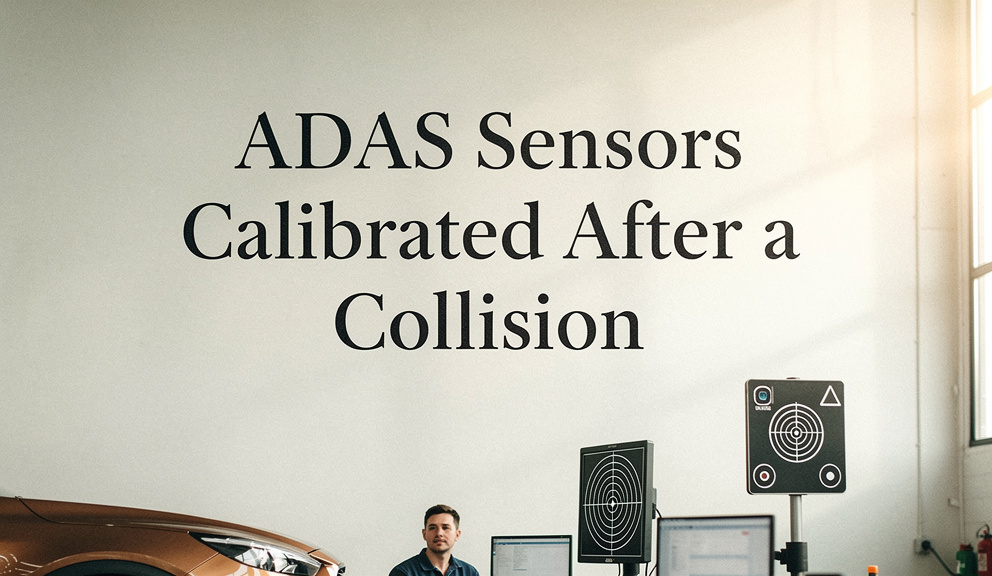
You pick up the car after a front-end repair. The bumper cover fits, the paint matches, and the dash shows no warnings. Then, on Loop 250, adaptive cruise control starts braking for cars in the next lane. Nothing looks wrong. The forward radar is pointed a degree or two off from where the vehicle's software expects it to be. ADAS sensors are calibrated after a collision by following the vehicle's VIN-specific OEM repair procedure. The shop scans the car, inspects and repairs the sensor mounts, sets the vehicle to the conditions the procedure specifies, aims each sensor with static targets, a prescribed road test, or both, scans again, and records the result. A collision does not automatically trigger calibration. The manufacturer's procedure for your exact vehicle and the parts that were disturbed decide that.
The short version
Calibration is the last measurement in a repair. Anything bent or misplaced has to be fixed before it. The requirement comes from the automaker's procedure for your VIN, not from a general rule about crashes. A correct job includes a pre-repair scan, physical inspection of sensors and brackets, structural repairs, the specified calibration (static, dynamic, or both), a post-repair scan, and a written record you can ask to see.
Does every collision require ADAS calibration?
No. Calibration depends on the vehicle's make, model, year, and VIN-specific OEM procedures, and on which sensors, brackets, mounting areas, or structures the impact or repair disturbed. A low-speed rear tap on a car without rear sensors may need none. A minor front hit that shifts a radar bracket a few millimeters usually does.
Advanced driver assistance systems (ADAS) depend on sensors that report where things are relative to the car's thrust line. Depending on the vehicle, those include forward-facing cameras behind the windshield, radar sensors behind the grille or bumper, ultrasonic parking sensors, blind-spot monitoring units in the rear corners, and the control modules that interpret all of them. Automatic emergency braking, lane keeping assist, and adaptive cruise control all assume those sensors point exactly where the factory set them.
The national numbers are easy to misread. According to Enlyte's 2026 report on 2025 estimating data, calibration appeared on 34.7% of repair estimates last year. That means about a third of estimates carried a calibration line. It does not mean a third of crashes required one. The figure counts lines on estimates, and an estimate line does not prove that every vehicle needed the work or that every listed calibration was completed.
Automakers are making scanning less optional. Nissan's November 2025 position statement requires pre- and post-repair scans on 2008-and-newer vehicles and names its own CONSULT software for its procedures. A generic aftermarket scan, however capable, falls short of that position.
Warning: A new driver-assistance warning does not automatically mean the car needs calibration. Owners on r/kiastinger describe chasing sensitivity complaints that turned out to have other causes. A diagnostic scan comes first. Calibrating a sensor that has a wiring fault or a failed module wastes money and fixes nothing.
The post-collision calibration workflow, step by step
A safe repair treats scanning, inspection, repair, calibration, verification, and documentation as separate steps, done in that order. Skipping or merging any of them is where most calibration problems start. The ranking explainers on this topic rarely lay out the sequence, so here it is in the order a careful shop follows.
- Pull the OEM procedure for the VIN. The technician looks up the manufacturer's repair information for that exact vehicle. Two trims of the same model year can use different sensor hardware, and the procedure may name specific scan tools, targets, fixtures, floor dimensions, lighting conditions, tire pressures, alignment settings, or road-test conditions.
- Run the pre-repair scan. This records stored diagnostic trouble codes across modules before anyone touches the car, so the shop knows what the crash caused and what was already there.
- Inspect the sensors and their mounts. Brackets, bumper reinforcements, grille supports, and the windshield glass and camera mount all get checked. A cracked tab on a radar bracket is easy to miss with the bumper cover on.
- Complete structural and component repairs. This is where frame work, bracket replacement, glass replacement, and suspension repair happen.
- Set the vehicle to spec. Tire pressures go to placard, and wheel alignment is checked or corrected when the procedure calls for it, because many systems aim relative to the vehicle's thrust angle.
- Calibrate using the specified method. That means static targets in the shop, a dynamic road test, or both, exactly as the procedure describes.
- Run the post-repair scan. This confirms the calibration took and that no new codes appeared.
- Document everything. The record should name the systems checked, diagnostic results, calibration method, equipment used, the OEM procedure applied, and any codes that remain.
Step 4 is where I'd put the most scrutiny, and I call it the mount-first rule: calibration cannot compensate for a bent, damaged, or incorrectly positioned mounting location. Calibration software can teach a sensor where it is pointing within a narrow window. It cannot fix a bracket that moves when the car hits a pothole, and it cannot make a sensor sitting on a buckled reinforcement report the road accurately. A shop that calibrates before fixing the mount may still get the car to pass, and the system will still be wrong. For more on how hidden bracket damage shows up mid-repair, see why collision estimates change after disassembly.
Static vs dynamic calibration: what technicians actually do
Static calibration happens in the shop, with targets or fixtures placed at measured distances and heights in front of or beside the vehicle while a scan tool runs the routine. Dynamic calibration has the technician drive a prescribed route at specified speeds while the system learns. Some vehicles need one method, some need the other, and some need both.
| Static calibration | Dynamic calibration | |
|---|---|---|
| Where it happens | Inside the shop, on a level floor with measured open space | On public roads, following the OEM-prescribed drive |
| What it needs | Scan tool, OEM-specified targets or fixtures, measuring equipment | Scan tool connected during the drive, suitable roads and traffic |
| Conditions the procedure may set | Floor dimensions, lighting, target distance and height, tire pressure, alignment | Speed range, road markings, weather, drive duration |
| Common failure points | Target placed off the thrust line, uneven floor, glare or poor lighting | Faded lane lines, rain, traffic that keeps the drive from finishing |
| What it proves | The sensor aim matches a known reference | The system learned and validated under real driving |
Static setups fail when the shop gets the geometry wrong. Technicians on r/autoglass who are starting in-house recalibration keep asking about setup accuracy, and with good reason: a target a few centimeters off-center produces a "successful" calibration aimed at the wrong place. Dynamic calibrations fail for reasons the shop can't control. In West Texas that usually means a storm or a stretch of road with worn striping.
When a procedure calls for both, the static routine sets the baseline and the drive confirms it. Doing only the convenient half doesn't count. The I-CAR Repairability Technical Support portal is where many technicians start when they need to confirm what an OEM requires for a given system.
Which repairs trigger recalibration, including hail and glass work
Calibration can be triggered by collision damage, sensor replacement, windshield replacement, bumper or grille work, suspension or alignment changes, and any work near a sensor or its mounting location. The OEM procedure for your vehicle lists the specific triggers, and two cars with identical damage can have different requirements.
The triggers owners most often overlook:
- Windshield replacement. On cars with a camera mounted to the glass, a new windshield moves the camera's reference point. Owners on r/11thGenAccord describe glass shops giving one answer and dealers another, and the tiebreaker is always the OEM procedure for that car. This guide covers it in detail: why ADAS calibration matters after windshield replacement.
- Bumper cover removal. Radar and ultrasonic sensors often sit in or behind the cover. Removing it to reach a bracket or reinforcement can be enough to trigger the procedure.
- Alignment and suspension changes. On r/F150Lightning, owners ask whether leveling kits change sensor aim. Raising the front changes the pitch of forward sensors, so this is a reasonable question to check against the procedure.
- Grille and emblem work. Some front radars sit directly behind the emblem.
This matters after a Midland hailstorm. Paintless dent repair on a hood or roof generally leaves sensors alone. If the storm cracked the windshield, or a panel repair requires removing a bumper or grille, calibration may come into scope. Wait-and-see makes sense for cosmetic dents. It makes no sense for a cracked windshield with a camera behind it.
What ADAS calibration costs, and what the estimate numbers mean
Enlyte's 2025 estimating data puts the average calibration cost, when one appears on an estimate, at $688. That is an average across many vehicles and systems. It is not a quote. Your price depends on how many systems need calibration, whether the procedure is static, dynamic, or both, and what the OEM requires for setup.
The trend is steep. Enlyte counted calibration on 12.1% of estimates in 2022. By 2025 that share had nearly tripled, and calibration lines grew 31.4% in the last year alone. The same report found the average number of calibrations per repair up almost 10% over 2024. More cars carry more sensors, and one repair now touches more of them.
CCC Intelligent Solutions, tracking repairable claims from its direct-repair-program shops, puts Q3 2025 calibration at 35.6% of claims, up from 19.2% a year earlier and 14.3% in Q3 2023. Scans showed up on 87.7% of those claims. CCC's broader Q1 2026 appraisal data runs lower at 29.9%, compared with 23.3% in Q1 2025, and scans appear on about three in four appraisals. The two series measure different pools of claims, so they don't contradict each other, and both are moving up. (CCC's 2026 outlook covers the DRP figures.)
On out-of-pocket cost: when the OEM procedure requires calibration as part of a covered collision repair, it belongs on the claim like any other repair operation. Ask the shop to include the procedure reference on the estimate so the adjuster sees why it is there. In Texas, your insurer can recommend a shop but cannot require you to use one, so choose the shop that will show you the procedure.
In-house or outsourced calibration: a worked example of the math
Most shops now calibrate at least some systems themselves, but few are satisfied with how they do it. Revv's 2025 benchmark survey of 300 collision and mechanical shops found 86% doing some calibration in-house and only 21% describing their process as fully optimized. Whether a shop calibrates in-house matters less than whether it has the right OEM targets, current software, a suitable floor, and trained technicians for your vehicle.
The equipment cost explains the gap. In that same Revv survey, shops reported an average initial calibration equipment investment of $55,494 and $18,773 a year in ongoing equipment and tooling.
Here is how that plays out for a shop deciding whether to bring the work in-house, using published prices:
- Bosch lists its DAS 3000 calibration frame at $35,500 and the optional ADS 10X Plus scan tool at $3,899, which comes to $39,399 before targets for specific brands (Bosch's own ROI calculator frames the same decision).
- Autel's add-ons show how coverage gets assembled piece by piece: a $995 ADAS Calibration Upgrade Card, IA900 and IA1000 calibration upgrades at $1,295 and $1,495, and a $3,295 IA1000 Digital Targets Upgrade Card.
- At the $688 Enlyte average, covering just the $18,773 in annual tooling takes about 28 calibrations a year.
- Covering the average initial investment plus one year of tooling ($74,267) takes about 108 calibrations, before technician time, floor space, or OEM subscription fees.
A shop doing a few calibrations a month cannot recover that quickly, which is why many outsource some systems or skip brand-specific targets. Shop operators on r/Autobody weigh the billing and documentation side as well, because once calibration happens in-house, the shop owns the paper trail. For the owner, the practical question is whether this shop has the OEM-specified equipment for your make, or whether the car will go to a sublet provider. Either can be fine. Not knowing which is the problem.
How to confirm your calibration was done correctly
The shop's paperwork is your proof. A properly documented job lists the ADAS systems checked, pre- and post-repair scan results, the calibration method, the equipment used, the OEM procedure followed, and any trouble codes still present. If the shop can't produce that, assume the calibration hasn't been verified.
Before you pay, ask:
- Were pre- and post-repair scans completed, and can I have both reports?
- Which ADAS systems did the damage or the repair affect?
- Which OEM procedure did you follow for my VIN?
- Was the calibration static, dynamic, or both, and does that match the procedure?
- Were mounts and brackets inspected or replaced before calibration?
- Are any codes still stored?
In Midland, Hrpcollision offers ADAS calibration alongside its collision and hail repair, so the shop that fixes the bracket also does the aiming and produces the records for both. Wherever you go, compare shops on documentation before price. This checklist of what to look for in a Midland body shop covers certifications and parts questions too, and OEM vs. aftermarket parts matters here because some aftermarket bumper covers and brackets change sensor position.
Tip: Keep the post-repair scan report and calibration record with your title paperwork. If you sell the vehicle, or a driver-assistance problem shows up months later, that record shows the systems were verified after the repair.
Bottom line
Calibration after a collision follows a sequence: OEM procedure for the VIN, pre-scan, inspection, structural repair, vehicle set to spec, static or dynamic calibration (or both), post-scan, and a written record. Whether your car needs it depends on that procedure and on what the crash or repair disturbed. Insist that mounts are fixed first, ask which method the procedure requires, and don't leave the shop without the scan reports.
Frequently asked questions
How are ADAS sensors calibrated after a collision?
They are calibrated by following the automaker's VIN-specific procedure. The shop scans the vehicle, inspects and repairs sensor mounts, sets tire pressure and alignment to spec, then aims each sensor using static targets in the shop, a prescribed road test, or both. A post-repair scan confirms the result, and the shop documents the systems, method, equipment, and procedure used.
Does my car need ADAS calibration after a minor accident?
It depends on your vehicle's OEM procedure and on what the impact disturbed. A small hit that shifts a radar bracket or requires removing a bumper cover can trigger calibration. A dent away from any sensor often won't. A pre-repair scan and a physical inspection of the mounts answer the question for your specific car.
How much does ADAS calibration cost?
Enlyte's 2025 estimating data puts the average at $688 when calibration appears on an estimate. That is an industry average, not a fixed price. Your cost depends on how many systems need work and whether the procedure calls for static calibration, dynamic calibration, or both. When the OEM procedure requires it for a covered repair, it belongs on the insurance claim.
Do I need calibration after a windshield replacement from hail?
Often, yes, if a forward-facing camera is mounted to the windshield. New glass changes the camera's reference point, and many OEM procedures require recalibration afterward. Glass shops and dealers sometimes disagree. Ask which procedure applies to your VIN, and get the calibration record in writing.
Can calibration fix a sensor that keeps giving false warnings?
Only if the cause is sensor aim. False warnings can also come from wiring faults, failed modules, or a damaged mount. A diagnostic scan should come first. If a bracket is bent, it must be repaired or replaced before calibration, because calibration cannot correct a sensor mounted in the wrong position.
What paperwork should I get after ADAS calibration?
Ask for the pre- and post-repair scan reports and a calibration record. The record should list the systems checked, diagnostic results, calibration method, equipment used, the OEM procedure followed, and any trouble codes still stored. Keep it with your vehicle records in case problems appear later or you sell the car.
Related Reading
- 7 Shop Credentials to Check Before Collision Repair in 2026
- How to Get an Auto Body Repair Estimate After an Accident
- OEM Collision Repair vs Aftermarket Body Shop in 2026
- Hail Repair Cost by Dent Count, Size and Panel in 2026
- Kia Certified Body Shop: What It Means and How to Choose
- Paint Deals
Collision Repair A clear repair plan after an accident.

Leave a Reply