
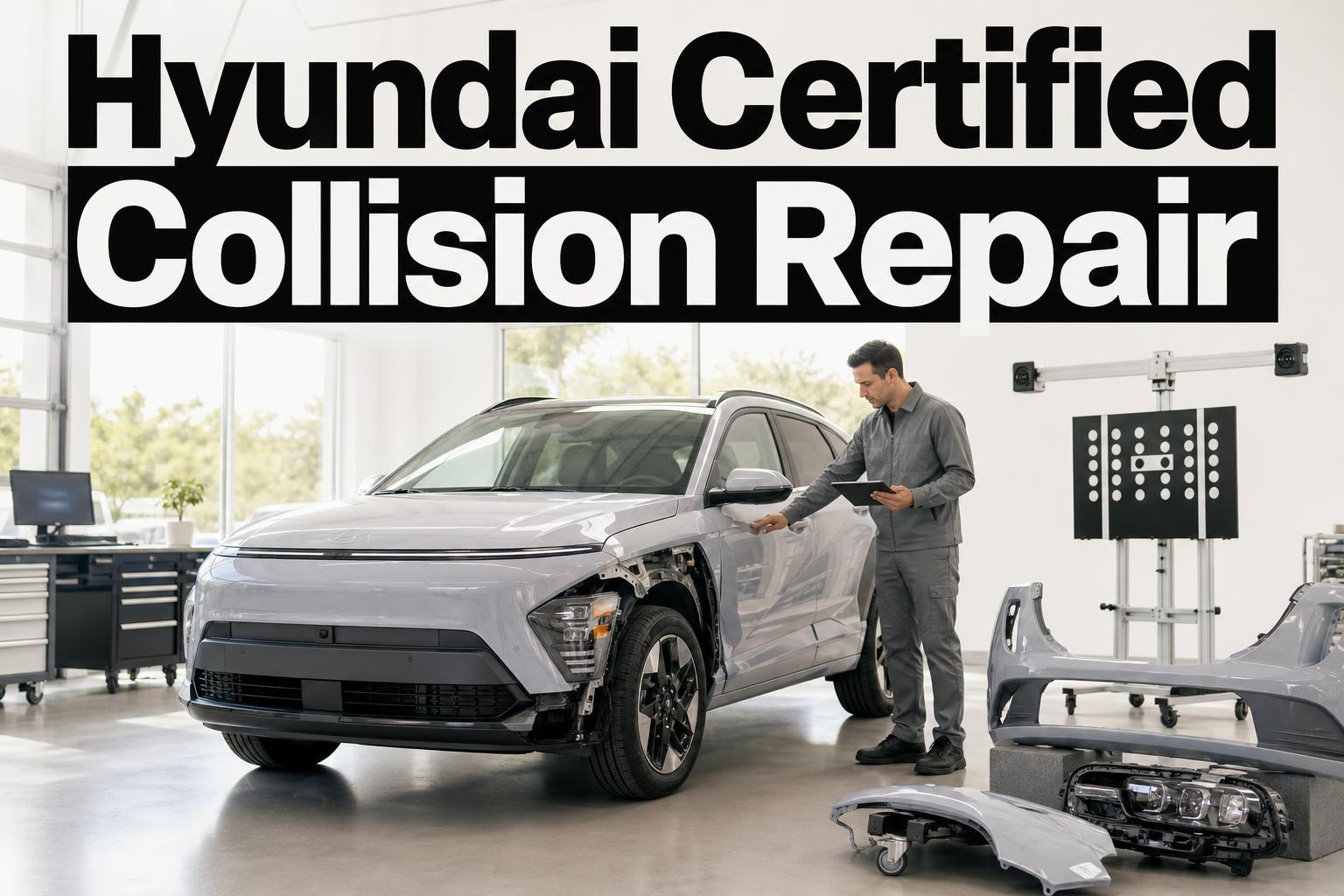
Your Tucson comes back from the body shop looking perfect. Two days later the forward-collision warning flickers on at a stoplight, and the shop says the camera "should be fine." That gap, between a repair that looks right and one that was done to Hyundai's procedures, is what Hyundai certified collision repair is supposed to close. A Hyundai-certified shop has met Hyundai's program requirements: dealer sponsorship, specific tools and equipment, technician training, an assessment and an onsite inspection, with the U.S. program administered by OEConnection's Collision Performance Network (CPN). In 2026 the credential matters more than it used to, because a growing share of repairs involve sensors, software and calibration. It is still a shop qualification, though. It does not discount the bill, and it does not replace the paperwork that proves your car was fixed correctly.
The short version
Hyundai certification tells you a body shop has invested in Hyundai-specific tools, training and parts sourcing and passed an inspection. It does not make repairs cheaper or guarantee the outcome. In 2026, with calibration now showing up on more than a third of insurer-program estimates, the real test is whether the shop documents scans, calibrations, parts and procedures for your specific vehicle.
What Hyundai certified collision repair means, and what it doesn't
Hyundai certified collision repair means the shop belongs to Hyundai Motor America's recognized network and has shown it can repair Hyundai vehicles with the required equipment, trained technicians and Genuine Hyundai Parts. It is a credential held by the facility. It is not a consumer repair plan, a warranty product, or a promise of lower prices.
The program goes by a few names. Hyundai's materials and many shop websites use "Hyundai Recognized Collision Repair Center," while most owners search for "Hyundai certified." They describe the same network. Hyundai's own certified collision locator describes participating shops as using Genuine Hyundai Parts, which is one of the clearest practical differences from a general shop that may quote aftermarket or salvage parts. If parts choice is your main worry, our breakdown of OEM vs. aftermarket parts after a collision covers what changes in fit, safety and resale.
What certification leaves out matters as much. Owners on r/CarsIndia, for example, ask whether paint matching, diagnostics and resale value will be handled correctly, and the badge answers none of those questions for any single car. A certified shop still has to build a vehicle-specific repair plan, scan the car before and after the repair, perform any required calibrations, use the correct parts and follow Hyundai's published procedures. The credential means it can. Your paperwork shows whether it did.
One more distinction trips people up. I-CAR Gold Class is a general training recognition that applies across brands. It is a good sign, but it is not Hyundai certification, and neither is a shop's claim that it "works on Hyundais every day." Experience is real; it is not an inspected credential.
How does a shop become Hyundai certified?
An independent shop usually needs a sponsoring Hyundai dealer, then must meet program requirements, buy the specified tools and equipment, complete technician training, pass an assessment and clear an onsite inspection. In the United States, OEConnection's Collision Performance Network runs the process. Hyundai does not publish the fee or the all-in cost of getting certified.
Dealer sponsorship is the step outsiders rarely hear about, and it shapes the network. An independent shop cannot apply cold; it needs a relationship with a Hyundai dealer willing to vouch for it. That is one reason certified shops cluster near dealers, and why some towns have none.
Shops kept joining through 2026. Hyundai Collision of Dundalk was reported as newly certified on February 24, 2026, and Arizona Collision Center in Tempe announced its designation the following month. Anyone who quotes you a precise national total of Hyundai-certified shops is guessing, because no current public count exists. CPN's network topped 2,200 participating providers in 2026, but that number spans several automaker programs, so it says nothing about how many shops near you are certified for Hyundai specifically.
Warning: A "Hyundai certified" line in a shop's ad or Google profile is a claim, not proof. Check the shop's name and address in Hyundai's own locator before you authorize repairs. Certifications lapse, and old marketing pages rarely get updated.
Why 2026 repairs are harder than the badge suggests
Modern Hyundais carry radar, cameras and driver-assist software that a collision can knock out of alignment even when the bodywork looks minor. Calibration now appears on more than a third of direct-repair estimates, and Hyundai's 2026 recall activity on forward-collision avoidance keeps safety-system accuracy in owners' minds. Certification signals capability; the repair complexity is the reason it matters.
The calibration numbers explain the shift better than any brochure. CCC Intelligent Solutions data, as reported by Autobody News, shows calibration on 35.6% of direct-repair-program estimates in the third quarter of 2025, up from roughly 27% a year earlier. That is nearly nine percentage points in twelve months, across all brands. A bumper cover on a 2015 sedan was a parts-and-paint job. On a current Tucson it can mean a radar aiming procedure, a camera calibration and a post-repair scan.
Training bodies are tracking the same shift. In 2026 I-CAR published guidance covering Hyundai and Genesis repair procedures, including Hyundai's requirements for glass replacement. Windshield work belongs on that list because the camera behind the glass usually needs recalibration once the glass is replaced.
Then there is the recall backdrop. Hyundai's quarterly report to NHTSA on a forward-collision-avoidance issue listed a recall population of 423,062 vehicles, with about 122,000 remedied as of the July 24, 2026 report. That is a recall, not a collision-repair metric, but owners on r/HyundaiTucson are discussing it alongside their post-accident repairs on 2025 and 2026 Tucson and Santa Cruz models. If your vehicle has an open recall, ask the shop to check it before the final scan, so you are not left guessing whether a warning light comes from the accident or the defect.
Electric models raise the stakes again. Owners of damaged Ioniq 5s on r/Ioniq5 regularly ask whether a leased car should go to a dealer or an independent shop. For any Hyundai EV, confirm the shop can handle high-voltage safety and battery-related procedures, and ask what happens when a repair needs programming the shop cannot do in-house.
What does Hyundai certification cost, and who pays?
Hyundai does not publish the certification fee or the total cost of required equipment and training. What you pay as an owner is the repair estimate, which reflects labor, parts and procedures, not a "certified" surcharge. Shop-side costs such as service-information subscriptions are real overhead, but they are not the price of your repair.
Most of the confusion comes from people mixing the two cost layers. Shops need access to HyundaiTechInfo, Hyundai's service portal for repair manuals, wiring diagrams, diagnostic information, bulletins and campaigns. They also need diagnostic software and, sometimes, module reflashing. Those are subscriptions the shop pays, and they explain why an independent shop without them may hand parts of the job to a dealer.
Here is a worked example using the most recent publicly posted price sheet, from HyundaiTechInfo's subscription document. The sheet carries a 2021 reference date, so treat these as indicative, not confirmed 2026 prices.
- Service information, annual: $600 (or $40 a week, $60 a month)
- J2534 diagnostic software, annual: $1,680 (or $60 a week, $270 a month), excluding the hardware interface
- ECU reflashing: $75 per download
A shop on annual plans spends about $2,280 a year before buying any diagnostic hardware. If one repair needs three module reflashes, that adds $225 in download fees for that car alone. A shop that buys weekly access only when a Hyundai comes in pays $100 for that week of manuals and software, which is a rational choice for a low-volume shop and a warning sign for one claiming Hyundai specialization.
Software versions move as well. HyundaiTechInfo lists J2534 software version 2.01.30 as published October 1, 2026. The public listing does not say every certified shop must run that exact version, so the useful question for a shop is whether it keeps its diagnostic software current, not whether it can recite a version number.
Tip: Ask for an itemized estimate that separates scans, calibrations and programming from body and paint labor. If those line items are missing on a car with driver-assist features, ask why before you sign.
Certified shop, dealer or general body shop: how they compare
For most Hyundai collision repairs involving sensors, structure or airbags, a Hyundai-certified shop is the strongest default because it pairs inspected capability with Genuine Hyundai Parts. Dealers handle programming well but may not run full body shops. I-CAR Gold Class shops are well trained but not Hyundai-inspected. Insurer-network shops vary.
| Option | Hyundai-specific inspection | Parts default | Scans and calibration | When it fits |
|---|---|---|---|---|
| Hyundai-certified collision shop | Yes, through CPN | Genuine Hyundai Parts | Required tools on site; may coordinate with a dealer for some programming | Structural, ADAS, airbag or EV-related damage |
| Hyundai dealer service department | Brand dealer, not always a body shop | Genuine Hyundai Parts | Strong on programming and recalls | Software, reflashing, recall work; body repair if it has a collision center |
| I-CAR Gold Class shop | No | Varies, ask | Depends on equipment | Cosmetic and moderate repairs when no certified shop is nearby |
| Insurer preferred-network shop | Not necessarily | Often set by insurer guidelines | Varies | Light damage where paperwork convenience matters most |
Our view: when the damage touches a bumper, windshield, mirror or anything with a sensor behind it, choose the certified shop, even if the insurer's network shop is closer. The extra drive costs an afternoon. A miscalibrated radar sticks with the car until someone finds it.
Fleet operators feel this trade-off more than individual owners. A work truck that comes back with a sensor fault costs a second trip and a crew short a vehicle, which is why a single shop that handles body work, calibration and status updates in-house tends to beat juggling a body shop, a glass shop and a dealer. Midland operators running Hyundai, GM or mixed fleets can compare options in our guide to collision repair for fleet vehicles in Midland, and for oilfield and service trucks across the Permian Basin, Hrpcollision's Fleet Collision Repair keeps those repairs in one Midland shop. The usual objection, that switching vendors means more paperwork, cuts the other way once you count the calls needed to track one truck through three providers.
How to verify a shop and what to ask before you sign
Verify certification in Hyundai's locator, then ask the shop to commit in writing to the documents it will return. Call it the proof file: pre- and post-repair scans, calibration reports, structural measurements, a parts list, the procedures followed and any unresolved warnings. A shop that balks at producing the proof file is telling you something the badge cannot.
The proof file also answers a worry that comes up repeatedly on r/Ioniq5: whether a collision repair will hurt future warranty claims. Documentation is your protection there. If a sensor fails a year later, a scan report and a calibration printout show the repair followed procedure.
Use these steps, in order:
- Confirm the shop appears in Hyundai's certified locator under its exact name and address.
- Ask which parts will be used, and get "Genuine Hyundai" written on the estimate where it applies.
- Request a written repair plan specific to your VIN, not a generic estimate.
- Ask whether pre- and post-repair diagnostic scans are included and whether you will get copies.
- Confirm which ADAS calibrations are required and whether they happen in-house or at a dealer.
- Ask how programming or reflashing will be handled if the shop cannot do it.
- For EVs, ask about high-voltage safety procedures and battery inspection.
- Get workmanship and paint warranty terms in writing, including what voids them.
On insurance: certified shops generally handle estimates, supplements and rental coordination, but no credential guarantees your insurer will pay for every procedure. Texas owners can choose their repair shop regardless of an insurer's network, and the Texas Department of Insurance explains that right in its consumer guidance. If you are in West Texas, our pages on Hyundai collision repair in Midland and manufacturer-certified body shops cover the local options, and Genesis owners should look for Genesis certified collision repair, since Genesis runs its own program.

Bottom line
Hyundai certification in 2026 is worth seeking out, especially when damage reaches anything with a sensor, a structural rail or a high-voltage component. It proves a shop invested in Hyundai tools, training and parts and passed an inspection. It does not prove your repair was done right. Verify the shop in Hyundai's locator, ask for an itemized estimate, and do not take the keys back without the proof file: scans, calibration reports, parts list and procedures. With calibration on more than a third of insurer-program estimates, that file is what separates a car that looks fixed from one that is.
Frequently asked questions
What does Hyundai certified collision repair mean?
It means the body shop has met Hyundai's program requirements, including dealer sponsorship, required tools and equipment, technician training, an assessment and an onsite inspection. In the U.S., OEConnection's Collision Performance Network administers the program. Certified shops use Genuine Hyundai Parts. The credential applies to the facility, so it signals capability rather than guaranteeing any individual repair or a lower price.
Is a Hyundai-certified shop cheaper than a regular body shop?
No, certification does not make repairs cheaper. Your cost depends on the damage, labor, parts and required procedures such as scans and calibrations. A certified shop may list more line items because it follows Hyundai procedures fully, while a cheaper estimate sometimes omits calibration or uses non-Genuine parts. Compare itemized estimates line by line rather than comparing totals.
Should I take my Hyundai to the dealer or a certified collision shop?
For body, structural and sensor-related damage, a Hyundai-certified collision shop is usually the better choice, because many dealers do not run full body shops. Dealers are strongest at programming, reflashing and recall work. A good certified shop will coordinate with a dealer when a repair needs software access or procedures it cannot perform in-house, and should tell you upfront if that is likely.
Will a collision repair affect my Hyundai warranty?
A properly documented repair should not hurt your position, but documentation is what protects you. Ask for pre- and post-repair scan reports, calibration printouts, a parts list and the repair procedures used. If a related system fails later, those records show the work followed Hyundai procedures. Keep copies with your vehicle records, especially on leased vehicles.
How do I check if a shop is really Hyundai certified?
Search the shop's exact name and address in Hyundai's official certified collision locator. Do not rely on a website badge or a Google profile, since certifications can lapse and marketing pages often go unchanged. I-CAR Gold Class is a separate, brand-neutral training recognition and does not count as Hyundai certification.
Does my car need ADAS calibration after a collision?
Often, yes. Damage or part replacement near the front bumper, grille, windshield, mirrors or rear bumper can affect radar and cameras. CCC data shows calibration on 35.6% of direct-repair-program estimates in late 2025. Ask the shop which calibrations your specific vehicle requires, whether they are done in-house, and request the calibration report when you pick up the car.
Related Reading
- 7 Shop Credentials to Check Before Collision Repair in 2026
- How ADAS Sensors Are Calibrated After a Collision in 2026
- OEM Collision Repair vs Aftermarket Body Shop in 2026
- How to Get an Auto Body Repair Estimate After an Accident
- How to Repair and Paint a Plastic Bumper Cover in 2026
- Hail Repair Cost by Dent Count, Size and Panel in 2026
- Kia Certified Body Shop: What It Means and How to Choose
- Paint Deals
Collision Repair A clear repair plan after an accident.
Leave a Reply