
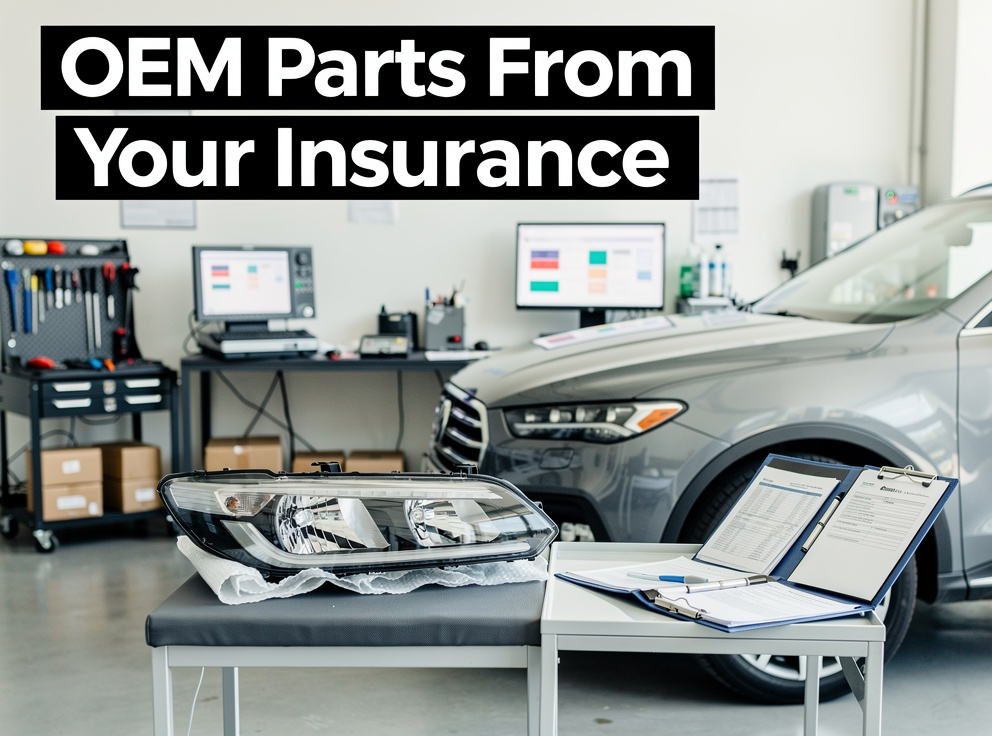
The estimate arrives as a PDF, and halfway down the page your front bumper cover carries a two-letter code: A/M. That means aftermarket, a part made by someone other than the company that built your car. It also means the insurer has already decided what goes on your vehicle, unless you speak up before parts are ordered. You can get OEM parts paid for by insurance in 2026, but only through specific routes: an OEM-parts endorsement on your policy, a state rule that applies to your claim, or a documented case from your repair shop that a substitute part is unavailable, does not fit, does not function, or conflicts with the manufacturer's repair procedures. The United States has no general nationwide right to new OEM parts after every covered accident.
This guide covers the full process. Plan on about an hour up front to read your policy and send one written request. If the insurer pushes back, add anywhere from a few days to a few weeks. Difficulty is moderate. You will not need a lawyer for most of it, but you will need a paper trail.
The short version
Check your policy for an OEM endorsement first, because that is the most direct path to insurer-paid OEM parts. Before the estimate is finalized, ask both the insurer and the shop in writing for OEM parts, and ask that the estimate label every part as OEM, aftermarket, or recycled. If a substitute part fails on fit, function, or factory procedure, the shop files a supplement. If your policy will not cover OEM, ask whether you can pay the difference, and send any refusal in writing to your state insurance department.
Before you start
Gather these before you call anyone:
- Your policy declarations page and any endorsements (the PDF from your insurer's app usually has both)
- Your claim number and the adjuster's email address
- The first estimate, if you already have one
- Photos of the damage, including close-ups of sensors, cameras, and trim
- Your VIN, which you will need to look up exact manufacturer part numbers
Why the parts line deserves more attention now
Repairs are getting more expensive one part at a time. CCC Intelligent Solutions' Crash Course 2026 report puts the average repair at $4,818 in 2025, a modest 1.7% rise over 2024. That headline figure hides the pressure on individual line items, because the average price per replacement part climbed 6% in the same year. Insurers respond to that math. The CCC data shows OEM part dollars falling 1.8% in 2025 while aftermarket part dollars rose 1.7%. On your own estimate, that shift looks like one more A/M code where you expected a factory part.
Most of your leverage sits in what this guide calls the parts-order window: the stretch between the first estimate and the moment the shop orders parts. Requests made inside that window are cheap to honor. Once parts are ordered or installed, any change costs everyone time and money.

Step 1: Find out whether your policy pays for OEM parts
Open your declarations page and look for an OEM-parts endorsement or an OEM-parts loss-settlement option. Collision coverage alone does not require an insurer to pay for new OEM parts, so if neither appears, assume your contract allows substitutes. The carrier's name does not settle the question. Progressive, Geico, or any other insurer will treat your claim according to the coverage you bought, so call your agent and ask: "Does my policy include an OEM parts endorsement, and which parts does it cover?"
That second clause matters. North Carolina's 2026 personal-auto filing, submitted by the North Carolina Rate Bureau, prices an OEM option at 5% of the comprehensive premium plus 5% of the collision premium. In the filing's own illustration, a driver paying $600 for comprehensive and $800 for collision would pay about $70 more a year. The option covers available OEM exterior sheet-metal and exterior plastic parts only, and other damaged parts can still be specified as non-OEM. That formula belongs to one state's filing and is not a national price.
Other states take different approaches. Utah requires insurers, on policies issued on or after October 1, 2026, to give written notice at issuance and renewal that they may authorize or specify aftermarket crash parts after a covered loss, but the statute does not create OEM coverage unless the policy provides it. An introduced Ohio bill discussed in 2026 proposed optional OEM coverage and a pay-the-difference option, but a proposal is not a right you can claim.
My recommendation: if your vehicle is six years old or newer and you plan to keep it, buy the endorsement if your insurer offers one. CCC measured average repairs on those newer vehicles at $5,721, which is $2,039 (55%) more than on vehicles seven years or older. Parts choice affects more dollars on a newer car.
Tip: Not at fault? A claim against the other driver's insurer does not run through your OEM endorsement. Ask your agent whether filing under your own collision coverage, where your endorsement applies, makes more sense for your claim. Then ask how the deductible would be handled if your insurer recovers costs from the at-fault carrier.
Step 2: Send a written OEM request before the estimate is finalized
Email the adjuster and the shop on the same day, using wording close to this:
Claim #______. I am requesting new OEM parts for this repair. Please confirm in writing whether my policy includes OEM parts coverage and which parts it applies to. Please have the estimate identify each part as new OEM, recycled OEM, or aftermarket. For any part that will not be new OEM, please state the reason and the policy provision you are relying on. If my policy does not cover the full OEM cost, please tell me whether I may pay the price difference.
Phone calls leave no record, and a request with no record is easy to deny later. Written requests also change outcomes. Policyholders on r/Insurance describe insurers that first refused or disputed OEM payment, then reconsidered after the customer asked the representative to review the actual policy documents.
Step 3: Read the estimate line by line
Read every part line and match each code to one of the categories below before you approve anything. On a typical repairable claim this is about a dozen lines of work, not a hundred. CCC counted an average of 13.0 parts per repairable non-comprehensive appraisal in 2025, down from 13.6 the year before.
| Estimate label | What it usually means | What to ask |
|---|---|---|
| OEM (new) | New part from the vehicle manufacturer | Is it in stock, or back-ordered? |
| A/M or aftermarket | New part from a third-party maker | Why was this chosen over OEM, and under which policy term? |
| LKQ, recycled, or used | Salvaged OEM part from another vehicle | What is its condition and mileage, and who warranties it? |
| Reconditioned | Repaired OEM part, often a bumper or wheel | Was it straightened, refinished, or both? |
The OEM label tells you who made the part. It does not tell you the part is new, available, or covered. Drivers on r/InsuranceCanada describe this exact confusion: they asked for manufacturer-stamped parts on newer vehicles, got aftermarket grilles or intercoolers on the estimate, and could not tell what their policy promised. Our guide to OEM vs. aftermarket parts covers the trade-offs in fit, finish, and warranty.
For hail claims, the parts question is often smaller than drivers expect. Paintless dent repair keeps the factory panels on the car, so parts choice usually comes into play only for pieces that have to be replaced. Filing a hail damage claim works differently from a collision claim in several ways.
Warning: Searching for a part by year, make, and model can miss OEM options. Parts shoppers on r/RockAuto recommend finding the exact manufacturer part number from your VIN before comparing prices or arguing over availability.
Step 4: Have the shop build a supplement for any part that fails
Ask the shop to file a supplement for any substitute part that is unavailable, does not fit, does not function, or conflicts with the manufacturer's repair procedures. A supplement is an additional request to the insurer for parts or labor that were not on the original estimate. A strong supplement includes photos of panel gaps or broken mounting tabs, the relevant section of the OEM repair procedure, and dated availability quotes.
The distinction that decides most disputes is preference versus proof. Wanting OEM parts for finish, warranty, or resale value is a preference. Your endorsement or your wallet pays for a preference. Showing that a specific aftermarket part will not mount correctly or will not let a sensor work is proof, and proof is what a supplement needs.
Sensors make this step more common than it used to be. CCC found calibrations on 28.3% of repairable claims in 2025, up from 21.8% the year before. If your car has radar or cameras behind the bumper or windshield, ask whether the shop performs ADAS calibration itself, as Hrpcollision does at its Midland shop, so calibration results can be attached directly to the supplement. One caution applies here: a required calibration does not, on its own, prove the insurer must pay for OEM parts. It only shows the repair has to meet a measurable standard.
Step 5: Ask whether you can pay the difference
If the policy covers only the cheaper part, ask both the insurer and the shop whether you can pay the price gap to upgrade to OEM. Some state rules and proposals address this option directly, but it is not a nationwide entitlement, so get the insurer's approval in writing. Ask for the dollar difference for each part, and make sure the final invoice lists those parts as new OEM. Without that line on the invoice, you have no record of what you paid for.
Step 6: Escalate a refusal in writing
Ask the insurer for its decision in writing, with the policy provision it relies on. Then reread your policy for an appraisal clause, which some policies include to settle disputes over the amount of a loss. If that fails, file a complaint with your state insurance department. In Texas, that is the Texas Department of Insurance. For large disputes, a consumer attorney can tell you whether a legal remedy is worth pursuing.
Regulators are paying attention to these disputes, though often with limited data. Vermont's Department of Financial Regulation surveyed 25 repair facilities, roughly one in six of the 147 shops it identified, along with 20 insurers or insurance groups, for a 2025 report that calls for changes to aftermarket parts and appraisal rules. Complaints add to the record regulators rely on.
Troubleshooting
What if the insurer says the OEM part is unavailable?
Ask for the date of the check and the source used. Then have the shop request the manufacturer part number from a dealer. If the part is back-ordered, decide whether to wait or to pay the difference once it arrives.
What if an aftermarket part is already installed?
Have the shop photograph and document any fit or function problems, and submit them as a supplement. Insurers sometimes reverse their decision when shown evidence after installation, but it costs more for everyone than raising the issue during the parts-order window.
What if the endorsement covers only some parts?
Read the scope language. Like North Carolina's option, an endorsement may cover only exterior sheet metal and plastic, which leaves other parts open to non-OEM substitutes.
What if the insurer pushes its own network shop?
You can usually choose your shop. Texas body shop choice rules explain how that works with your claim.
Next steps
Read your declarations page today, before you need it. If you have a claim open now, send the Step 2 email before the shop orders parts. If your vehicle is newer or ADAS-equipped, consider an OEM certified collision repair shop that works directly from manufacturer repair procedures.
Frequently asked questions
Can I request OEM parts from my insurance company after an accident?
Yes, and you should make the request in writing before the estimate is finalized. A request alone does not obligate the insurer to pay. Payment depends on your policy, especially whether it carries an OEM endorsement, your state's rules, and whether a substitute part can be shown to fail on fit, function, availability, or manufacturer repair procedures. Ask that the estimate label each part as OEM, aftermarket, or recycled.
Will Progressive or Geico pay for OEM parts?
It depends on the policy you bought, not on the carrier's name. Any insurer, including Progressive and Geico, pays according to your coverage terms. Ask your agent whether your policy includes an OEM parts endorsement and which parts it covers. Without one, expect the insurer to be allowed to specify aftermarket or recycled parts, subject to your state's rules.
:::
Is OEM parts coverage worth adding to my policy?
For newer vehicles you plan to keep, usually yes. CCC found 2025 repairs on vehicles six years old or newer averaged $5,721, so parts choice affects a lot of money. North Carolina's 2026 filing shows one price model, about $70 a year on a sample policy, but that formula is specific to that state.
:::
Can I force the insurer to use OEM parts if I wasn't at fault?
Not automatically. Your OEM endorsement applies to your own policy, not to the at-fault driver's insurer. Your leverage on a third-party claim is documentation showing a substitute part does not fit, function, or meet factory procedures. You can also ask whether filing under your own collision coverage, where your endorsement applies, is the better route.
:::
Do hail damage repairs require new OEM parts?
Often they do not. Paintless dent repair restores dented panels without sanding, filler, or repainting, so the original factory panels stay on the vehicle. The parts question comes up only for components that have to be replaced, and the same endorsement and supplement process applies to those parts.
:::
Related Reading
- OEM Collision Repair vs Aftermarket Body Shop in 2026
- How to Get an Auto Body Repair Estimate After an Accident
- 7 Shop Credentials to Check Before Collision Repair in 2026
- 9 Signs of Hidden Damage After a Car Accident in 2026
- Hail Repair Cost by Dent Count, Size and Panel in 2026
- Hyundai Certified Collision Repair: What It Changes in 2026
- How to Repair and Paint a Plastic Bumper Cover in 2026
- How ADAS Sensors Are Calibrated After a Collision in 2026
- Kia Certified Body Shop: What It Means and How to Choose
- Paint Deals
Collision Repair A clear repair plan after an accident.
Leave a Reply