
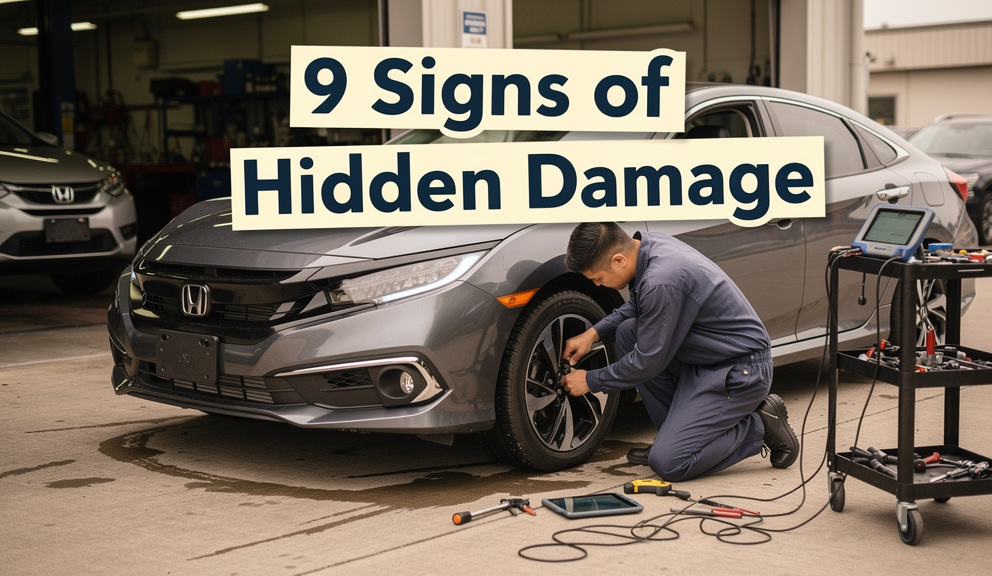
You drove it home. The bumper cover clipped back on, the headlights work, and the other driver's insurer has already called twice to "close this out." The car looks fine, and a car that looks fine is the hardest kind to diagnose, because the damage that costs the most after a collision usually sits behind a panel, inside a module, or under the floor.
To find hidden damage after a car accident, watch for nine specific symptoms in the days and weeks after the crash, then have a shop confirm them with a diagnostic scan, structural measurements, an alignment check and, where the manufacturer requires it, sensor calibration. The sign we rank first is a driver-assistance system that behaves differently than it did before the crash. The cameras and radar behind your bumper and windshield can be knocked out of aim by an impact that leaves no visible mark, and a misaimed sensor fails at the moment you need it.
The short version
Hidden collision damage shows up as symptoms before it shows up as visible damage: odd driver-assistance alerts, new warning lights, uneven panel gaps, steering pull, new noises, fluid leaks, electrical faults, glass or seal problems, and water inside the car. No single symptom proves damage, and no single clean result proves the car is safe. A professional inspection that combines scans, measurements and alignment checks is what turns a suspicion into an answer. If you see smoke, a growing puddle, an airbag light or severe steering trouble, stop driving and arrange a tow.
How these signs were ranked
The ranking comes from how a collision shop finds hidden damage, which is also how we work on cars at our Midland shop. We put the most weight on two questions: how likely is the symptom to point at damage that a walk-around inspection misses, and how much does that damage matter to how the car protects you in the next crash. Signs that only a scan tool, a structural measuring system or a calibration target can confirm rank highest, because those are the ones owners and quick-look estimates skip. Throughout the piece I lean on what I call the clue-to-proof gap: everything you notice from the driver's seat is a clue, and only diagnostics, measurements and manufacturer procedures count as proof. Good repairs close that gap before the first panel comes off.
Your driver-assistance system starts acting strange
Lane-keeping that nudges you toward the shoulder. A parking sensor that beeps at an empty driveway. Adaptive cruise that brakes for a car in the next lane, or a forward-collision warning that stays quiet when it should have spoken. Any of those after a crash is the strongest hidden-damage sign on this list, because the hardware behind them lives exactly where minor body damage hides: radar units behind the bumper cover and grille, cameras at the top of the windshield and in the mirrors, ultrasonic sensors pressed into the fascia. A mounting bracket bent a few degrees looks like nothing at all. To a radar unit aimed far down the road, a few degrees is the difference between your lane and someone else's.
The repair data shows how routine this has become. CCC Intelligent Solutions' Crash Course 2026 report found that the share of repairable appraisals including an ADAS calibration rose from 21.8% in 2024 to 28.3% in 2025. Calibration used to be an edge case for luxury models, and it is now an ordinary line on ordinary estimates. CCC's mid-year update puts the first-quarter 2026 figure at nearly three in ten repairable vehicles, up from 23.3% a year earlier.
Two terms get confused here, and the confusion costs people money. A diagnostic scan reads the codes the car's computers have stored. A calibration re-aims a camera or radar sensor to the manufacturer's specification using targets, a level floor and the maker's procedure. They are separate services, and neither is automatically required after every crash. CCC measured the 2025 average calibration fee at $485.56, which is why you want the requirement identified on the first estimate, not discovered after the car is back together. Our guide to collision sensor calibration covers which repairs typically trigger one.
At our shop, ADAS calibration sits inside the same repair plan as the bodywork. We assess the vehicle before recommending repair, replacement, refinishing or further inspection, and sensor requirements belong in that first assessment. That matters if you need the car back for work, because a calibration flagged late is the most common way a three-day repair turns into a two-week one.
A warning light that wasn't there before the crash
A new light on the dash is the car telling you it has stored a fault, and the fault itself is invisible from the outside. Airbag and safety-system lights deserve the most respect. The airbag system relies on crash sensors, wiring and a control module, and an impact can damage any of them, or leave the module holding a crash record that has to be cleared or replaced according to the manufacturer's procedure. An airbag light means the system may not deploy correctly in the next collision. Treat the car accordingly.
Manufacturers have moved toward scanning almost every collision car for this reason. GM's March 2026 position statement on pre- and post-collision diagnostic scans recommends a scan before repairs begin and another after they are finished for vehicles being assessed for collision repair. That is GM's guidance for its applicable vehicles, not a universal rule, but most makers point the same way. Shops have followed: in the first quarter of 2026, 74.8% of repairable appraisals included a scan, compared with 70.9% a year earlier.
The pre-repair scan finds what the crash broke. The post-repair scan proves the repair fixed it, and a printed copy of both is the cleanest receipt you can ask for. Expect a professional scan to cost somewhere around $150; CCC's benchmark for 2025 was $149.10, though your shop's figure will depend on the vehicle and the procedure the manufacturer requires.
A cleared light is not a fixed car. If a light comes on, goes off and comes back, the fault is intermittent, and intermittent faults after a collision usually trace to a connector or harness that took a hit. Write down when it appears. That note will save a technician an hour.
Warning: An airbag or safety-system warning light, smoke, a fluid puddle that keeps growing, or steering that suddenly feels wrong are reasons to stop driving now. Arrange a tow instead of "seeing if it gets better" on the way to the shop.
Panel gaps are the frame talking
Walk around the car and look at the seams. The gap between the hood and each fender, the doors and the pillars, the trunk lid or tailgate and the quarter panels should be even, and roughly the same on the left side as on the right. If one side of the hood gap is wide enough to slide a finger into and the other is tight, or a door now needs a hard slam to latch, something behind the skin has moved. That could be a damaged mount, a latch problem, or a shift in the body structure itself.
This is where minor-looking rear and front impacts fool people. The plastic bumper cover is designed to flex and spring back. Behind it sits the bumper reinforcement, a steel or aluminum beam that absorbs the energy, and behind that, the frame rails. The cover can look perfect while the reinforcement is crushed and a rail has a kink. Users on r/Insurance describe exactly this worry after low-speed bumps with nothing visible to photograph, and their instinct is right: the damage you can't see is what a cheap estimate leaves out. Our breakdown of whether a damaged bumper should be repaired or replaced walks through what sits behind the cover.
Confirming structural damage takes measurement, not eyesight. We check the vehicle against the manufacturer's dimensions with structural measuring equipment, then handle frame repair and alignment in-house when the numbers are off. We prefer genuine OEM parts and work with your insurer to get them approved, for reasons laid out in our piece on OEM vs. aftermarket parts. Our collision repairs carry a lifetime warranty for as long as you own the car, which answers the fear of picking it up and finding something wrong later. It is also why estimates sometimes grow: a shop that finds a bent rail after disassembly has to document it, a process explained in why collision estimates change after disassembly.
The car pulls, or the steering wheel sits crooked
Where panel gaps show the body has moved, a pull shows the wheels have. If the car drifts left on a flat road, or the steering wheel sits a few degrees off center while you drive straight, the impact may have bent a tie rod, a control arm, a wheel, or a suspension mount. Curb strikes and corner impacts cause this even when the bodywork damage is a scuffed bumper.
The slower version is tire wear. A tire wearing hard on its inside or outside edge can take several weeks to show, which is why it often surfaces after the claim is closed. Check tread across the full width a month after the crash. CCC put the average total collision repair at $4,818 in 2025, a 1.7% rise on 2024, and suspension parts missed on the first estimate are a common reason a repair ends up above the number you were first quoted.
New clunks, rattles and scraping
Noises are frustrating because they rarely happen on the test drive. The fix is documentation. Note exactly when the sound occurs: over bumps, turning left or right, accelerating, braking, or only above a certain speed. A clunk over bumps points toward suspension or a loose mount. A scrape in turns can mean an inner fender liner or splash shield pushed into the tire. A vibration under acceleration can mean a driveline or engine mount problem.
A ten-second phone video with the sound audible is worth more than any description you give at the counter. Hand it to the technician along with your notes.
Fluid, smoke or a burning smell
This sign ranks lower only because it is rarely hidden: most people notice a puddle. What they misjudge is how serious it is. Fresh fluid under the car after a crash can be coolant from a cracked radiator, oil, brake fluid, or transmission fluid, which is usually reddish and means the transmission or its cooler lines took a hit. A burning smell or any smoke can mean fluid on hot exhaust parts or damaged wiring.
Small seeps can be driven to a shop. A puddle that grows while you watch, or any smoke, cannot. NHTSA's early estimate for 2025 counted 36,640 traffic deaths, about 2,600 fewer than the 39,254 recorded in 2024, and a fatality rate of 1.10 per 100 million vehicle miles traveled. Fewer deaths is good news. A car with a failing brake line or overheating engine on Interstate 20 is the kind of risk that keeps that number from falling further.
Electrical gremlins that come and go
An inoperative headlight, a window that works one day and not the next, a radio that resets, a battery that is flat two mornings in a row. After a collision these usually trace to a pinched harness, a cracked connector, a damaged ground, or the jolt of power loss when the battery cable shifted. Modern cars run dozens of modules on shared networks, so one damaged wire can produce symptoms in a system nowhere near the impact. These faults often leave codes, which is one more reason the post-repair scan matters.
Glass, seals and water: the slow signs
The last two signs share a section because they share a cause. Both come from a body opening that no longer seals the way it did at the factory, and both tend to show up days or weeks later, often at the first rain or the first highway drive.
Glass problems announce themselves as a crack that grows, a loose or shifted windshield, new wind noise at highway speed, or a windshield-camera fault. That last one ties back to the top sign: GM's windshield replacement guidance notes that glass replacement and even minor body damage can affect safety-related systems on applicable vehicles. A new windshield on a car with a forward camera often means a calibration, and the glass invoice will not always say so.
Water problems are quieter. Damp carpet, water pooled in the spare-tire well, condensation that won't clear, or a musty smell all point to a damaged seal or a body seam that opened slightly in the crash. Lift the trunk floor and look. People shopping salvage and auction cars on r/AutoBidMasterHelp make the same point from the buyer's side: listing photos and damage notes routinely miss concealed water problems, and only a hands-on inspection finds them. Of these two signs, water is the more expensive one to ignore, because it reaches wiring and modules mounted low in the cabin.
What an owner can check, and what only a shop can confirm
The difference between the two is the clue-to-proof gap in practice. You can collect clues safely, in your driveway, in about twenty minutes. Confirmation needs equipment you don't own.
Two consumer tools come up often, and both have a place. The BlueDriver Pro OBD2 scanner costs $139.95 according to its U.S. product page, carries no subscription fees, and will read many stored diagnostic codes. It cannot verify a structural repair, run every manufacturer-required scan, or calibrate a sensor. A CARFAX vehicle history report runs $49.99 for one, $69.99 for two, or $119.99 for four, and it surfaces reported accidents and title history. It is a record of what was reported, not a physical inspection, so a clean report does not prove a car is free of hidden damage.
Here is the order we would follow after any collision, minor or not:
- Photograph all four corners, every damaged area, and the underside you can see, before the car is moved again if possible.
- Write down every warning light on the dash, with the date it first appeared.
- Compare panel gaps side to side around the hood, doors and trunk, and test that every door and the trunk latch on a normal close.
- Look under the car for fresh fluid, and check the same spot the next morning to see whether the puddle grew.
- Lift the trunk floor and feel the carpet in each footwell for dampness after the first rain or car wash.
- Note when any new noise, pull or vibration happens: speed, turning direction, braking or bumps.
- Stop driving and call for a tow if you see smoke, a growing leak, an airbag light, or severe steering trouble.
- Ask for a written inspection and estimate, and ask directly whether pre- and post-repair scans, structural measurements, an alignment check, and ADAS calibration apply to your vehicle.
That last step does the most for you. CCC's mid-year update put the average repair at about $4,821 in the first half of 2026, nearly flat on the year, while parts prices ran roughly 8% higher. When labor and totals hold steady but parts climb, an estimate that leaves out a scan or a calibration looks cheaper on paper and grows later.
Tip: Texas law lets you choose where your car is repaired; an insurer can recommend a shop but cannot require one. Get the insurer's estimate, then ask your chosen shop to compare it line by line for scans, measurements and calibration. Our guide for [first-time claimants in Midland](https://hrpcollision.com/best-collision-repair-options-for-first-time-claimants-in-midland-tx/) covers the paperwork.

The nine signs at a glance
| Sign | What it usually points to | Rough cost to confirm |
|---|---|---|
| Driver-assistance acting differently | Misaimed camera, radar or parking sensor | About $485 average calibration (CCC, 2025), plus scan |
| New warning light | Stored fault codes, airbag or safety-system damage | About $149 average scan (CCC, 2025) |
| Uneven panel gaps or latch trouble | Shifted structure, bent mounts, crushed bumper reinforcement | Free estimate at Hrpcollision; measurement listed on estimate |
| Pull or crooked steering wheel | Alignment, suspension, wheel or underbody damage | See shop estimate |
| New clunks, rattles or scraping | Loose mounts, suspension or rubbing components | See shop estimate |
| Fluid, smoke or burning smell | Cooling, transmission, brake or electrical damage | See shop estimate |
| Intermittent electrical faults | Harness, connector or ground damage | Often found during scan |
| Glass damage or new wind noise | Seal, opening or windshield-camera issues | See shop estimate; may need calibration |
| Damp carpet or water in the trunk | Damaged seals or opened body seams | See shop estimate |
What didn't make the list, and what we would do
A few signs came close. Rust bubbling along a seam months after a repair is real, but by then the problem is the repair, not the crash. A tire with a sidewall bulge is serious and needs replacing right away, though it is rarely hidden. Door latches that misbehave are folded into the panel-gap sign, since they share a cause. Drivers on r/PakistanAutoHub and elsewhere describe the same unease after a rear-end bump on a car that still drove fine, and the advice holds everywhere: drivable is not the same as undamaged.
Our recommendation, and the one we would defend to any adjuster, is to get a written inspection that includes pre- and post-repair diagnostic scans on every collision car built in the last decade, even when the damage looks cosmetic. The scan is roughly the cost of a tank and a half of fuel, it closes the clue-to-proof gap faster than anything else, and it is the document you will want if a light comes on in six months. If you are in Midland and want that inspection done right the first time, start with a free estimate at our shop, or compare options in our guide to the best auto body shops in Midland.
Frequently asked questions
How do I find hidden damage after a car accident?
Start with your own checks, then get professional confirmation. Photograph the car, note any new warning lights, compare panel gaps side to side, look for fluid leaks, and watch for steering pull, new noises, odd driver-assistance alerts and water inside the cabin. Those are clues. Confirming hidden damage takes a collision shop with a diagnostic scanner, structural measuring equipment, an alignment check and, where the manufacturer requires it, sensor calibration. Ask for pre- and post-repair scan reports in writing.
Can a minor accident damage the frame or alignment?
Yes. A low-speed impact can crush the bumper reinforcement, bend a mount or shift a frame rail while the plastic bumper cover springs back looking normal. Curb strikes and corner hits often bend suspension parts or knock the alignment out with very little body damage. Uneven panel gaps, a crooked steering wheel and uneven tire wear are the usual early signs. Structural measurement against factory dimensions is the only reliable way to confirm frame damage.
Is a diagnostic scan the same as an ADAS calibration?
No. A diagnostic scan reads fault codes stored in the car's computer modules, showing what the crash affected and whether the repair cleared it. An ADAS calibration re-aims a camera or radar sensor to the manufacturer's specification using targets and a set procedure. They are separate services with separate costs; CCC's 2025 averages were $149.10 for a scan and $485.56 for a calibration. Neither is automatically required after every crash.
Should I tell my own insurer if someone hit my parked car?
In most cases, yes. Many auto policies require prompt notice of any accident, even when another driver is at fault, and reporting it protects you if hidden damage surfaces later or the other driver's insurer disputes the claim. Drivers on r/personalfinance raise this question often. Notifying your insurer does not always mean filing a claim against your own policy. Check your policy wording and report the facts as soon as you can.
Do I have to use the repair shop my insurance company recommends?
Not in Texas. State law allows you to choose your repair shop, and an insurer cannot require you to use its preferred one. A recommended shop may be convenient, but convenience is not the same as a thorough inspection. Whichever shop you choose, ask whether the estimate includes pre- and post-repair scans, structural measurements, an alignment check and any required calibration, because those items are where hidden damage gets found or missed.
Related Reading
- 7 Shop Credentials to Check Before Collision Repair in 2026
- How to Get an Auto Body Repair Estimate After an Accident
- OEM Collision Repair vs Aftermarket Body Shop in 2026
- How ADAS Sensors Are Calibrated After a Collision in 2026
- Hyundai Certified Collision Repair: What It Changes in 2026
- How to Repair and Paint a Plastic Bumper Cover in 2026
- Hail Repair Cost by Dent Count, Size and Panel in 2026
- Kia Certified Body Shop: What It Means and How to Choose
- Paint Deals
Collision Repair A clear repair plan after an accident.

Leave a Reply