
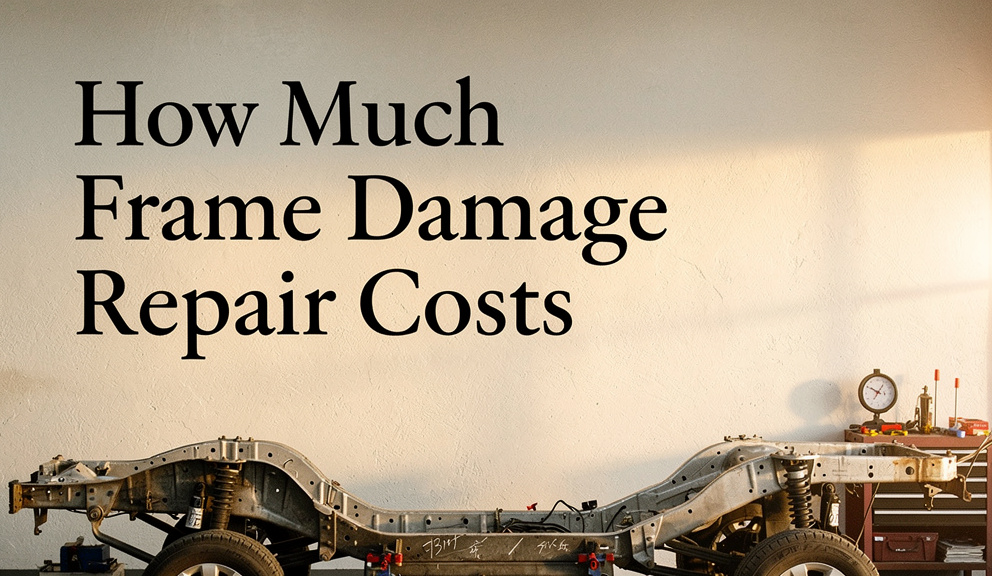
The rear bumper on the crew truck looks like it took a shove, not a hit. A trailer hitch is a little crooked, a bed seam sits slightly proud, and the truck still drives to the yard. Then the estimate arrives at three or four times what a bumper should cost, because a frame rail behind that bumper is kinked. For a body-on-frame pickup in 2026, straightening a bent frame typically runs about $2,500 to $6,500, moderate structural work about $3,500 to $7,000, and a severe rebuild with section or full frame replacement can climb past $7,000 and reach $18,000 or more, according to ranges published this year by DG Collision Center. Those are one shop's advertised figures, not a national average, and your truck's real number comes from a measured inspection, not a calculator.
The short version
Most collision-bent truck frames that can be straightened land in the low-to-mid four figures. Once a shop has to cut out and replace frame sections, or the truck needs a full rebuild, the bill moves into five figures and starts competing with the truck's actual cash value. Rust-damaged frames are a separate job with separate pricing. Get a written estimate built on computerized frame measurements before you decide anything.
How much does truck frame repair cost by type of damage?
Truck frame repair cost depends mostly on whether the frame can be pulled back to factory dimensions or has to be partly or fully replaced. Straightening a body-on-frame pickup commonly runs $2,500 to $6,500; moderate structural work, $3,500 to $7,000; severe rebuilds, $7,000 to $18,000 or more, per one shop's published 2026 ranges.
The table below uses DG Collision Center's 2026 frame straightening estimates. Treat them as a sanity check, not a quote.
| Repair tier | What the work usually involves | Published 2026 range |
|---|---|---|
| Frame straightening (body-on-frame truck) | Measuring, anchoring, pulling rails back to spec, re-measuring | $2,500 to $6,500 |
| Moderate structural work | Straightening plus sectioning or replacing damaged structural pieces | $3,500 to $7,000 |
| Severe collision rebuild | Extensive structural repair, major section or full frame replacement, related mechanical work | $7,000 to $18,000+ |
The moderate and severe ranges cover all vehicle types, so a heavy-duty pickup with a long wheelbase and bulky suspension tends to sit higher inside each band than a compact car. Truck frames also differ from unibody cars in a way that matters for cost. On a unibody vehicle such as a Nissan 350Z, the "frame" is the body shell itself, and forum price talk about those cars does not transfer to a ladder-frame F-250 or Silverado 2500.
What moves a truck within these ranges: the make and model, how far the damage travelled down the rail, whether OEM frame sections are available or backordered, the local labor rate, and how much suspension, steering, and driveline work comes along with it. A rear hit that bends a rail behind the axle often drags in hitch, bed, and bumper repairs. For a broader look at pricing across vehicle types, see how much car frame repair costs.
Why a frame labor rate won't predict your final bill
An hourly frame labor rate tells you what a shop charges for structural time, not what your truck will cost. Multiply $93 an hour by estimated hours and you will miss parts, refinishing, alignment, calibration, and whatever teardown uncovers. That shortcut, which we call the rate-times-hours trap, is the most common way owners lowball a frame job.
The benchmark itself is solid. Collision Advice and CRASH Network surveyed 473 shops in 49 states in April for their 2026 Who Pays for What? frame and mechanical report, and the average of median non-DRP frame labor rates came out to $93 an hour. By insurer, those medians barely moved, sitting between $90 and $95.
The trouble is that a truck repair is billed in several labor categories at once. Under that same survey, 44% of shops charge a separate structural rate, which means the frame hours on your estimate may be priced differently from the body hours on the next line. Mechanical time for suspension and steering is usually billed at yet another rate.
Location changes the picture too. Massachusetts' Auto Body Labor Rate Advisory Board, in its December 2025 report, found an insurer-weighted average frame rate of $50 an hour while the median rate shops actually reported was $80. That thirty-dollar gap is a reminder that the rate an insurer pays and the rate a shop posts are often two different numbers, and the difference can land on the owner.
Rates are also rising. CCC Intelligent Solutions' Crash Course 2026 tracked a 2.9% increase in its weighted average across labor types last year, so a quote from 2024 is already stale.
Tip: Ask any shop to list frame labor, body labor, mechanical labor, and refinish labor as separate lines with separate hourly rates. If an estimate shows one blended number, you cannot compare it to anyone else's.
How do you know if a truck frame is actually bent?
You confirm a bent truck frame with computerized measurement, not by eye. Uneven panel gaps, a crooked hitch, doors or tailgates that bind, a truck that pulls or wears tires oddly, and a cab or bed that sits unevenly are warning signs. Only measuring the frame against factory data points confirms damage and how much.
On r/f150, owners regularly describe a rear-end collision with modest visible damage that produced a surprisingly large estimate, and the question that follows is always the same: how do I know the rail is really bent? The honest answer is that exterior damage is a poor guide. Energy from a hit travels along the rail and can buckle it a foot or more from the bumper, behind body panels and bed brackets where nobody looks.
A proper inspection puts the truck on a measuring system that compares dozens of points on the frame to the manufacturer's specifications. In Midland, Hrpcollision handles that step through its Frame Repair & Alignment with 3D Technology, which documents measurements before and after the pull. Whichever shop you use, insist on the printout. Some shops advertise the inspection for free; plenty don't, so ask up front.
Post-repair work matters as much as the pull itself. Frame geometry affects where radar, cameras, and ride-height sensors point. The CCC report counted calibration on 28.3% of repairable claims in 2025, up from 21.8% the year before. A truck that leaves a frame rack without a wheel alignment, a diagnostic scan, and any required ADAS calibration is a truck that may come back, which is the outcome fleet managers can least afford.
A worked example: what a rear-hit fleet pickup can cost
Take a hypothetical service pickup: a three-quarter-ton crew cab, five years old, with an actual cash value of $28,000. It is rear-ended at a lease road gate. The bumper and hitch take the visible damage, and measuring shows the left rail kinked behind the rear axle.
Here is how the numbers can stack up, with every figure other than the published benchmarks labeled as illustrative:
- Frame labor: the shop writes 22 structural hours. At the $93 survey benchmark, that line alone is about $2,050.
- Body and refinish: bumper, hitch receiver, bed realignment, and paint blending add their own hours at a different rate.
- Mechanical: rear suspension inspection, any bent components, and a four-wheel alignment.
- Scan and calibration: pre- and post-repair diagnostic scans, plus rear camera or blind-spot sensor calibration if the truck has them.
- Supplement reserve: teardown finds a cracked bed mount nobody could see on day one.
An itemized estimate like this commonly lands in the $5,000 to $6,500 zone, the upper half of the published straightening range, even though the frame labor line was only about a third of it. Now run what we call the value-gap test: $6,500 against a $28,000 truck is roughly 23% of its value. That is a repair, not a total-loss conversation.
Change one variable. Make the truck twelve years old with an ACV of $9,000, and a severe rebuild estimate of $8,000. Repair cost now nearly equals what the truck is worth, and the insurer will compare it to the total-loss threshold instead of approving the work. Same damage, opposite outcome.
Is frame damage worth fixing on an older or rusted truck?
Collision frame damage on a truck worth well over the repair cost is usually worth fixing, provided measurements confirm it can return to factory spec. Rust damage is a different decision. Corrosion repair uses different processes, often requires replacing metal across a wide area, and is not priced like a collision pull.
Owners on r/ToyotaTacoma argue about exactly this: is it sensible to spend around $6,500 on a truck with frame problems when everything else about it is solid and the owner loves it? Our position is that sentiment is a fine tiebreaker but a poor first filter. Start with the value-gap test, then look at the rest of the truck. If the engine, transmission, and suspension are sound and the frame is the only major problem, a well-documented repair often makes sense. If the frame is one of five expensive problems, it usually doesn't.
Rust deserves blunt treatment. A collision estimate tells you nothing about a rotted frame, and patching perforated rails is a different job from straightening a bent one. Threads on r/AskMechanics and r/hardbody show owners weighing whether an older truck with a rusted or bent frame is even safe to drive. Have the frame inspected for wall thickness and perforation before buying parts. Swapping in a complete used or new frame is the route owners on r/1stGenTacomas often discuss for high-mileage trucks they want to keep, and it is a large project with its own pricing.
Then there is resale. Owners on r/legaladvice describe trucks that were safely repaired yet lost a major chunk of resale value after a frame replacement. Diminished value is real, it is largest when the frame or full frame assembly was replaced, and it varies by truck, market, and how well the repair is documented. Keep every measurement printout. Buyers and appraisers discount uncertainty more than they discount a documented, measured repair.
How insurance, supplements, and total loss affect the bill
Insurance usually pays for collision frame repair minus your deductible, but the first estimate is rarely the final one. Hidden damage found during teardown gets added through supplements, and if the total approaches the truck's actual cash value, the insurer may declare a total loss rather than pay for repairs.
Total losses are common. In the CCC Crash Course 2026 report, non-comprehensive claims flagged as total losses reached 23.9% in 2025, while repairable claim volume dropped 9.7%. Neither figure is the odds that a frame-damaged truck gets totaled, but together they show insurers writing off vehicles faster than they used to. CCC's preliminary average repair cost across all claims was $4,818, up 1.7%, which puts a typical truck frame straightening job at or above the cost of an average claim.
Three questions protect you here:
- Does the estimate cover hidden damage found at teardown, and how will the shop submit supplements to the insurer?
- Is the shop billing at rates the insurer has agreed to, or will a gap fall on you?
- If the truck is totaled, can you see the valuation and comparable vehicles behind the ACV figure?
For fleets, the tempting shortcut is the insurer's preferred network because it means less paperwork. That works when the network shop can measure structurally, calibrate sensors in-house, and give one contact for status updates. If it can't, the paperwork you saved comes back as downtime and repeat visits. We cover the fleet side in more detail in collision repair options for fleet vehicles in Midland and work truck repair options in Odessa.
What a trustworthy frame repair estimate should list
A reliable truck frame estimate itemizes every operation and sets out pre-repair measurements with them. If you are comparing two shops, line them up against this checklist; anything missing is either hidden in a lump sum or not being done.
- Pre-repair frame measurements with factory specifications
- Repair method for each damaged area: straighten, section, or replace
- Parts with sources named (OEM, used, or aftermarket) and expected availability
- Labor split into frame, body, mechanical, and refinish, each with its rate
- Suspension and steering inspection, plus wheel alignment
- Corrosion repair, if any, priced as its own line
- Pre- and post-repair diagnostic scans and any ADAS calibrations
- Post-repair measurement printout
- Supplement policy and warranty terms in writing
- Towing and storage charges
For truck-specific shop selection in West Texas, see frame repair solutions for trucks and SUVs in Midland.
Bottom line
Budget $2,500 to $6,500 for a straightforward frame straightening on a body-on-frame truck, and plan for five figures if sections or the whole frame need replacing. Don't price the job from an hourly rate; get a measured, itemized estimate. Compare it with the truck's actual cash value before you commit, and treat rust as a separate project with a separate price. If the repair costs well under the truck's value and comes with documented before-and-after measurements, fix it.
Frequently asked questions
How much does it cost to fix a bent frame on a truck?
Straightening a bent frame on a body-on-frame pickup typically costs about $2,500 to $6,500, based on one collision shop's published 2026 range. Moderate structural work runs roughly $3,500 to $7,000, and severe rebuilds involving section or full frame replacement can exceed $7,000 and reach $18,000 or more. Heavy-duty trucks, parts backorders, and related suspension or sensor work push costs toward the top of each range. A written estimate based on computerized measurements is the only reliable number.
Can a damaged truck frame always be repaired?
No, not every damaged truck frame can be repaired economically or safely. Many collision bends can be pulled back to factory specifications, and damaged sections can often be replaced. When damage is extensive, rust has thinned the metal, or the repair cost approaches the truck's actual cash value, replacement or a total loss becomes the realistic outcome. Measuring the frame against factory data is how a shop makes that call.
How expensive is it to replace a truck frame entirely?
Full truck frame replacement falls in the severe-repair tier, which one shop's 2026 published range puts at $7,000 to $18,000 or more. The final cost depends on frame availability, whether the frame is new or used, how much of the truck has to be disassembled, and what else was damaged. Expect a meaningful hit to resale value after a full frame replacement, even when the truck is restored to safe condition.
Is it safe to drive a truck with frame damage?
Driving a truck with confirmed frame damage is risky, and you should not tow or haul with it until it is inspected. A bent frame can change suspension geometry, braking behavior, and how the truck absorbs energy in another crash. It can also misalign driver-assistance sensors. If you see uneven panel gaps, a crooked hitch, binding doors, or a pull to one side, get a computerized frame measurement before putting the truck back in service.
Will insurance cover truck frame repair?
Collision coverage usually pays for frame repair caused by a crash, minus your deductible. Hidden damage found during teardown is typically added through a supplement. If the total repair cost approaches the truck's actual cash value, the insurer may declare it a total loss instead. Rust-related frame deterioration is generally treated as wear and maintenance rather than collision damage.
Does frame damage lower a truck's resale value?
Yes, major frame repairs often reduce resale value, especially when the frame or full frame assembly was replaced. The size of the loss varies with the truck, the local market, and how well the repair is documented. Keeping pre- and post-repair measurement printouts, alignment records, and calibration reports helps buyers and appraisers trust the repair, which limits the discount.
Related Reading
- 9 Signs of Hidden Damage After a Car Accident in 2026
- How to Get an Auto Body Repair Estimate After an Accident
- OEM Collision Repair vs Aftermarket Body Shop in 2026
- Hail Repair Cost by Dent Count, Size and Panel in 2026
- 7 Shop Credentials to Check Before Collision Repair in 2026
- How to Repair and Paint a Plastic Bumper Cover in 2026
- How ADAS Sensors Are Calibrated After a Collision in 2026
- Hyundai Certified Collision Repair: What It Changes in 2026
- Kia Certified Body Shop: What It Means and How to Choose
- Paint Deals
Collision Repair A clear repair plan after an accident.

Leave a Reply